
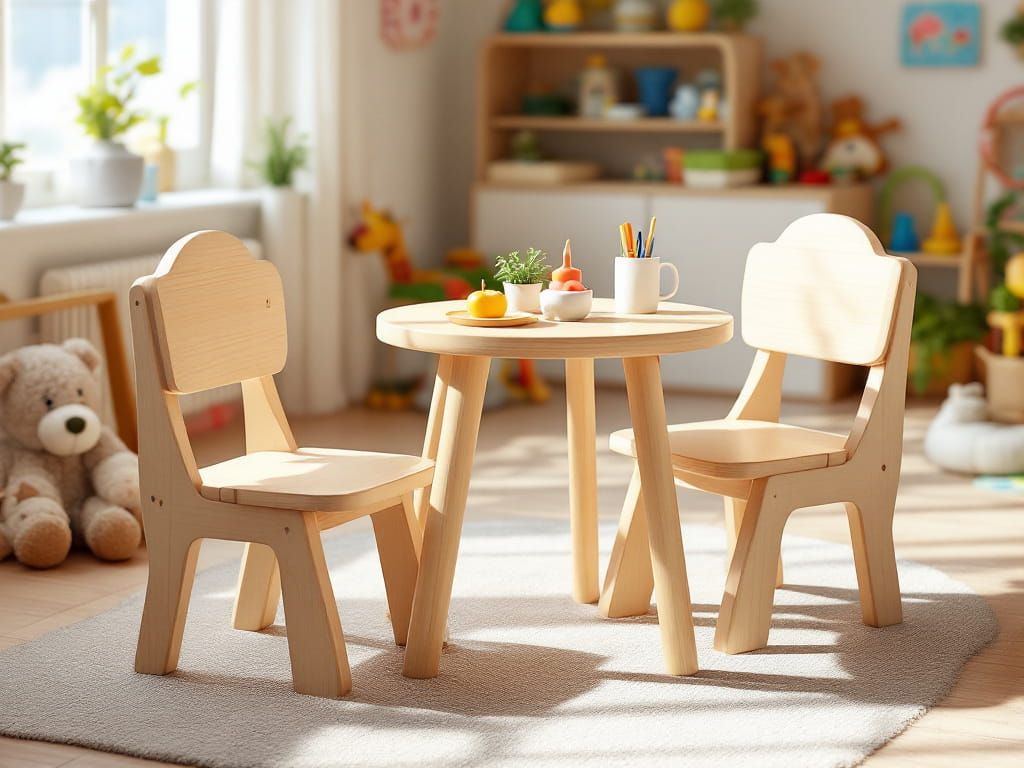
Custom children’s furniture
Custom children’s furniture means manufacturing cots, tables, chairs, wardrobes and shelving units from plywood, MDF, particleboard and MFC to your dimensions and drawings, with an emphasis on safe, eco-friendly materials. The format is built for wholesale: shops, marketplace sellers, suppliers to kindergartens and schools — in batches from small runs to large orders. Below: which materials and finishes are used, what stages the production process consists of, which product types are in demand, and how to place an order tailored to your range.
Custom children’s furniture: wooden manufacturing
Children’s furniture stands apart in the furniture trade. Where strength and looks are enough for adult furniture, with children’s pieces safety, eco-friendly materials and proper ergonomics come first. This covers a wide range of products — from cots and changing tables to school desks, shelving units and roomy wardrobes — and each has its own set of requirements.
Materials are chosen with care. Plywood, MDF, MFC and other boards must be certified and safe, with no excess emission of harmful substances — a child spends half the day around this furniture. Geometry gets separate attention: no sharp corners, burrs or protruding fasteners that could cause injury. Every part is rounded off and sanded smooth.
Precision here is not a luxury but a necessity. Custom children’s furniture withstands what adult furniture never has to: children climb on it, rock it, jump on it. That is why joints must be tight and the structure resistant to constant loads and wear. Modern CNC machines deliver exactly the repeatability without which a batch cannot be built evenly.
The range of styles and sizes turns out to be broad — meeting the needs of both a small shop and a large wholesaler. Flexibility is valued: the ability to produce both a mass batch to a standard design and a limited run with custom dimensions, colour and décor for a specific retail chain.

Beds

Tables

Chairs
School desks
Shelves

Cabinets
Dressers
For kindergartens
For schools
The range of wooden children’s furniture in demand on the market
Within children’s furniture there are several subcategories with steady wholesale demand. In first place are cots and convertible cots that grow with the child and meet safe-sleep requirements. Close behind come wardrobes and dressers: roomy, stable, with reliable hardware that is hard to work loose.
Tables and chairs for study and creative work are a separate story, where ergonomics and a margin of strength decide everything. Sets that combine functions are often ordered: a workstation with drawers for stationery and textbooks. The same category includes height-adjustable growing furniture that lasts not one year but several.
Separate demand comes for sets for kindergartens, schools and development centres. There the furniture lives non-stop, and durability comes to the fore. It is also important to be able to make products in different colours and non-standard sizes for a specific room or the customer’s brand.
This set of subcategories makes it possible to cover complex needs for different market segments — both small retailers and large wholesalers who need a single contractor for their entire children’s furniture range.
How wooden products are manufactured
The production process for wooden children’s furniture: a detailed breakdown of the stages
Production of children’s furniture starts with reviewing the brief and the customer’s wishes. Parts are designed from ready drawings or programs developed in-house, then the material is selected. Next comes cutting boards and blanks to size — with precise adherence to dimensions, because all subsequent assembly depends on it.
After cutting, the parts go to milling: there they are shaped, grooves are cut, holes are drilled and decorative elements are made. Next comes sanding, by hand and by machine, so the surface comes out smooth and the edges safe. For children’s furniture this stage is especially important: an under-sanded corner is unacceptable.
The parts are then assembled into finished products on quality hardware. Assembly precision and fastening reliability are under special control here — stability and service life depend on them. After assembly the furniture is painted or coated with protective compounds, then checked against all parameters before packing.
The whole process is set up to keep both deadlines and quality at every step. For wholesale clients and regular partners this is the key point: the batch must arrive on time and with no inconsistency between products.
Features of custom children’s furniture: what to look at
Making children’s furniture has its own strict rules, and the first is safety. Only proven materials with minimal formaldehyde and other chemical emissions are used, backed by certificates. This is not a formality but a basic requirement for products a child lives around.
Second is strength and stability. Custom children’s furniture goes through intensive use, so fasteners and joints must hold the load without play or loosening. Reinforcing the load-bearing joints and good hardware are exactly what provide this reliability for years to come.
Third is ergonomics. Dimensions are calculated for the child’s age and physiology. Tables and chairs are often made height-adjustable — this is both about correct posture and about keeping the furniture from becoming obsolete in a year. Surfaces are finished so that they are pleasant to the touch and safe.
Fourth is appearance and functionality. Colour, front design and décor are chosen so that the furniture appeals to both children and parents, not merely performs its task reliably. Modern production lines make it possible to create custom designs for a specific brand without losing output speed.
The benefits of working with professionals

Modern equipment
Panel saws, CNC and milling machines — precision, speed and quality guaranteed

Extensive experience and expertise
We know how to handle wood and sheet materials — reliably, precisely, professionally

Fast order fulfilment
Fast and without compromising quality. We value your time and our commitments

A full range of services in one place
Cutting to size, sawing, milling, sanding, painting, assembly — all in-house, with no middlemen

Trusted materials and consumables
We work only with quality materials, so you can be confident in the result

An individual approach to every client
We work to your drawings, create a machining program for the task and account for every detail
The advantages of choosing us for wooden children’s furniture manufacturing
Our approach to making children’s furniture is built around the wholesale customer’s needs. The main trump card is modern equipment and a fine-tuned process that deliver high precision and consistent quality from one product to the next. For a batch this is critical: the buyer should notice no difference between the first unit and the hundredth.
Flexibility matters too: small batches and large orders are taken on equally. Custom solutions are developed to the client’s requirements, and quality holds regardless of volume — whether ten products or a thousand.
Materials are chosen with care, free of hazardous components, with an eye to the eco-friendliness of the finished products. Control runs at every stage — from raw-material intake to packing — so defects are weeded out before shipment rather than surfacing on the customer’s shelf.
This approach is what makes the workshop a convenient partner for shops, dealers and other manufacturers who value reliability, consistent quality and meeting deadlines.

Expanding the range: other categories of wooden products
Besides children’s furniture, a wide range is available in related categories. This lets a wholesaler cover several lines at once with a single contractor — simpler logistics, shorter lead times, fewer approvals with different suppliers.
The line-up also includes adult furniture — wardrobes, kitchen sets, office solutions — as well as interior elements: doors, panels, decorative inserts. Separately, products from wood-based materials are made for construction and finishing, from furniture panels to ready-to-assemble parts.
Special emphasis is on products made from plywood, MDF, particleboard and MFC: this provides versatility and freedom in choosing the material for a specific task. Precise execution of drawings and modern machining methods make the products sought after by large dealers and retail chains.
The option to combine children’s furniture production with other categories opens up room for cooperation and range expansion — a convenient choice for a business that does not want to split orders among a dozen contractors.
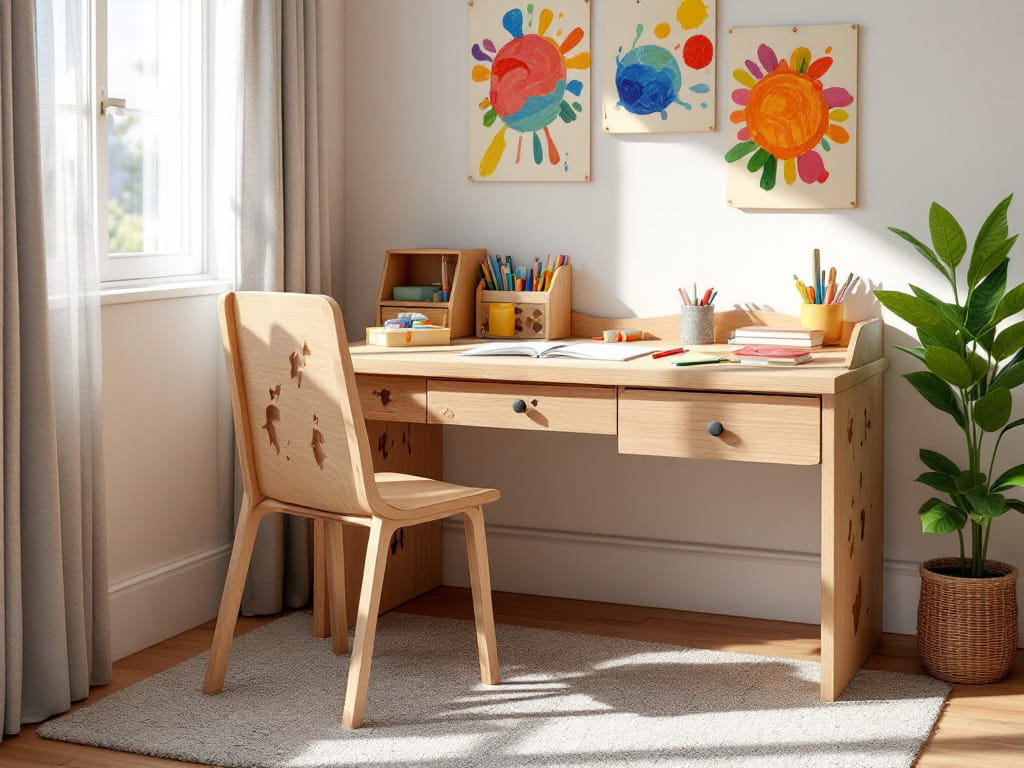
Our portfolio — finished products
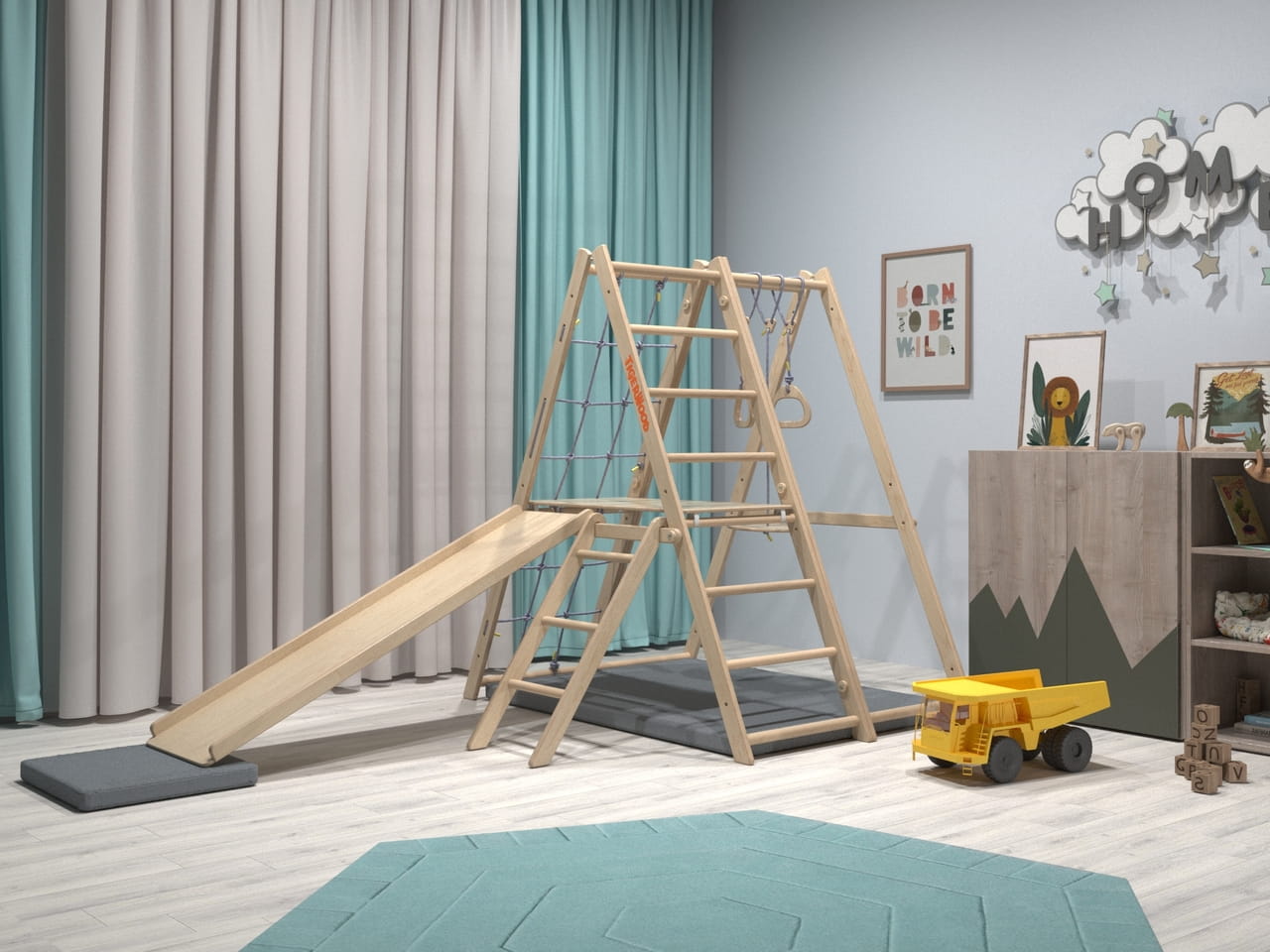
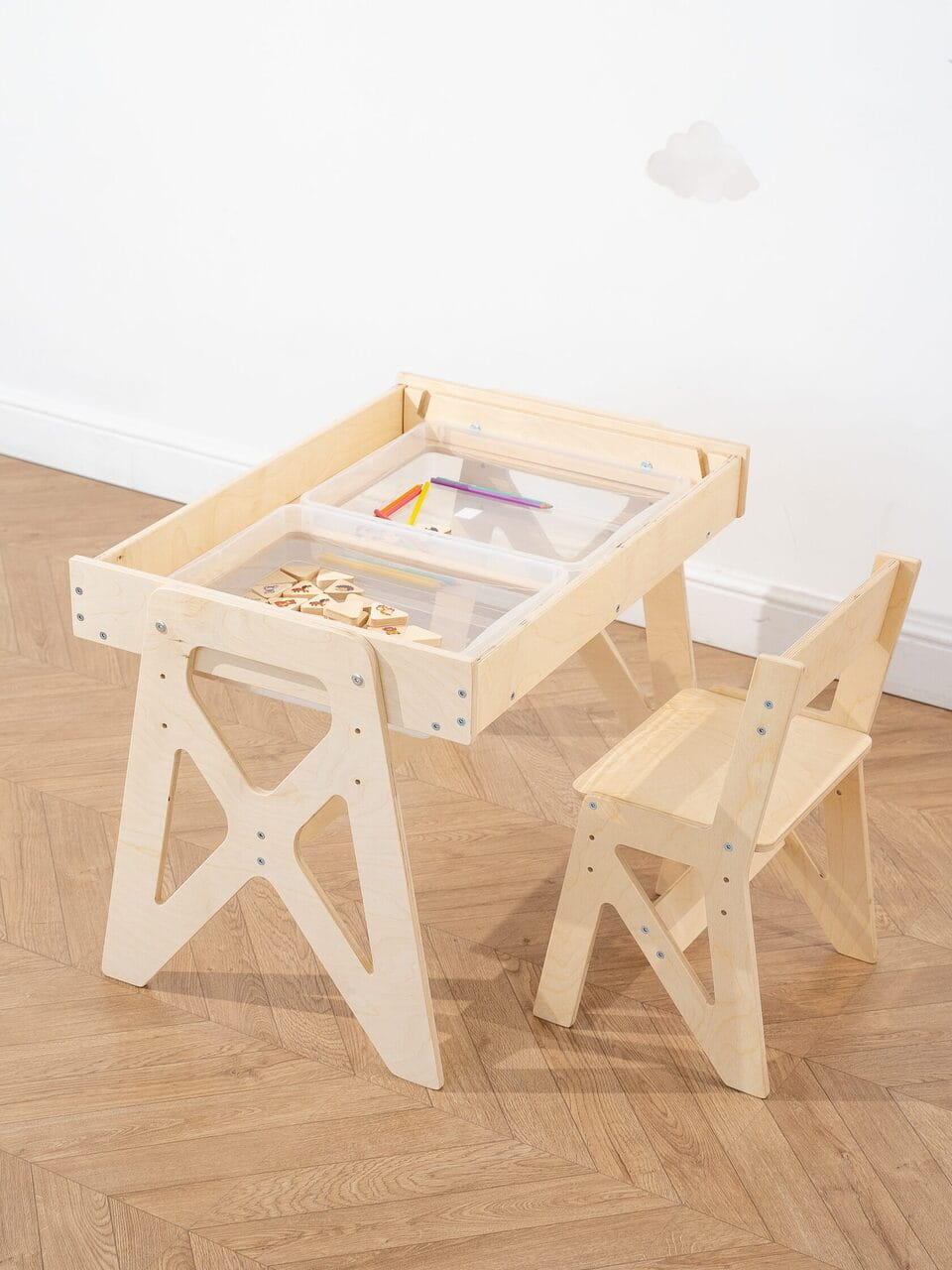


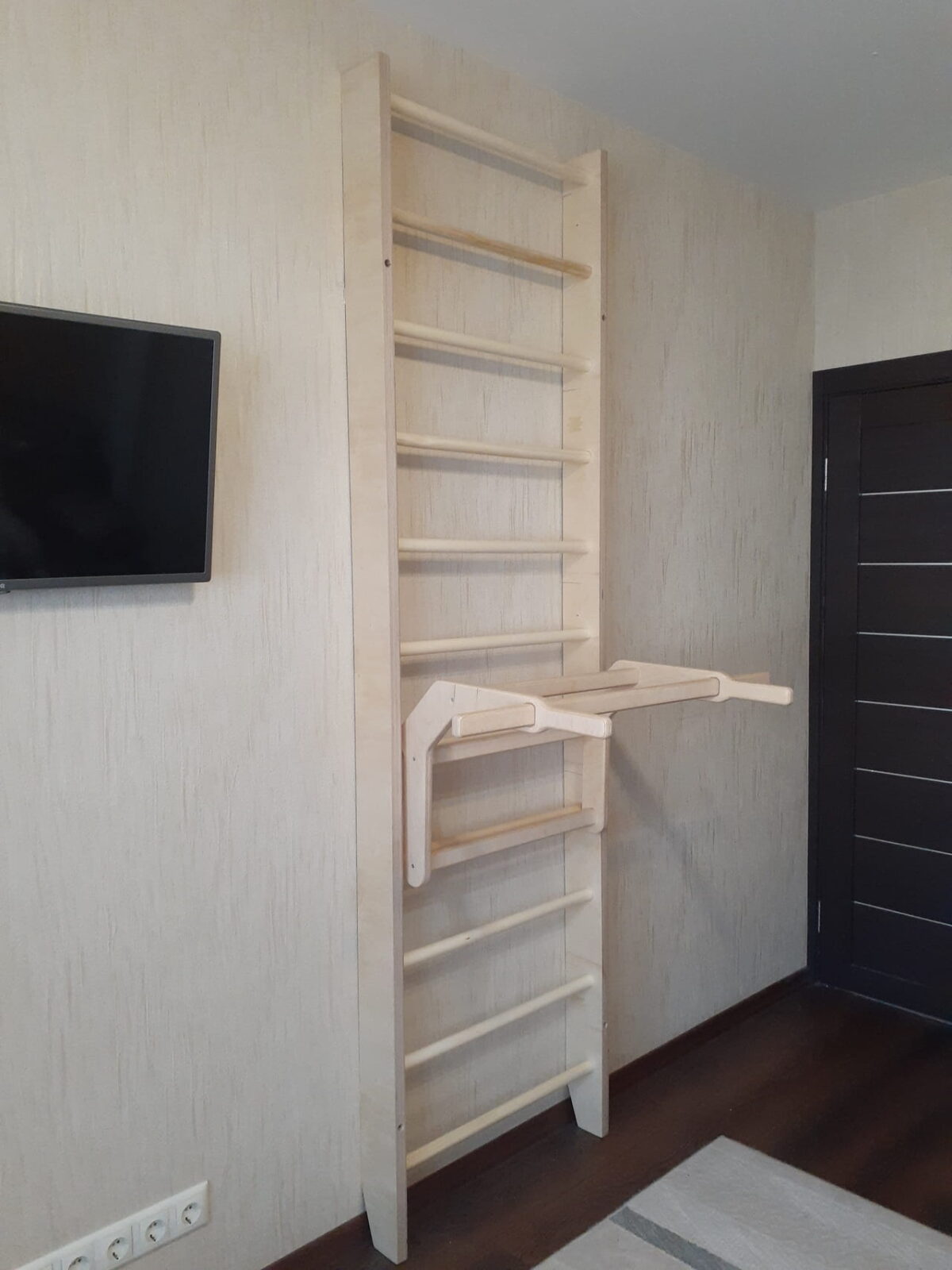
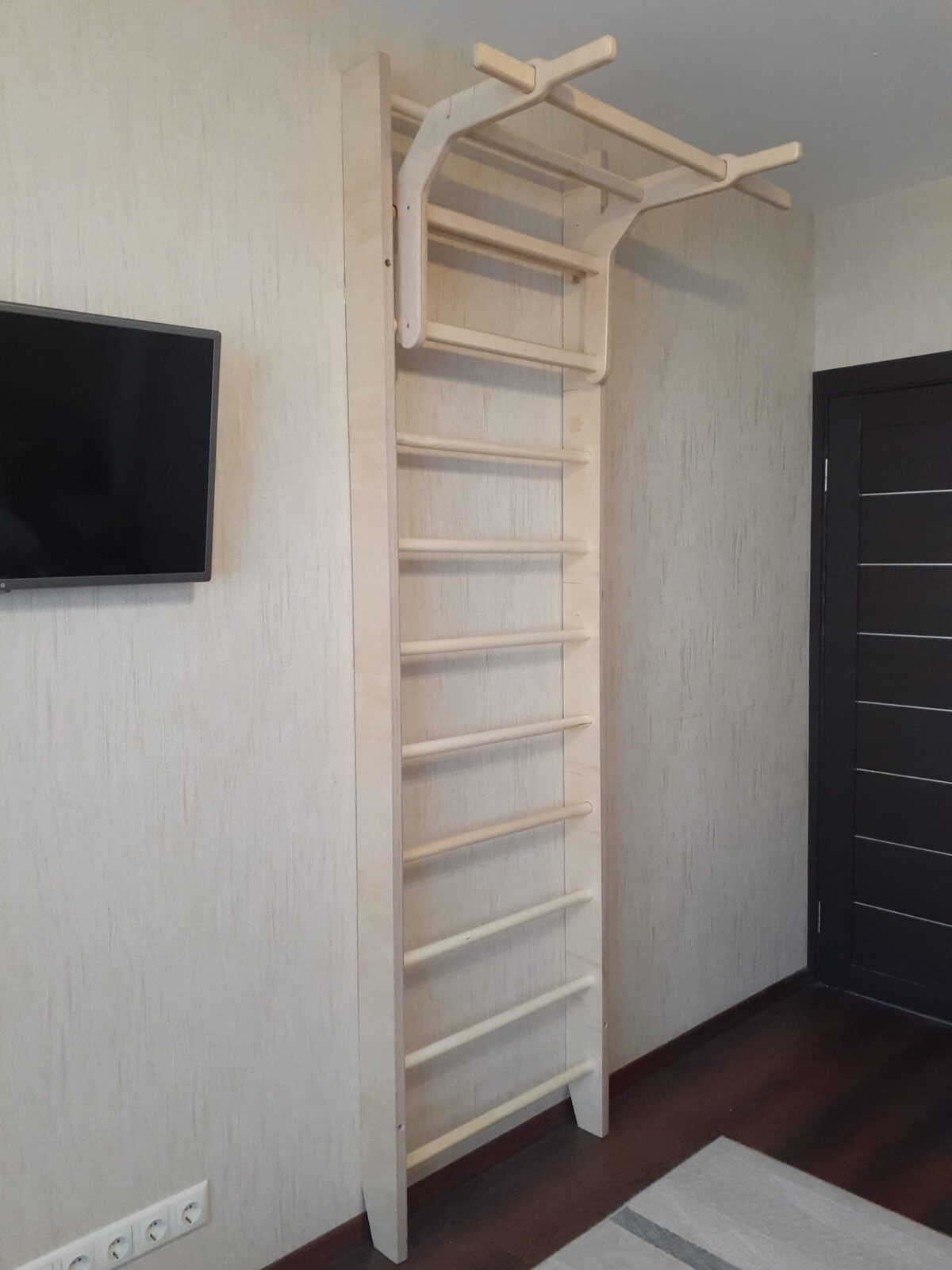
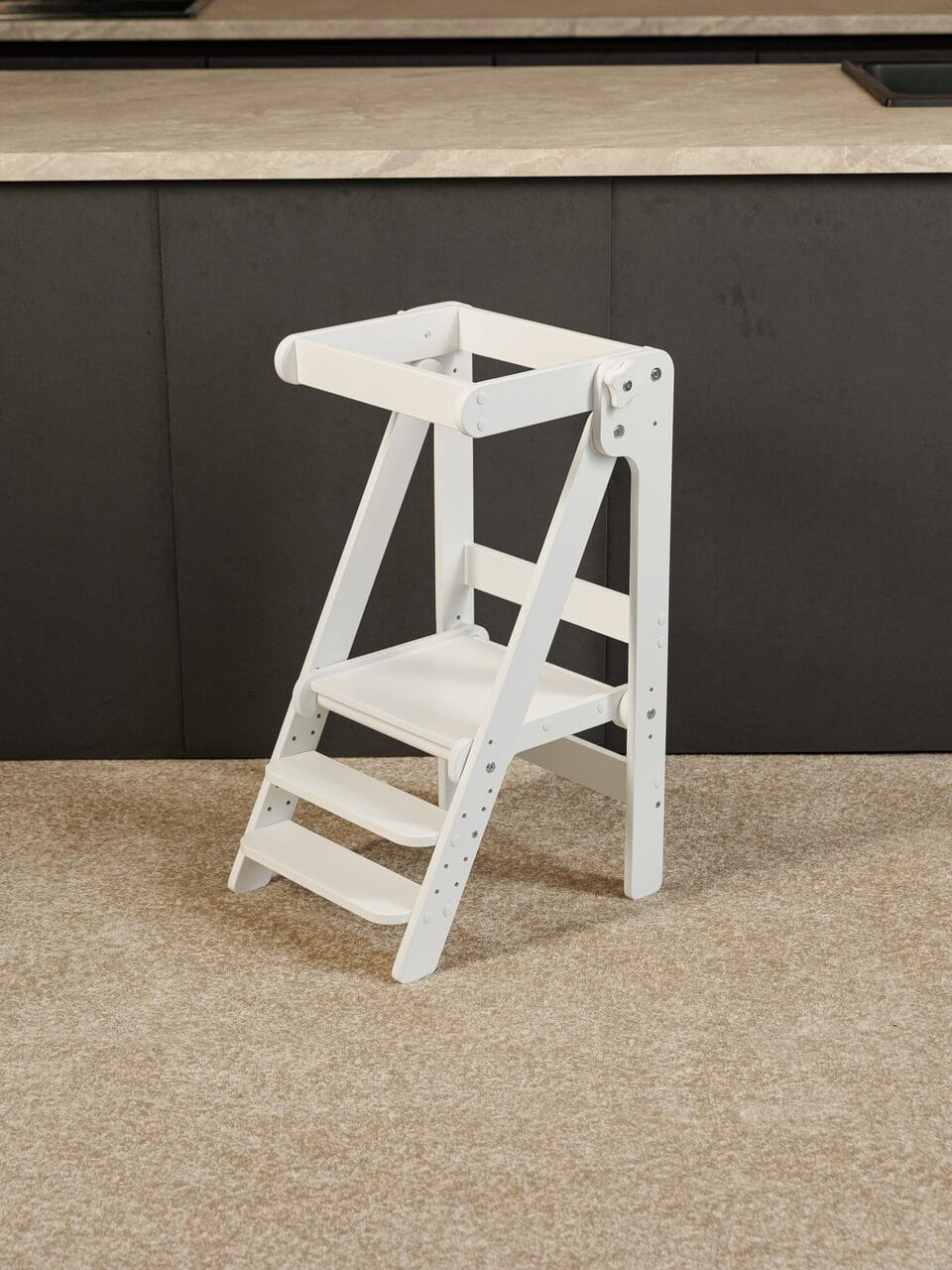
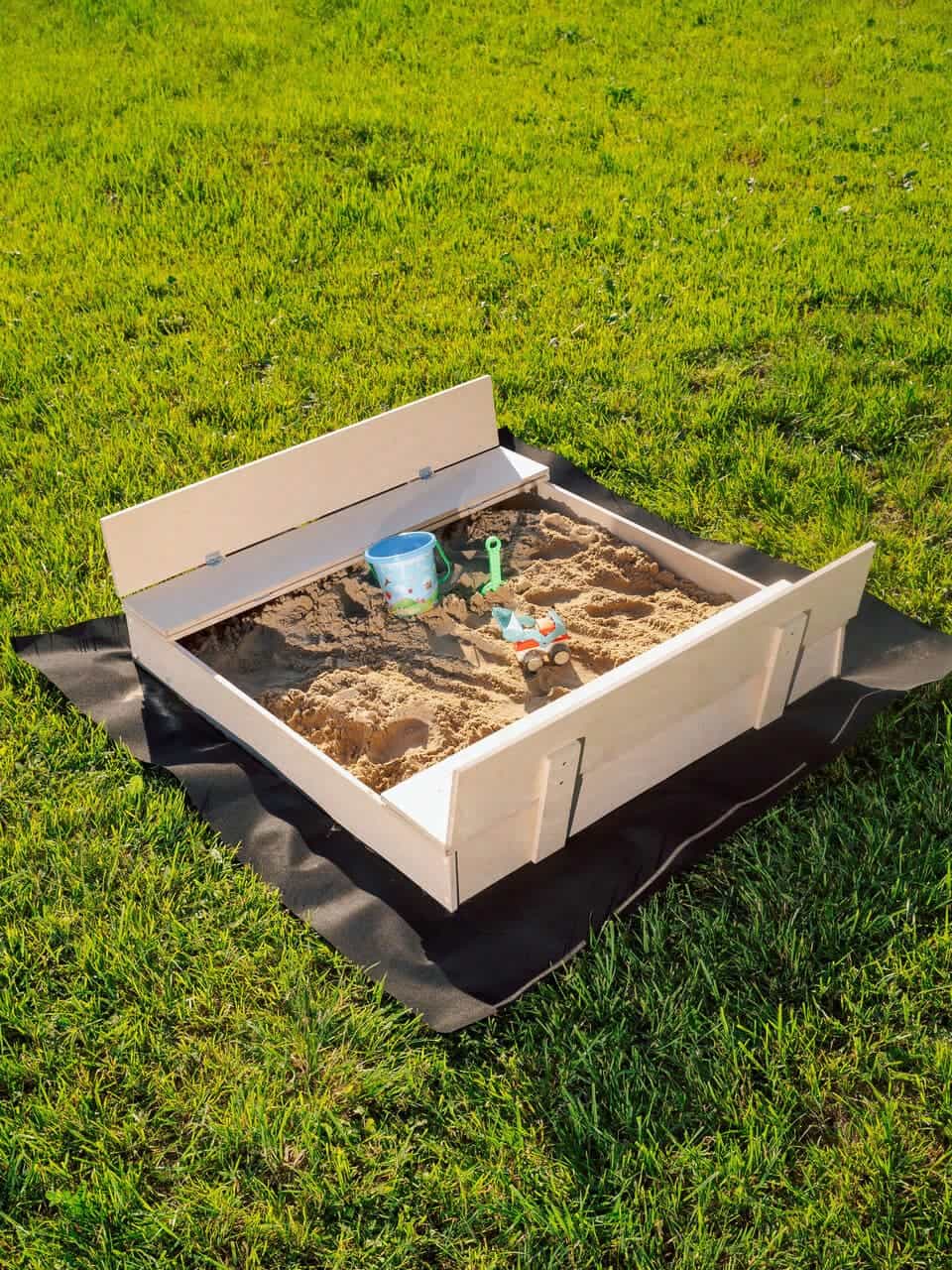

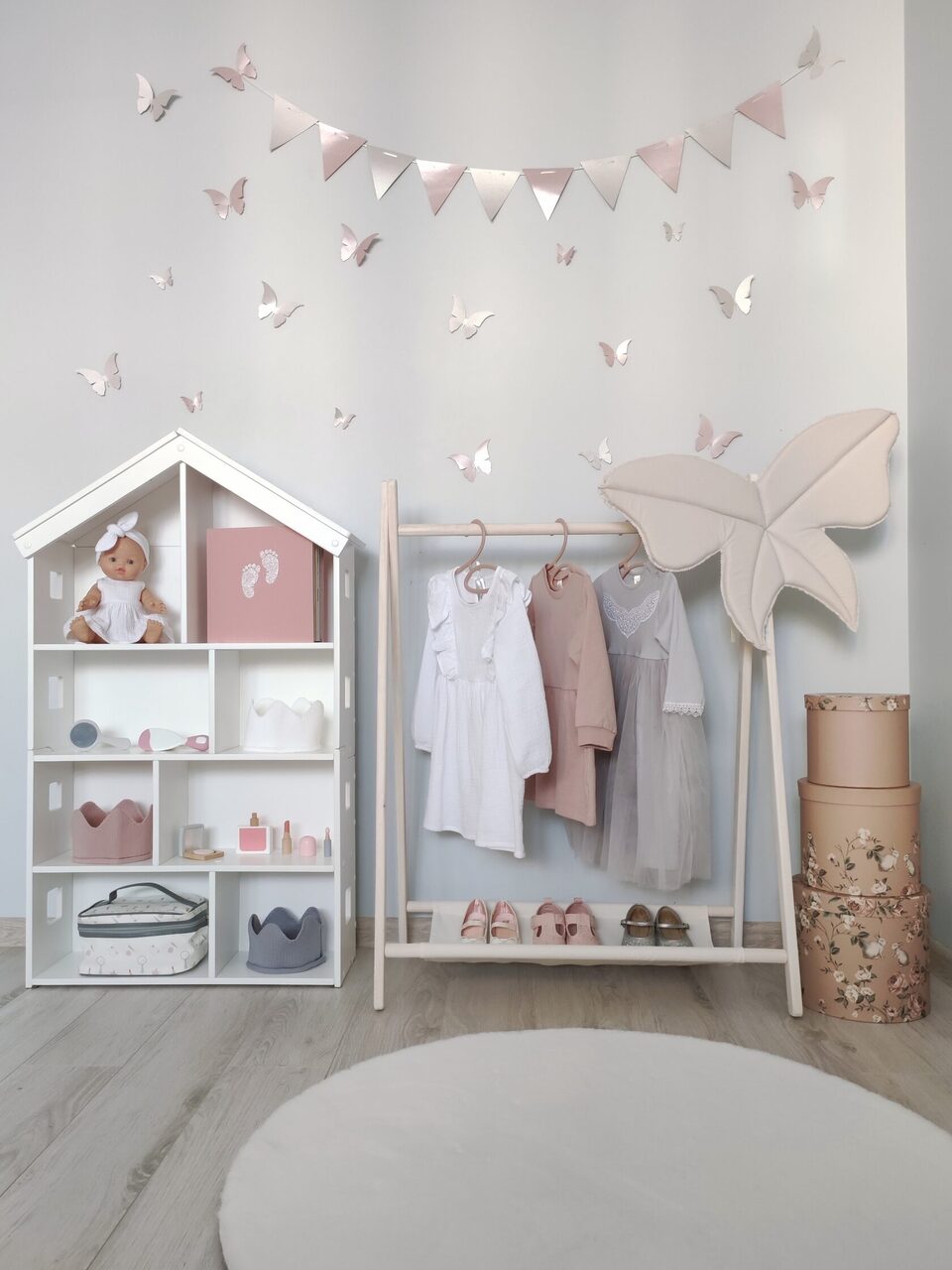

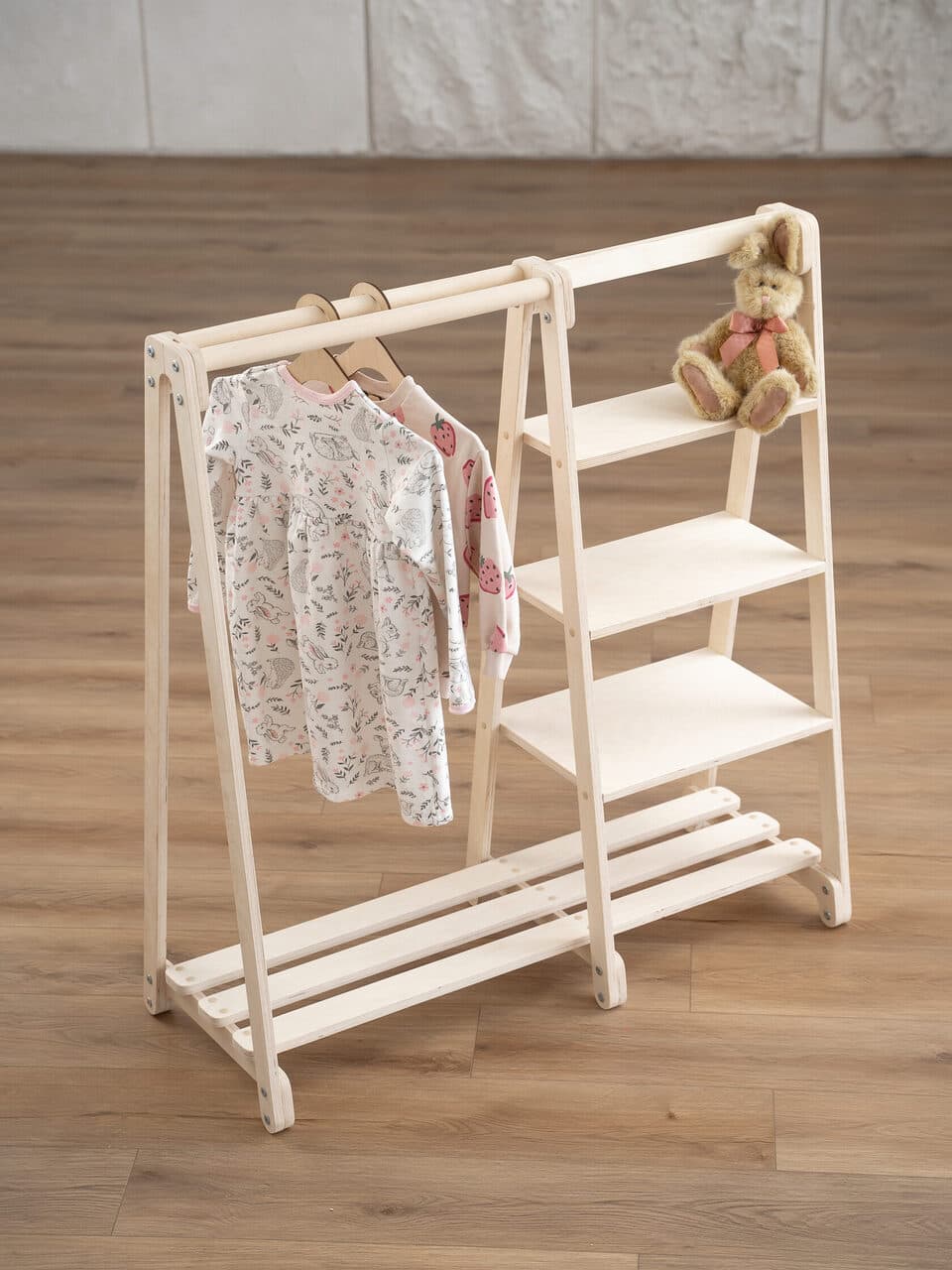
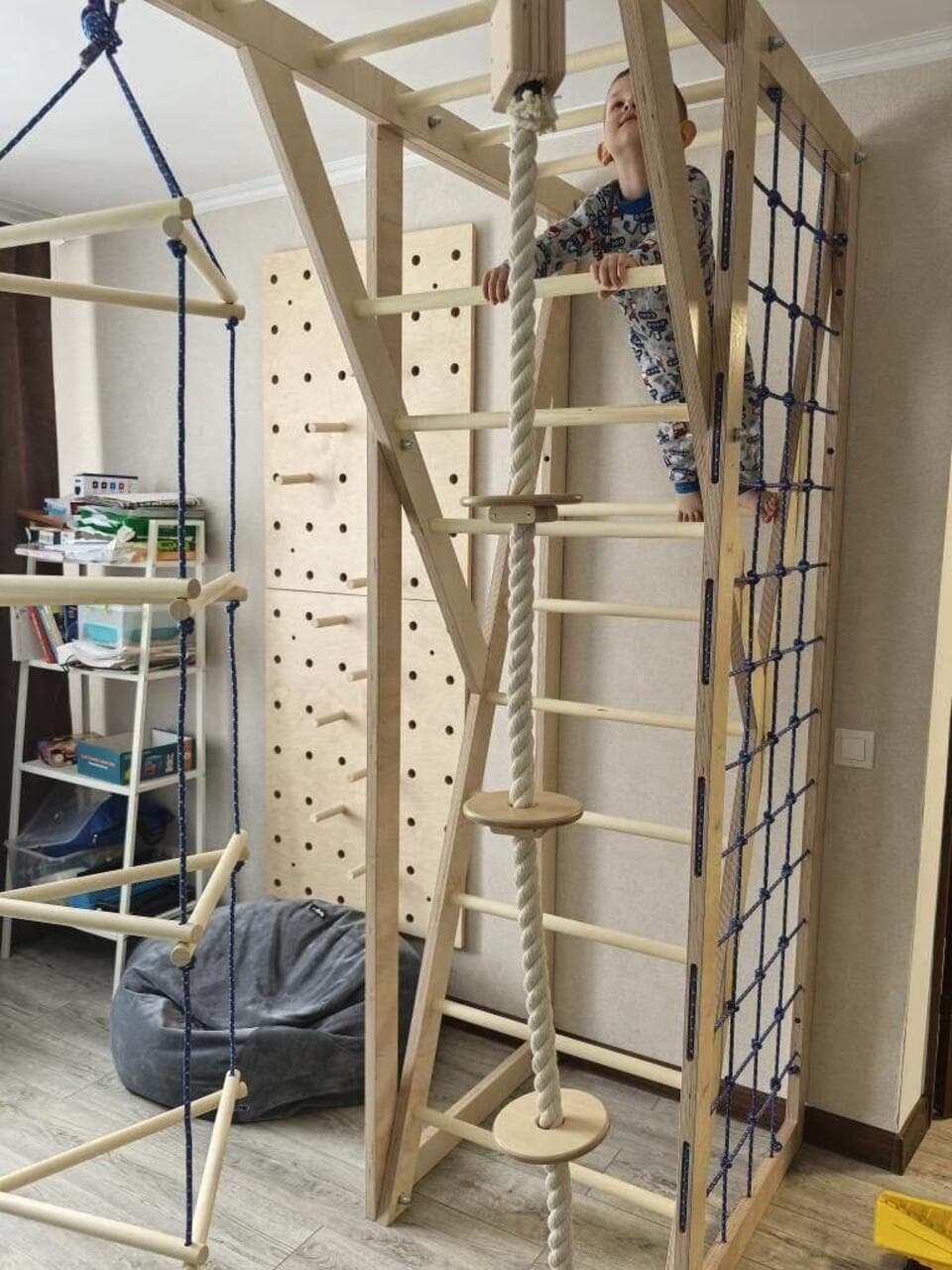
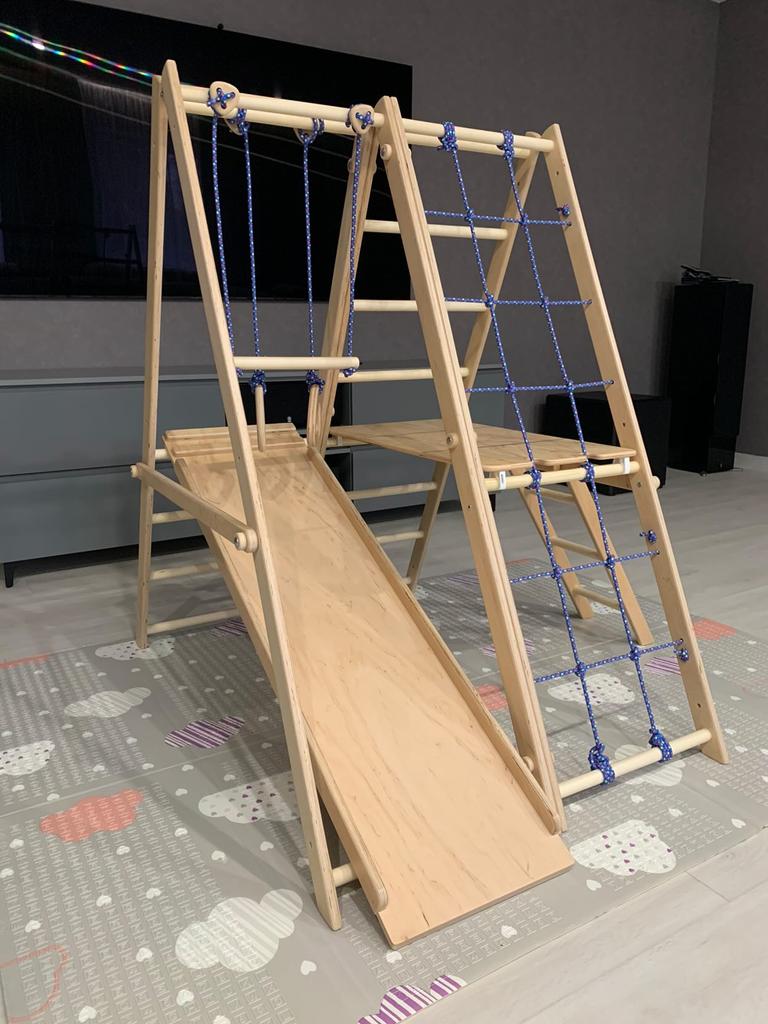

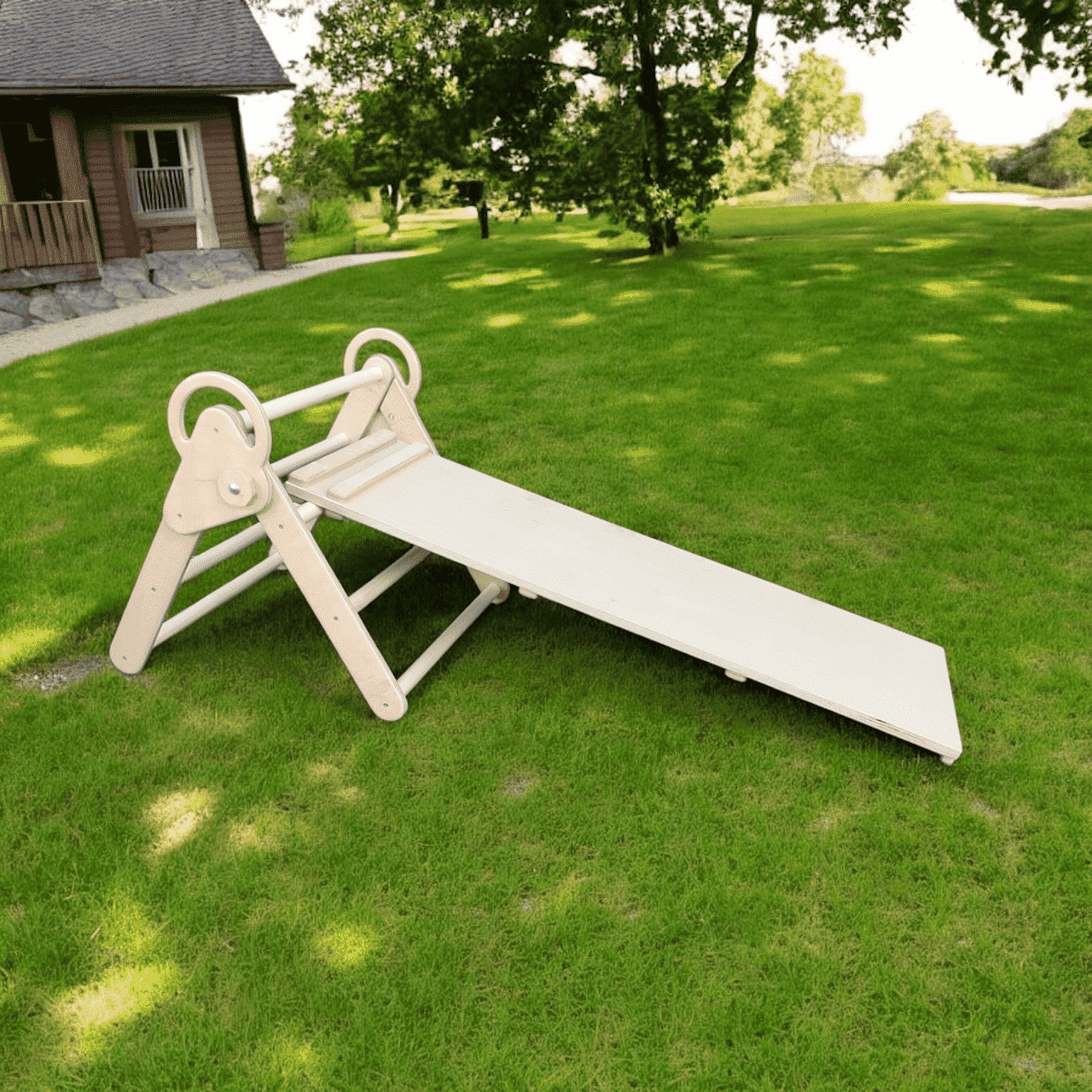

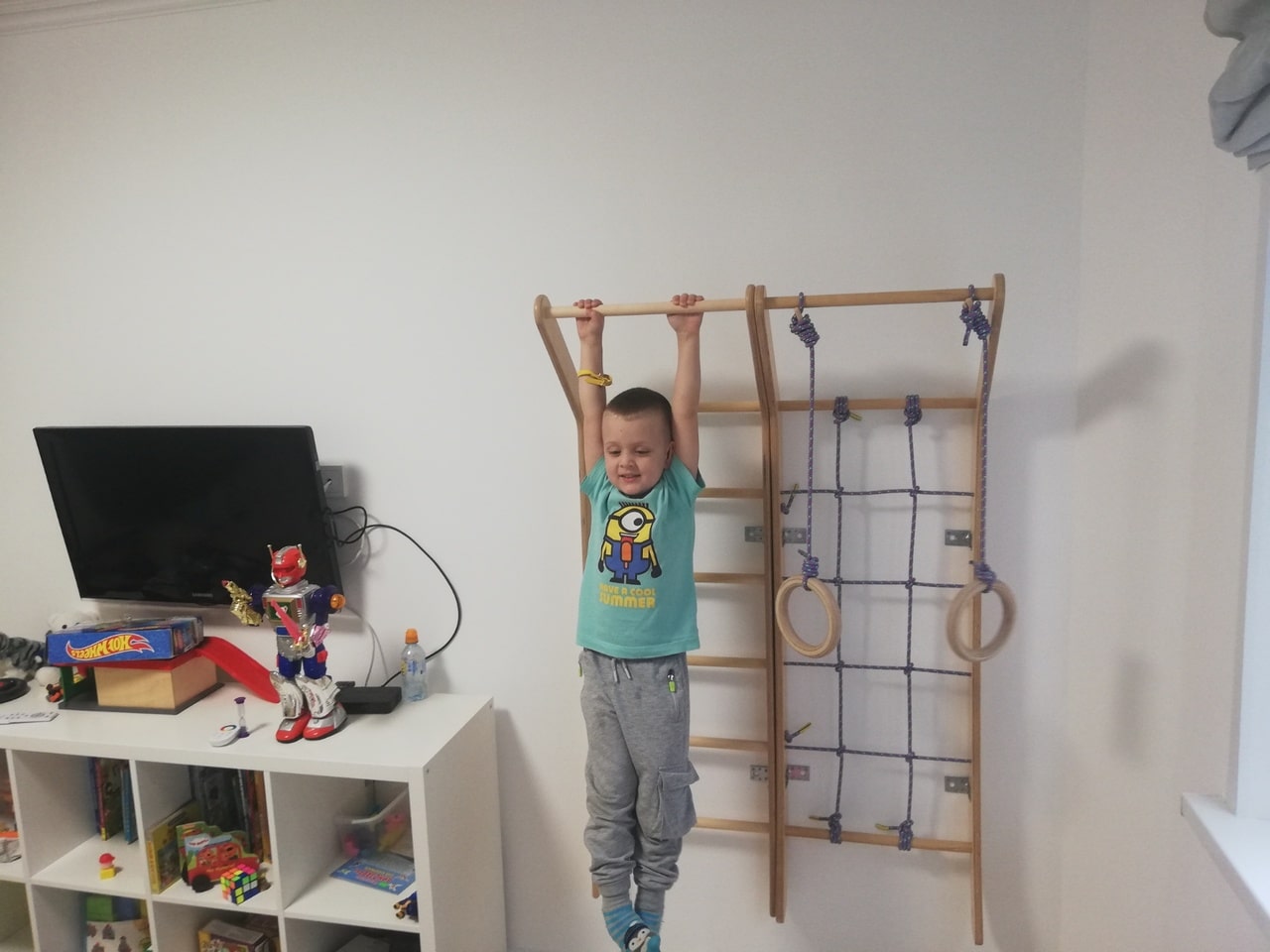


Examples of completed projects: wooden children’s furniture
The portfolio holds a variety of children’s furniture projects for wholesale customers across Europe. Among them are large batches of height-adjustable cots, sets of wardrobes and dressers for specialist shops, and dedicated tables and chairs for educational institutions.
Each project came with detailed technical documentation, material selection and compliance with safety standards. Special attention went to ergonomics and structural reliability, which customers themselves noted more than once in their reviews.
For some clients, custom runs with original design solutions were produced — this made the products stand out on the shelf and met the specific requirements of retail chains and other furniture makers.
The completed work clearly shows both the level of equipment and the approach to each order: the products come out ready for mass sales and intensive use, not for a one-off display.
Who uses a carpentry workshop’s services

Furniture makers

Interior designers

Advertising companies

Exhibition stand builders

Art studios

Cafés and restaurants

Construction firms

Retail equipment manufacturers

Furniture factories

Private craftsmen

Custom orders

Manufacturing companies

Museums and exhibition halls

Architects

Theatres and film studios

Educational organizations

Children’s products manufacturing

Repair specialists

Online stores

Sole proprietors
Who the main clients are in children’s furniture manufacturing
The main customers in the children’s furniture line are wholesale trading companies, furniture manufacturers, retail chains and distributors across Europe. Among them are large sellers who need a reliable contractor able to ramp up volumes quickly for seasonal demand.
This also includes specialist children’s furniture shops, for which regular supply and flexible terms matter. Separate interest comes from companies fitting out the interiors of kindergartens, schools and development centres, where durable, safe furniture is needed in batches.
Support runs from a consultation on materials to timely delivery — this is what attracts clients who value stability and predictable quality. Such a spread of customers only underlines how versatile the products are.
Custom children’s furniture in wholesale manufacturing — quality, safety, variety
Manufacturing wooden children’s furniture is a multi-stage and demanding process: demanding of materials, of technology, of quality control. Experience in this field makes it possible to turn out products that meet strict safety requirements and last a long time without losing their looks.
It all begins with material selection. Plywood, MDF, particleboard and MFC are used only when certified, compliant with environmental standards and free of toxic substances — for children’s products this is a condition with no exceptions. Safe protective coatings are applied on top.
Design and construction are thought through for ergonomics and convenience. Products are made strong and stable, with a margin for long service. Smooth lines, the absence of sharp corners and safe coatings are what set well-made children’s furniture apart from merely scaled-down adult furniture.
Production includes thorough sanding, careful assembly and painting with eco-friendly compounds. The result is both durable and pleasing to the eye. A flexible format is provided for wholesalers: both serial output to a standard design and custom batches for a specific brand.
The work is built on transparency and reliability: clear terms, timely deliveries, support at every stage. This is what makes the workshop sought after in the children’s furniture segment — from small shops to large chains with high standards.
Custom children’s furniture: what a wholesale buyer needs to know
What follows is a no-nonsense breakdown for those who buy children’s furniture in batches or put it on the shelf under their own brand. What materials it is made from and how they differ, what lies behind the word “safety”, how to read lead times and price, which product types are taken up most readily and what to look at when choosing a contractor. All of it from the practice of wholesale manufacturing, not from a marketing brochure.
Materials: how they differ and what to choose
The basis of any children’s furniture is the material, and it determines the price, the weight and how safe the product is. There is no universal answer: it makes sense to use different materials for a cot, a wardrobe door and a chair seat. There are several common options, and each has its own niche worth understanding before ordering a batch.
Birch plywood is the favourite for a nursery. It is strong, holds fasteners, is not afraid of being climbed and jumped on, and shows a recognisable layered edge on the cut that many brands make part of the design. MDF is good where a smooth painted front or a milled relief is needed: it is uniform and takes a coating perfectly. MFC is the workhorse for carcasses and shelves: inexpensive, practical, with a huge choice of wood-look and solid-colour finishes. Particleboard more often goes into internal, hidden parts, where price matters more than looks.
| Material | Why it’s good for a nursery | Where it’s most often used |
|---|---|---|
| 🪵 Birch plywood | Strength, eco-friendliness, attractive edge | Cots, frames, growing furniture |
| 🟤 MDF | Smooth front, relief, even painting | Doors, fronts, décor |
| ⬜ MFC | Ready finish, price, choice of colours | Carcasses, shelves, wardrobes |
| 🧱 Particleboard | Economical base | Internal hidden parts |
| 🌳 Solid wood/panel | Natural feel, repairability | Premium ranges, tabletops |
In practice, a single product is often assembled from several materials at once: a plywood frame, painted MDF fronts, a back panel of thin fibreboard. This sensible mix keeps both quality and price within bounds. If you are unsure of the choice, it is easier to describe the product and its purpose — a suitable set of materials will be suggested for the specific task and batch budget.
What “safe” really means
The word “safe” appears often in descriptions of children’s furniture, but behind it lie quite specific things, not marketing. The first is formaldehyde emission from board materials. For children’s products, boards of class E1 and below are used, where the release of harmful substances is minimal and stays within sanitary norms. This is confirmed by certificates, not words, and a wholesaler should request them at purchase.
The second is geometry and finishing. Children’s furniture has no sharp corners: they are rounded off, edges are covered, ends are sanded smooth. A child will inevitably run into the corner of a table, and whether it is rounded or not decides whether there is a bruise. Protruding fasteners, burrs on plywood, gaps a finger could slip into — all of this is unacceptable on children’s furniture and is filtered out during inspection.
The third is the coating. Varnishes, paints and oils for children’s furniture are chosen without toxic components, so that they do not smell or release harmful substances even when warmed by the sun or a radiator. A good coating is also practical: it wipes down easily, is not afraid of wet cleaning and does not peel off from the furniture being constantly touched. These three layers — material, geometry, coating — add up to that very safety.
Growing furniture and age-appropriate sizes
A distinct and highly sought-after format is furniture that grows with the child. Height-adjustable tables and chairs, convertible cots, shelving with repositionable shelves. The idea is simple: the parent buys the item once instead of replacing it every two years, and for a retailer that is a strong selling point in the product description.
Children’s furniture sizes are calculated for age groups, and this is no small matter. A table and chair must match the child’s height, otherwise posture suffers: the feet should reach the floor and the elbows rest comfortably on the tabletop. That is why wholesale orders often cover ranges for different ages — from toddlers to schoolchildren — to meet all of a shop’s demand in one delivery. Adjustable models solve this more elegantly: one item instead of three.
Colour, design and styling
Children’s furniture sells not only on function but on looks — both parents and children choose with their eyes. So colour and front styling play no smaller a role than strength. Some order a calm Scandinavian palette with natural birch, some bright coloured fronts, some furniture with milled décor in the shape of clouds, stars or animals. All of this is achievable within serial production.
For a wholesaler it matters that the design can be tied to their own brand: a single palette, a recognisable shape, signature décor on the fronts. This makes the product stand out on the shelf and keeps it from being confused with competitors’ goods. And changing the colour or décor within a single construction usually does not break the schedule — the coating and the milling tooling change, but the basic cutting stays the same.
How to choose a child’s cot and table: a short guide
If you are building a range, it helps to understand what the end buyer looks at — this helps you order what will sell. For cots the key things are: frame stability, a safe gap between the bars, no sharp corners, coating quality and the ability to adjust the base height. Convertibles are valued for serving from birth to school age, changing configuration along the way.
For tables and chairs, people look at ergonomics and a margin of strength. A chair must hold the weight not only of a child but of an adult who sits down beside them; a tabletop must not fear modelling clay, paints and a wet cloth. Height adjustment extends the set’s life by years. The same criteria are worth keeping in mind when ordering a batch: furniture made with them in mind comes back less and collects better reviews, and therefore sells better.
Care and use
Children’s furniture lives in tough conditions: it is soiled, scratched, washed and stood on. To keep its looks longer, the coating is chosen to resist wet cleaning and household chemicals, and surfaces are made smooth, with no pores where dirt gathers. It is enough for the parent to wipe the furniture with a soft cloth and no aggressive cleaners — and it stays neat for years.
A couple of sensible rules extend service life: do not place the furniture right up against a radiator, so the wood does not dry out and crack, keep it away from constant damp, and do not overload shelves beyond their rating. Fasteners are worth tightening over time — not because the furniture is bad, but because it is used hard. These points are worth stating in the product listing: they head off some of the buyer’s questions and reduce returns.
What makes up the price
The question “how much does a batch cost” has no exact answer without details, and that is honest rather than an evasion. The price of children’s furniture is made up of several clear components, and each can be estimated in advance. Understanding this arithmetic helps both to stay within budget and to see where you can genuinely save without losing quality.
- 🧱 Materials. Plywood costs more than particleboard, painted MDF more than laminated board — the choice moves the estimate directly.
- 🎨 Finish. Plain laminate, single-colour painting or complex milled décor — different budgets.
- 🔩 Hardware. On children’s furniture it should not be skimped on: durability depends on it.
- 🔁 Run size. The larger the batch, the lower the price per unit thanks to tooling.
- 📐 Construction complexity. A convertible with adjustments costs more than a simple shelving unit.
The most reliable way to avoid surprises at the final figure is to send a clear brief and not rush the schedule. Rework caused by imprecise input and working in crunch mode are exactly what add to the estimate the percentages you wanted to avoid. It makes sense to fix the price and the lead time before the start, so that new figures do not surface along the way.
Lead times: what to plan for
The lead time depends on the batch size, the complexity of the products and whether painting is needed. In children’s furniture the coating usually takes the longest to dry — here haste harms the result, and it is better to allow an extra day than to get an under-cured front. Simple serial items go faster; products with transformation and complex décor need more time for tooling and assembly.
For wholesale, regularity matters, not just the speed of a single batch. If supplies are needed regularly, the schedule is agreed in advance, so the goods arrive in time for seasonal demand rather than after it. Children’s furniture is markedly tied to the season: peaks fall on back-to-school preparation and the pre-holiday months, and a sensible customer plans the purchase with time to spare.
A one-off batch, a series and marketplace supply
The format of cooperation is flexible. A one-off batch suits testing demand for a new item: a small run, a quick check, minimal risk. A regular series is for those whose product already sells and who need a steady flow of identical items for the catalogue. In both cases custom children’s furniture is produced to a single standard, so the buyer notices no difference between deliveries.
Marketplace sellers are a separate story. Here what matters is not only the product itself but the packaging to the platform’s requirements, labelling, compactness for warehouse storage and resistance to shipping. Furniture for a marketplace is often made flat-packed, with clear assembly instructions, to reduce the rate of damage in transit and returns. All of this is taken into account as early as the batch design stage.
Common mistakes when ordering a batch
Most problems arise not in production but at the stage of setting the task. Here is what most often gets in the way of a batch that sells well and comes back rarely.
- ❌ Skimping on hardware and coating. A cheap hinge and weak varnish come back as returns and bad reviews.
- ❌ Sizes with no link to age. A table that doesn’t match height — and the goods sit in the warehouse.
- ❌ No request for certificates. For children’s furniture, safety documents are mandatory.
- ❌ Too large a first order. A new item is better tested with a small batch.
- ❌ Ignoring packaging. For delivery and marketplaces this is half the battle.
It is no big deal if you have not accounted for some of this — that is what a dialogue before launch is for. A competent contractor asks these questions in advance himself: suggests age-appropriate sizes, offers reliable hardware, reminds you about certificates and packaging. This saves money, nerves and reputation on the shelf.
Quality control and warranty
Control is built into the process, not tacked on at the end for show. At intake the material and certificates are checked: the wrong board or a dubious coating is rejected before cutting. During assembly, geometry, fastening reliability and sanding quality are watched — on children’s furniture an under-sanded corner or play in a joint is unacceptable. At the end the product is checked in full, and only then packed.
For wholesale such control matters twice over: a single defective item in a batch hits a shop’s reputation harder than it seems. When the whole path from raw-material intake to packing runs under unified control, responsibility for the result is not spread thin, and there is someone to answer for it. This is what real warranty is — not a piece of paper but a built process in which defects never reach the buyer.
Delivery and assembly
The finished batch is shipped across Europe. Children’s furniture is packed with care: corners and fronts are protected, fasteners are supplied separately, and clear instructions are included with flat-pack items. The delivery method is chosen to suit the volume and address — from a freight carrier to self-collection. For regular supplies the schedule is agreed in advance, so the goods arrive right on demand.
Large items are often more convenient to transport disassembled and put together on site — this lowers the risk of damage in transit and the cost of carriage. Compact items are shipped assembled. Which to choose is decided from the logistics of the specific order: sometimes assembled furniture is better value, sometimes flat-pack, which saves space in the warehouse and the vehicle.
The equipment that quality rests on
A consistent batch of children’s furniture is impossible without the right machines, and talk of quality without them is empty. Cutting is done on a panel saw that gives a clean, chip-free edge, and on CNC where a shaped contour or milled décor is needed. The program reproduces the shape without deviation, so the hundredth item in a batch cannot be told from the first — for wholesale this is fundamental.
Sanding plays no smaller a role. For children’s furniture it is done especially thoroughly, in several passes, by hand and by machine — so the surface comes out smooth and all edges safe. The finish coat is applied in a separate, dust-free zone and dried in a clean space. It is precisely the combination of precise cutting, careful milling, multi-stage sanding and skilled painting that gives a result you would not be ashamed to put on the shelf.
A glossary of terms for the customer
When discussing an order, words come up that are familiar to production but hazy for a buyer. A short glossary will clear up misunderstandings before the start.
| Term | What it means |
|---|---|
| 🌿 Emission class E1 | The standard for formaldehyde release; for a nursery, E1 and below are used |
| 🖇️ Edge banding | Tape that seals the board’s edge against moisture and chipping |
| 🔩 Boring for fittings | Holes for hardware and fasteners drilled to the layout |
| 🔄 Convertible | A product that changes configuration as the child grows |
| 📐 Growing furniture | A table/chair adjustable for age |
| 📦 Flat pack | A knock-down product for compact transport |
What an order looks like in practice
So that all of the above does not remain theory, here are typical scenarios. A children’s goods shop wants to add a line of table-and-chair sets for different ages to its range. To its dimensions and colour wishes a series is designed, plywood and MDF are cut, parts are milled with rounded corners, sanded and painted in the agreed palette. The result is a batch of finished sets in uniform retail packaging.
Another case is fitting out a kindergarten. Here durability and safety come first: the furniture lives non-stop and is washed every day. Cabinets, tables and shelving of increased strength are ordered, with reinforced joints and a hard-wearing coating. A third example is a marketplace seller who needs a compact, flat-packed model with clear assembly instructions to reduce returns. Three different tasks are met by one service; only the configuration and packaging change.
Combined materials in a single product
Good children’s furniture is rarely made from a single material. The frame is taken from strong plywood, the fronts from painted MDF, the shelves from MFC, the back panel from thin fibreboard. Such a mix keeps both price and quality: where strength is needed there is plywood, where looks matter a painted front, where a practical base is enough laminated board. Bringing this together into a coherent product is convenient at a single site.
A single-cycle approach wins out in the end. When cutting, milling, painting and assembly run under one roof, parts do not “drift” in size at the seams between contractors, and the batch comes out uniform. The customer does not have to piece together the work of several performers and figure out who is to blame if something does not match. For children’s furniture, where the cost of a mistake is a child’s safety, this is especially important.
Your own contractor or a large factory
A large factory is good for very big runs of standard models, but it is usually in no hurry to take on a custom run, non-standard sizes or a small trial batch. A private craftsman is flexible, but his volume and the consistency of quality from batch to batch are limited, and certifying children’s products often becomes a problem. A full-cycle workshop occupies the middle ground: it takes both a trial batch and a series, keeps industrial precision and covers the whole path from material to packaging under a single responsibility.
For wholesale this is also convenient in that you can grow gradually: start with a trial run of a new item, test demand, then scale up the volume for the catalogue without changing contractor or re-explaining the requirements. Once the specifics of the range are already known to the workshop, each subsequent batch goes faster and more predictably.
Ecology and certification in more detail
For children’s furniture, safety documents are not bureaucracy but a seller’s working tool. Certificates confirm that the materials and coatings meet sanitary norms and do not release harmful substances, and it is exactly these that both marketplaces and large chains ask for when listing goods. A sensible wholesaler requests the supporting documents for a batch in advance, so as not to face a blocked product listing after the purchase.
Eco-friendliness is made up of small things: low-emission boards, water-based coatings or safe oils, the absence of dubious glues. On their own they are not obvious, but together they give furniture that is confidently placed in a child’s room and in a kindergarten. For a brand this is also a selling point in the product description: “safe materials” stops being empty words when specific documents stand behind them.
Coatings and colour: what children’s furniture is finished with
The choice of coating for children’s furniture solves three tasks at once: safety, looks and practicality. Varnish gives a durable film and brings out the texture of plywood or wood — good where a natural look is wanted. Paint covers the surface with solid colour and allows either a calm pastel or a bright front. Oil preserves the natural grain and is pleasant to the touch, but requires more careful upkeep. For a nursery all compounds are taken free of toxic components.
The practicality of a coating for children’s furniture matters no less than looks. The surface must survive wet cleaning, marker and modelling-clay marks, frequent touching by sticky hands. So the priority is hard-wearing coatings that wipe down easily and do not peel with use. The colour is chosen by sample or catalogue and held consistent across the whole batch, so that items in one delivery are a single tone rather than all over the place.
Styles of children’s furniture
There is fashion in children’s furniture too, and it pays a seller to keep it in mind. Scandinavian style with natural birch and a calm palette is steadily popular — it fits most interiors and appeals to parents. Bright coloured models are chosen for play areas and toddlers. A separate niche is furniture with themed décor: milled stars, clouds, little animals, shaped rails. All of this is achievable in series and helps a product stand out on the shelf.
At the same time, style must not come at the expense of function. No design will save a beautiful but unstable shelving unit or a table with sharp corners. A sound approach combines both: the product both looks appealing and stays safe and strong. It is exactly this combination that sells well and collects positive reviews, and therefore drives repeat orders.
Furniture for kindergartens, schools and centres
Furniture for educational institutions is a separate segment with its own rules. Here durability comes first: tables, chairs, cabinets and shelving are used intensively, washed every day and not spared. So joints are reinforced, reliable hardware is fitted and a coating resistant to constant cleaning is chosen. Sizes are held to age groups, so the furniture is comfortable and does not harm posture.
For such orders batch uniformity also matters: all the furniture in a group or classroom must be identical in size, colour and quality. Serial production with control is exactly what ensures this. Elements for a specific room are often added to the basic items — non-standard dimensions, the institution’s brand colours, extra storage sections. Flexibility here is valued no less than strength.
How to prepare an order
A good order starts with a clear task. The clearer the input, the fewer clarifications and the more accurate the result. A little preparation on the customer’s side saves both sides time and reduces the risk of getting the wrong thing.
- 🧸 Describe the products: what furniture, for what age, in what style.
- 📐 Provide dimensions or a drawing — at least approximate sizes.
- 🎨 Decide on the material and the colour of the fronts.
- 🔢 Specify the run — a trial batch or a regular series.
- 📄 Clarify whether certificates and special packaging are needed (for example, for a marketplace).
- 📅 Name the desired deadline, especially if the order is tied to a season.
You do not have to come with a ready technical package — many orders start with the phrase “we need a line like this, help us figure it out”. The workshop’s job is precisely to translate wishes into the language of drawings and materials. But the more input at the start, the shorter the path to a finished batch of children’s furniture.
More questions about custom children’s furniture
Can a trial batch be made before a large order? Yes, it is a sensible step. A small run shows both the quality and how the product sells — and only then is the volume scaled up to match demand without undue risk.
Is it feasible to produce furniture under our own brand? Yes. A single palette, a recognisable shape, signature décor on the fronts — all of this is tied to your brand, so the product stands out on the shelf and is not confused with competitors’ goods.
What about packaging for a marketplace? Products are made compact and knock-down, supplied with instructions and fasteners, and packed with corner protection. This reduces damage in transit and the return rate — metrics critical for the platforms.
Will a model be reproduced if we need to top up an order? Yes, if the item has already been through production: the dimensions, colour and construction are known, and the additional batch will come out to the same standard. That is why many return to the same contractor.
A one-off order or ongoing cooperation
The children’s furniture workshop is equally open to a one-off order and to a long partnership. A one-off batch is a way to test a new item quickly: a small run, minimal risk, a clear result. If the product takes off, the volume is scaled up for the catalogue. Ongoing cooperation suits those with stable sales better: a supply schedule, predictable quality, priority in season.
Over time a regular customer gains a tangible advantage. The workshop already knows their range, packaging requirements and usual palette — and each subsequent batch goes faster, with fewer approvals. There is no need to explain again that the fronts are painted in a certain tone and the furniture is packed for a marketplace. Many come this way: from a single trial batch, and stay for years, because it is simply more convenient than searching for a new contractor each time.
Why a single site pays off in the end
The temptation to assemble production from the cheapest performers is understandable: cutting cheaper here, painting at a discount there, assembly entrusted to a third party. On paper it is a saving, in practice a risk. Every seam between contractors is a place where time is lost, mismatched items appear and an argument starts over who is to blame for the defect. For children’s furniture, where both safety and batch uniformity matter, such inconsistency is especially dangerous.
A single cycle at one site costs a little more in the moment but wins out in the end — through lead times, batch integrity and one party responsible for everything. When cutting, milling, sanding, painting and assembly run in sequence under common control, dimensions do not “drift” and products come out identical. The customer does not have to piece together the work of several performers — he sets the task and receives a finished batch there is someone to answer for.
Precision and repeatability in a series
For wholesale, repeatability matters no less than the precision of an individual product. When a batch has a hundred identical chairs, it is critical that the last differs in nothing from the first — in size, colour, the fit of the parts. The program on a CNC machine does not tire or “lose its eye”, so the series comes out consistent from start to finish. Hand finishing meanwhile removes what the machine leaves, uniting manufacturability with the neatness of hands-on work.
Inconsistency in a batch hits sales harder than it seems. A buyer who takes two seemingly identical sets in a shop and finds a difference in shade or size is unlikely to come back. So consistency from one product to the next is not a technical nitpick but a direct contribution to the brand’s reputation on the shelf. It is exactly this that serial production with control at every stage ensures.
A consultation before ordering
Discussing a batch commits you to nothing. You can describe the children’s furniture you want to put on the shelf, attach dimensions or a reference — and get a guide on price, lead times and suitable materials. Useful details surface at this stage: where to use plywood instead of particleboard, what run size is sensible for a start, why the packaging is better made for a marketplace from the outset. Such a conversation saves both money and time and clears up half the questions in advance.
To sum it all up: custom children’s furniture is a way to get safe, strong and neatly made products from wood and board materials for your own range, in batches from a trial run to large wholesale. It is enough to describe the task — the rest will be broken into stages, materials selected, deadlines met and a finished batch handed over, ready for sale and for the little owner’s hands.
Stability and anti-tipping protection
A separate topic worth remembering when ordering tall children’s furniture is stability. Children climb on shelves and open shelving units, and a tall wardrobe or dresser not fixed to the wall can tip over. So a stable base is built into the design, and fixings for anchoring to the wall are supplied with the product. For a retailer this also reduces risk: a safe construction means fewer complaints and better reviews.
Small things that an adult does not notice are thought through too. Soft-close doors, so fingers are not pinched. Drawers with a stop, so a child cannot pull them all the way out onto themselves. Rounded rails on cots. Individually these are details, but together they add up to furniture that is confidently placed in a child’s room, not just photographed nicely for a catalogue.
Seasonality of demand and planning
Children’s furniture has pronounced seasonality, and it pays a wholesaler to build it into the purchasing plan. The peak falls on back-to-school preparation: tables, chairs and shelving for schoolchildren are snapped up in late summer. The second surge is the pre-holiday months, when furniture is bought as a gift. In these periods the production queue is tighter, and it is wiser to order a batch in advance, so the goods arrive in time for demand rather than after it.
Regular customers are at an advantage here: their schedules are known, and priority in season is easier to get. Planning supplies for demand peaks is what distinguishes systematic work with a range from panic top-up orders, when the needed goods are already gone and there are two weeks left in the season. A small time buffer almost always pays off in calm sales during the hot period.
A few more common questions
How small a batch will you take? There is no hard minimum — a trial run is taken on to test demand for a new item. The only difference is the price per unit: on a series, thanks to tooling, it is lower than on single pieces.
What if we don’t have our own drawing? A description and a reference are enough. The construction and layout will be developed in-house, agreed with you and put into work. A ready technical package speeds up the start but is not required to order children’s furniture.
Can several items be combined in one delivery? Yes, and it is convenient: cots, tables, wardrobes and shelving are combined into one batch, which simplifies logistics and shortens lead times compared with ordering from different contractors.
Waste, savings and sensible use of material
The subject of waste seems dull right up until you count the money on a large batch. The difference between a considered and a careless layout of parts on a sheet easily comes to several boards, and that is a noticeable sum in the serial production of children’s furniture. Precise cutting with an optimised nesting map keeps losses to a minimum: parts lie tightly, and large offcuts go into small elements of the same project.
For a wholesaler this is a direct saving, and for the workshop a clean, predictable process: it is clear how much material a run will take, and there is no need to buy an extra board at the last moment because of a spoiled blank. There is an environmental side too: less discarded material means less load on both the budget and the environment. A small thing rarely thought about at the start, but which on a series adds up to a noticeable benefit and order in the work.
And a final practical point: children’s furniture is better ordered as a package of items at once and with an eye to future supplies. Once the workshop knows your range and standards, each new batch goes faster and more evenly, and you get consistent goods for the catalogue with no surprises on unpacking. All that remains is to describe the task — the rest will be broken into stages and carried through to a finished result.
Where to begin cooperation
If you are only considering adding children’s furniture to your range, it is easier to start small. Describe which items interest you and what buyer they are aimed at — for a kindergarten, a home room, a schoolchild. Indicate an approximate budget and desired deadline. This is enough to estimate the materials, construction and price, and the rest is clarified as you go. A trial batch will show both the quality and how the product sells, without large outlay at the start.
Much then depends on feedback from the shelf. Some things sell better, some are worth refining in colour or size — and the next batch takes that experience into account. This is how a line gradually takes shape that precisely matches your audience’s demand. Custom children’s furniture is convenient in that the range can be tuned to real sales, rather than guessing in advance by locking in a large run of one model.
Another argument for ordering for your own range is control over the product’s characteristics. Buying ready furniture from an intermediary, you take what there is, with all its compromises on material and quality. Ordering children’s furniture directly from the workshop, you set the parameters yourself: which material, which coating, which dimensions and which packaging. This lets you build a line precisely for your audience and price segment, rather than fitting in with someone else’s catalogue. For a shop or a seller, such control directly affects margin, reviews and the return rate.
What materials are used to manufacture children’s furniture?
Mainly certified plywood, MDF, particleboard and MFC that meet environmental and sanitary norms and are safe for children. The material is checked for suitability before it goes into work.
What machining technologies are used?
CNC machines are used for milling and cutting, along with multi-stage sanding and painting with eco-friendly compounds. This combination delivers both precise joints and a safe, smooth surface.
Can furniture be ordered to custom drawings?
Yes, the customer’s ready drawings are accepted, and if there are none, the design and production program are developed in-house from a description and dimensions.
What quality guarantees are provided?
Control runs at every stage: both materials and finished products undergo an internal check against safety and strength standards. Defects are weeded out before shipment.
Is furniture produced in large volumes?
Yes, capacity is geared to both small batches and large wholesale orders — meeting agreed deadlines with consistent quality across the whole batch.
What coating options are available?
Varnishes, paints and oils without toxic substances are used. They protect the product while preserving the natural look of the wood and giving off no smell.
Are delivery services provided?
Yes, delivery is arranged across Europe. The method and terms are chosen to suit the batch dimensions and the customer’s address.
Is it possible to manufacture furniture for commercial institutions?
Yes, furniture is produced for kindergartens, schools and development centres — with increased durability and strict compliance with safety requirements.
Reach us in whatever way suits you best
Call us, message us on a messenger app or reach out via social media — choose whichever way suits you
🗺️ We accept orders from clients across Europe
💬 Useful information and articles
Eco-friendly and safe materials for modern wood production
Eco-friendly and safe materials for modern wood production In recent years we increasingly think about what the things around us are made of. A home, furniture, a floor, a kitchen, a

How to Correctly Choose Between Plywood, MDF, Particleboard, and MFC for Different Tasks
How to Correctly Choose Between Plywood, MDF, Particleboard, and MFC for Different Tasks In the world of woodworking and furniture making, every material has its own story. Plywood, MDF, particleboard, and

Cutting sheet wood materials at different angles: why and how it is done
Cutting sheet wood materials at different angles: why and how it is done Working with wood materials is not just sawing. To get a truly high-quality and durable product, you have

Recommendations for choosing sheet materials for indoor and outdoor projects
Recommendations for choosing sheet materials for indoor and outdoor projects In woodworking, choosing the right sheet material is like laying a foundation for a builder. What you pick at the very