Modern methods of painting wooden products: the subtleties of handwork and the power of spray booths

Finishing is not just the final stage in the manufacture of a wooden product – it is its calling card, an indicator of quality and durability. It is painting that gives wood its aesthetic completeness, emphasizes its unique texture and, most importantly, provides reliable protection against moisture, ultraviolet light and mechanical damage. In our work we deal daily with choosing the optimal method of applying a coating, balancing between the traditional techniques of handwork and the high-tech capabilities of modern spray booths. Each of these approaches has its own undeniable advantages and areas of application, which we will describe in detail.
The fundamental role of finishing in woodworking
The quality and durability of any wooden product, be it an exclusive furniture front, a complex architectural detail or a decor element, depend directly on the finish coating. The coating performs a triple function: protective, decorative and operational. Underestimating this stage inevitably leads to premature wear, loss of appearance and, as a result, to a decline in the value of the products.
A correctly selected and applied paint and varnish material forms a strong barrier that prevents moisture from penetrating into the pores of the wood. Water is the main enemy of wood, causing it to swell, deform, crack and creating a favorable environment for the development of fungus and mold. Effective protection against moisture is critically important for products used in conditions of variable humidity, for example windows, doors and garden furniture. In addition, coatings significantly reduce the impact of ultraviolet radiation, which over time causes discoloration and yellowing of the surface.
The decorative function of finishing allows the craftsman to manage the visual perception of the product. With the help of tinting compounds, stains and pigmented enamels, one can both emphasize the natural beauty of the wood grain and completely change its color, imitating valuable species or realizing complex design concepts. The choice of gloss level (from matte to high-gloss) also makes a substantial contribution to forming the style. The operational function is connected with increasing the wear resistance of the surface. Applying polyurethane or acrylic varnishes creates a hard layer resistant to scratches, abrasion, household chemicals and grease, which is especially relevant for worktops, floors and kitchen fronts.
Depending on the purpose of the product, we select not only the type of coating (oil, wax, varnish, enamel) but also the technology of its application. For large-scale production, the speed and stability of the result are critically important, while for single, exclusive items, for example hand carving, the priority becomes the meticulous precision of processing each element. Painting requires not only quality materials but also strict compliance with the technological chain: surface preparation (sanding, dedusting), primer application, intermediate drying, sanding and final application. Departing from any of these steps jeopardizes the entire process.
The magic of hand application: brush, roller, pad
The hand application of paint and varnish materials is a technique that does not lose its relevance even in the age of automation. This method is indispensable when it comes to single, exclusive products, complex architectural elements or repair and restoration work. Handwork allows the craftsman to control the process to the maximum, adapting it to the individual features of a specific part, its shape, texture and degree of absorbency.
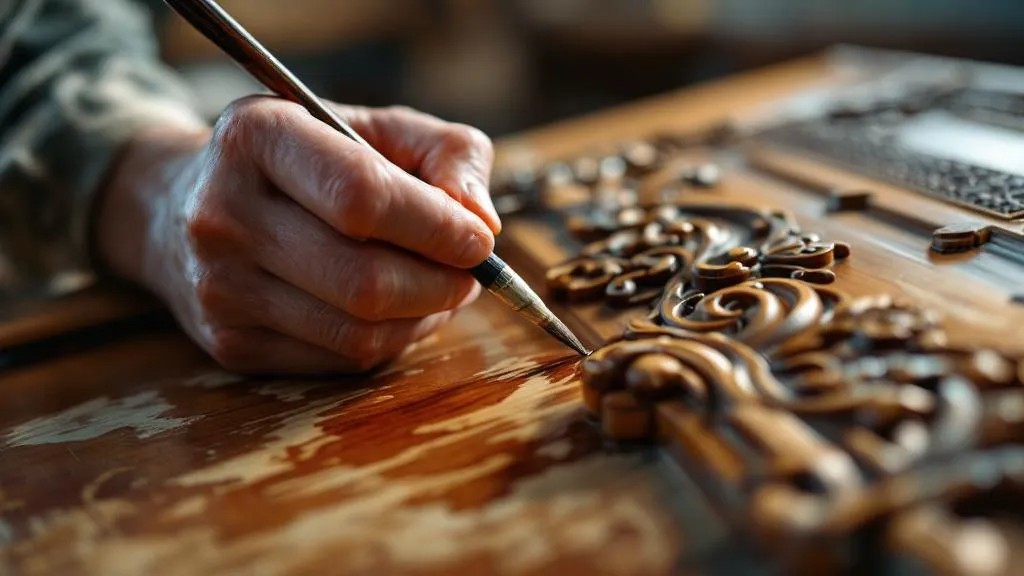
A key advantage of hand painting is the possibility of the meticulous working of hard-to-reach places. This is especially important for products with complex geometry: carving, chamfers, decorative recesses, end cuts. A brush makes it possible to distribute the material neatly and precisely, eliminating the runs and skips that often occur when spraying such surfaces. When working with stains and tinting oils, hand application makes it possible to create unique decorative effects, such as patination, glazing or an aging effect, which are practically impossible to reproduce by machine.
Hand-application techniques include the use of a brush, roller, and also a rag or pad. The brush (flat or round) is the main tool for applying varnishes and enamels, requiring high skill from the operator for the even distribution of material without visible streaks and bristle marks. The roller is more often used for painting large flat surfaces, such as worktops or furniture panels, providing a fairly high speed and an even layer, although it is not always suitable for obtaining a perfectly smooth, “mirror” gloss. The use of a pad or soft rag is indispensable when working with oils and waxes, allowing the compound to be rubbed deeply into the pores of the wood, emphasizing its natural texture and ensuring maximum eco-friendliness of the coating.
Despite the apparent simplicity, hand painting places high demands on the painter’s qualification. Uniformity of the layer, the absence of bubbles and runs, correct blending of the borders – all this is the result of many years of experience and a “feel” for the material. The speed of work is, of course, lower than with machine application, and the labor costs higher, which makes this method less economically advantageous for large-scale production. However, in the segment of premium, customized products, where individuality and handwork are valued, there is practically no alternative to hand application. This is a method where aesthetics and durability are created not by the power of a machine but by the precision and attention of a human.
The hand method also allows the craftsman to correct the process in real time. If the wood absorbs the tinting compound unevenly, the painter can instantly change the brush pressure or the concentration of the material on a certain area. This level of adaptivity is critically important when working with natural wood, which is always heterogeneous. Thus, handwork is not an outdated approach but a specialized, high-level technique for unique and complex projects.
Hand-spraying technologies: pneumatic and airless methods
Between classic brush application and full automation in a booth lies the method of hand spraying, which represents a compromise between productivity and control. This approach uses various equipment – from traditional pneumatic spray guns to modern airless systems – and makes it possible to apply paint and varnish materials in a thin, even layer, which is the key condition for obtaining high-quality gloss and matte coatings.
Pneumatic spraying (with compressed air) is the most common method. Its operating principle is that the material is fed to the nozzle of the spray gun, where it is mixed with compressed air and broken up into the smallest particles (atomization), forming a spray fan. This method is ideal for achieving a thin, “furniture-grade” quality of coating – smooth, without orange peel or brush marks. Various systems (HP, HVLP, LVLP) make it possible to optimize the process: HVLP (High Volume Low Pressure) systems use a large volume of air at low pressure, which significantly reduces material losses to overspray (mist) and ensures a high transfer coefficient of the coating onto the product. This is critically important for saving expensive materials and minimizing contamination of the working area.
Airless spraying (Airless) works on a different principle. The coating is fed to the nozzle under very high pressure (up to 250 atmospheres) by means of a piston or diaphragm pump, and atomization occurs solely through the sharp drop in pressure at the nozzle exit. Air is not used. This method is characterized by an extremely high application speed and is ideal for viscous materials and painting large areas, such as large wall panels, beams or massive furniture. The airless method provides a very dense, thick layer but is not always suitable for obtaining thin decorative coatings that require “jewel-like” precision and minimal orange peel.
Despite the use of mechanized tools, hand spraying remains the work of a highly qualified painter. The quality of the coating depends on many variables that the operator must control: material viscosity, air pressure, distance to the surface, hand movement speed, spray-gun tilt angle and the technique of “overlapping” layers. Any deviation from the norm leads to defects: runs, dry overspray, uneven layer thickness or “mottling” (differences in shade).
To obtain a stable and high-quality result, hand spraying must be carried out in a specially equipped zone with supply-and-exhaust ventilation and air filtration. This ensures the removal of the coating mist, prevents dust from getting onto the freshly painted surface and guarantees worker safety. Thus, hand spraying is a key link between traditional craftsmanship and industrial finishing quality.
Spray booths: the heart of serial production

A spray booth is not just a separate room, it is a high-tech complexcreated to provide ideal, controlled conditions for applying and drying paint and varnish materials. In conditions of serial and large-scale production of wooden products, such as furniture fronts, doors or parquet boards, the use of spray booths becomes not a luxury but a production necessitythat determines the quality, speed and economic efficiency of the process.
The main purpose of the booth is strict microclimate control. Ideal coating quality is possible only under certain, stable parameters of temperature and humidity. The booth is equipped with a powerful supply-and-exhaust ventilation system with multi-stage air filtration. The supply air passes through filters (usually ceiling ones) that remove the finest dust particles, preventing them from settling on the freshly painted surface. The exhaust system, often located in the floor (post-filters), effectively removes solvent vapors and excess mist (overspray) from spraying, ensuring clean air in the working area and safety for personnel.
Booths are equipped with climate-control and heating systems. The temperature inside can be regulated to accelerate the polymerization (drying) of the material. In drying mode, the supply ventilation can operate in recirculation mode with heating, which significantly reduces the curing time of the coating and makes it possible to move quickly to the next technological stage (sanding or applying the next layer). This is critically important for adhering to tight production schedules. A quality spray booth is a sealed space that eliminates the influence of external factors such as drafts, seasonal temperature fluctuations or dust from other workshops.
The efficiency of the booth is directly related to the type of equipment used. Inside, both hand spray guns and stationary robotic systems can be used. For large, flat parts, conveyor lines with automatic spraying installations are often used. In such cases the booth provides a continuous flow of clean air and a stable temperature, guaranteeing identical coating quality for each part in the batch.
In the end, the spray booth solves two key tasks: stability of quality (the coating turns out perfectly clean, without dust defects and with an even layer thickness) and increased productivity. The investment in a booth pays off through reducing defects, accelerating drying and the ability to use highly efficient coatings that require a strict temperature regime. This is the cornerstone of modern, high-quality production of wooden products.
Comparison of productivity and economic efficiency
The choice between hand labor and a spray booth is largely determined by the scale of production and the requirements for the product. From the point of view of productivity and economic efficiency, these two approaches are at opposite poles, and their correct comparison is critically important for planning any woodworking business.
Productivity in the context of hand painting (brush/pad) is the lowest. This is a labor-intensive process, dependent on the physical capabilities and speed of a single craftsman. Even when using hand spraying, an operator can process a limited number of parts per shift. The time spent moving the product, preparation, application and waiting for one layer to dry significantly increases the production cycle. Hand painting, by its very nature, does not scale, which makes it economically inexpedient for mass production.
On the contrary, a spray booth with a conveyor line and automated equipment provides orders of magnitude higher productivity. In a booth it is possible to process large batches of identical parts simultaneously. Thanks to controlled drying (forced blowing, raising the temperature), the time between applying layers is reduced from hours to tens of minutes. The stability of the process in the booth makes it possible to minimize changeover time and eliminate the human factor, which is a powerful driver of productivity.
From the point of view of economic efficiency, hand labor carries high direct costs associated with paying a highly qualified craftsman, but low capital costs (minimal equipment). The economic benefit of hand labor manifests itself only in the segment of exclusive, high-margin products, where the consumer is willing to pay for handwork and an individual approach.
A spray booth requires significant capital investment (the cost of the booth itself, ventilation systems, filters, heaters, compressors and spraying equipment). However, these costs quickly pay off in conditions of large production volume due to several factors:
- Reduced defects: Minimizing dust ingress and the stability of conditions reduce defects to a minimum.
- Coating savings: A high transfer coefficient (especially in HVLP systems and automated complexes) reduces material losses to overspray.
- Time savings: Accelerated drying reduces the overall production cycle and makes it possible to sell the finished products faster.
Thus, for the production of serial furniture fronts, doors or moldings investment in a spray booth is critically necessary. Hand labor remains the domain of restoration, exclusive orders and the finishing touch of complex, non-serial elements.
The ideal coating: factors affecting the final result

Obtaining an ideal paint and varnish coating on wood is a multifactorial process involving not only the application method but also the quality of surface preparation, the properties of the material itself and the environmental conditions. Ignoring any of these aspects will inevitably lead to defects that reduce the aesthetics and durability of the product.
1. Surface preparation: This is the most important stage. The wood must be sanded to the required roughness (the grit of the final sanding is determined by the type of coating), thoroughly dedusted and, if necessary, impregnated with antiseptic and priming compounds. Poor-quality sanding causes the wood texture or abrasive marks to be visible under the finish layer, and dust causes the appearance of “craters” and “orange peel.”
2. Quality and compatibility of the coating: The choice of varnish, enamel or oil must correspond to the operating conditions of the product. Outdoor work requires weather-resistant materials with UV filters; worktops require chemically and mechanically resistant polyurethane varnishes. It is extremely important to ensure the compatibility of all layers of the system: primer, tinting and finish coating. Incompatibility can cause rejection, cracking or loss of adhesion.
3. Application conditions: Air temperature and humidity affect the speed of solvent evaporation and, accordingly, the flow of the material and its adhesion. Application at too high humidity can cause clouding of the varnish (a whitish bloom), and at too low a temperature – an increase in viscosity and poor flow, which leads to the appearance of “orange peel.” As already discussed, the spray booth is created to stabilize these conditions.
4. Application technique: Regardless of whether a brush or spray gun is used, the material must be applied in an even, controlled layer.
- In hand spraying the key parameters are correct pressure, viscosity and the technique of “overlapping” the fans to ensure an even thickness without skips.
- When working with a brush it is important to avoid going over a layer that has already been applied and begun to dry, so as not to disrupt the flow process.
5. Interlayer processing: In most cases, intermediate sanding is required after applying priming and some finish layers. This removes the raised wood grain, eliminates minor defects and ensures better adhesion between subsequent layers.
The ideal coating is the result of strict compliance with the technology at every stage. In our practice we use process charts for each type of coating and material to eliminate variability and guarantee a consistently high result.
The use of oils and waxes: the specifics of handwork
Oils and waxes occupy a special place among finish coatings for wood. Unlike varnishes and enamels, which form a surface film, oils and waxes penetrate deep into the structure of the wood, impregnating and protecting the fibers from within. This finishing method is ideal for emphasizing the natural beauty and tactile properties of the material, and its application almost always requires handwork.
The operating principle of oils and waxes is based on their ability for deep penetration. Oil, often based on linseed or tung oil with the addition of natural resins and pigments, polymerizes inside the pores of the wood, making it water-repellent and resistant to soiling. The surface remains “breathing”, since the pores are not clogged with a film. This prevents the accumulation of moisture under the coating and is an advantage for solid products subject to seasonal fluctuations in humidity. Tactilely such a surface feels like “living” wood – warm, matte or semi-matte.
The specifics of hand application are due to the need to rub in the material.
- Application: The oil is applied generously to the surface with a brush, roller or pad.
- Dwell time: The material is given time (usually 10-30 minutes) for deep penetration into the pores.
- Removing excess: A critical stage. All excess that has not been absorbed into the wood must be thoroughly removed with a clean rag. If excess oil is left on the surface, it polymerizes, forming a sticky, uneven and unaesthetic layer.
- Rubbing in and polishing: Final polishing with a soft rag or pad gives the surface a velvety look and reveals the depth of the color.
The process of rubbing in and removing excess is practically impossible to automate well on a conveyor. Special polishing machines can be used for large flat surfaces (floors, worktops), but complex geometry, end faces and corners require exclusively handwork. It is precisely the craftsman who, using tactile sensations, determines whether the oil has been absorbed enough and whether the excess has been completely removed.
Key advantages of oil and wax finishing:
- Repairability: A damaged area can be easily restored with local sanding and reapplication, which is impossible for film coatings.
- Emphasizing texture: Oil “wets” the wood, making the texture more expressive and deep.
- Eco-friendliness: Natural compounds are often used, which is important for children’s furniture, kitchen utensils and interiors with high environmental requirements.
For this reason, in our practice oils and waxes are always applied by craftsmen by hand, guaranteeing the highest quality of the tactile and visual finish.
Automation in the booth: robots and conveyor systems
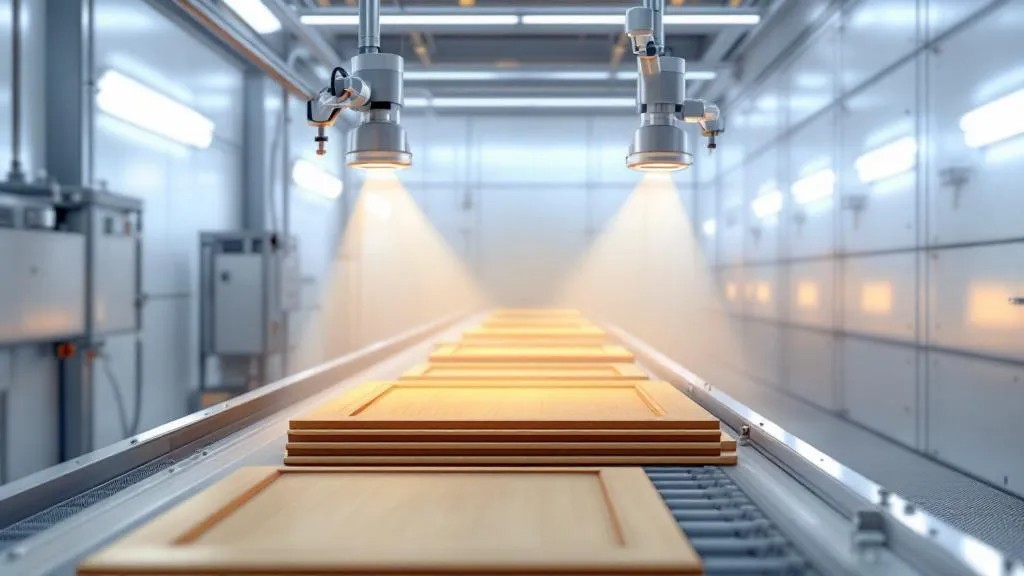
To achieve maximum productivity, quality stability and cost minimization in large-scale production of wooden products, the spray booth is integrated with high-tech automation systems: robotic complexes and conveyor lines. This makes it possible to move from hand labor to a continuous, controlled process.
Conveyor systems are the basis of automated painting. Products (fronts, doors, moldings) are fixed on special hangers or placed on a transport belt. This system ensures the continuous and stable movement of the parts through all technological zones:
- Loading/unloading zone: Where the parts are placed and removed.
- Dedusting/ionization zone: For removing static charge and the last dust particles.
- Application zone: Where the painting itself takes place.
- Drying/polymerization zone: A booth with a regulated climate.
Robotic painting complexes represent the pinnacle of automation. A robot manipulator equipped with a spray gun is programmed to perform a precise movement trajectory adapted to the geometry of a specific part. The advantages of robots are indisputable:
- Perfect repeatability: The robot applies material at the same speed, distance and angle, guaranteeing absolutely identical coating quality across the entire batch of products, which is impossible for a human.
- High speed: The robot’s working speed is much higher than that of a human painter.
- Material savings: Robots work with the maximum transfer coefficient, minimizing overspray and, therefore, the consumption of expensive coatings.
For flat products (for example, furniture panels), pass-through spraying machines or coating rollersare often used. The roller application method is ideal for uniform, very thin and fast painting of a plane, but is not suitable for profiled parts. Pass-through machines equipped with several spray guns apply material to the moving conveyor belt, ensuring the coating of all sides of the product.
Full automation requires high initial investment and complex technical maintenance. Introducing robots is expedient only with enormous volumes of serial production and a stable product range. However, for our business this provides a competitive advantage through speed, quality stability and the ability to work with the most demanding industrial coatings.
Preparation and cleanliness: critical conditions for a flawless finish
Regardless of which painting method is chosen – hand or booth – the quality of surface preparation and ensuring the cleanliness of the working area are critical factors that decisively affect the final result. Improper preparation or the presence of contaminants nullify all efforts and expenditure on expensive paint and varnish materials.
1. Sanding: The sanding process is not just leveling the surface, it is forming the basis for adhesion (bonding) of the coating. The grit of the final sanding must strictly correspond to the type of coating. For transparent varnishes and oils, finer sanding is required (for example, P180-P240) to avoid the visibility of scratches. For enamels a coarser abrasive is permissible. Insufficient sanding leads to unevenness, and excessive sanding to “burnishing” of the wood pores, which impairs the absorbency of tinting compounds.
2. Dedusting: After sanding, microscopic particles of wood dust and abrasive remain on the surface. The ingress of this dust into freshly applied varnish or enamel leads to the appearance of craters, spots and “orange peel”. Dedusting must be multi-stage:
- Mechanical: Use of compressed air (with filtration) or a vacuum cleaner.
- Static: Use of ionizing guns to remove the static charge that attracts dust.
- Final: Wiping the surface with special tack (tactile) cloths immediately before applying the coating.
3. Control of wood moisture: The wood must have a standardized production moisture content (usually 8-12%). If the wood is too damp, this can cause peeling, blistering or cracking of the coating during drying, since the moisture will strive to get out.
4. Cleanliness of the working environment: Hand spraying and brushwork require dedicated, isolated rooms. A spray booth ensures cleanliness through:
- Multi-level filtration of the supply air.
- Overspray removal systems (exhaust filters) that prevent recirculation of the aerosol.
- Maintaining slight excess pressure inside the booth to prevent dust being drawn in from outside.
Compliance with these rules is not an option but a necessary condition. In our workshop we pay preparation and cleanliness the same, and sometimes more, attention than the painting process itself, since a finished coating can only be as good as the prepared base.
Coating defects: causes and methods of prevention
Defects of the paint and varnish coating are an inevitable part of the production process; however, a high level of skill and strict technological control make it possible to reduce them to a minimum. Every defect has a clear cause, and understanding this cause is the key to preventing it.
Typical defects and their causes:
- Runs and sags:
- Cause: An excessively thick layer of material, too low a viscosity of the coating, too slow a movement of the spray gun or brush, or a low temperature in the room slowing the evaporation of the solvent.
- Prevention: Optimizing viscosity, controlling layer thickness, correct application technique.
- Orange peel:
- Cause: Poor flow of the material. May be caused by too high a viscosity, too rapid evaporation of the solvent (which does not allow the material to “settle”), too low a spraying pressure or too great a distance from the spray gun to the surface (dry overspray).
- Prevention: Using the correct thinner, adjusting the spraying pressure, ensuring the optimal temperature in the booth.
- Bubbles and craters (“fish eye”):
- Cause: Air entrapment during application (too intensive shaking of the coating), solvent trapped in a thick layer and evaporating from within, or, most often, surface contamination with grease, silicone or oil.
- Prevention: Thorough degreasing of the surface, use of clean tools, avoidance of silicone-containing products in the painting shop.
- Peeling (loss of adhesion):
- Cause: Poor surface preparation (insufficient sanding or the presence of dust), incompatibility of layers (for example, applying finish varnish to an unsuitable primer) or high moisture of the wood.
- Prevention: Strict compliance with process charts, checking the compatibility of coatings, controlling wood moisture.
- Traces of dust and lint:
- Cause: Poor-quality dedusting of the surface or dirty air in the working area/booth.
- Prevention: Regular replacement of filters in the booth, ionization, use of tack cloths.
In most cases, a defect requires complete or partial resanding and reapplication of the material. This leads to increased time and material costs.
A bulleted list: Key measures for preventing defects
- Systematic Viscosity Check: Mandatory monitoring of coating viscosity with a viscometer before each use to ensure optimal spraying and flow.
- Regular Filter Replacement: Timely maintenance of the ventilation system and replacement of ceiling and floor filters in the spray booth to maintain the cleanliness class.
- Use of Process Charts: Strict adherence to the instructions on drying time, temperature and layer thickness for each product.
Thus, an effective defect-prevention system includes: high-quality preparation, strict microclimate control, correct selection and preparation of the coating, and the high qualification of the operator, be it a painter with a brush or a robot setter.
Environmental and regulatory requirements for painting production
A modern woodworking enterprise cannot function without taking into account the strict environmental and regulatory requirements that concern both the materials used and the organization of the painting process itself. Compliance with these standards is not only a legislative requirement but also an important aspect of corporate responsibility and competitiveness.
1. Water-based coatings and VOC regulation: The main trend in recent decades has been the transition from organic-solvent (solvent-based) paint and varnish materials to water-based materials (acrylic, polyurethane). Water-based coatings contain significantly less volatile organic compounds (VOC). VOC regulation is a key environmental requirement, since these compounds are harmful to human health and pollute the atmosphere. The use of water-based systems, despite their increased sensitivity to humidity and temperature, reduces the toxic load on personnel and the environment and also simplifies waste disposal.
2. Waste disposal: All waste from painting production is subject to strict classification and disposal in accordance with local legislation.
- Liquid waste: Unused coating residues, solvents, washing liquids – require collection and transfer to specialized licensed companies for recycling or controlled destruction. Strictly prohibited is the discharge of such waste into the sewer.
- Solid waste: Contaminated filters, rags, coating packaging – are also classified as hazardous and require special disposal. In our work we implement solvent regeneration systems in order to reduce the volumes of liquid waste as much as possible.
3. Requirements for spray booths: From the point of view of occupational safety and ecology, spray booths must comply with strict standards:
- Ventilation efficiency: Ensuring the necessary air-exchange rate so that the concentration of solvent vapors in the working area does not exceed the maximum permissible concentrations (MPC).
- Emission filtration: Exhaust air, before being released into the atmosphere, must pass through highly efficient filters (usually carbon or water) to clean it of coating aerosol and vapors.
- Fire safety: Booths belong to zones of increased fire hazard and must be equipped with explosion-proof equipment and effective fire-extinguishing systems.
Compliance with these standards requires constant investment in modern equipment and staff training, but it guarantees the legality and safety of production and also allows us to use markings confirming the eco-friendliness of our products.
Development prospects: UV curing and powder coatings
The wood-finishing industry is constantly evolving, offering new technologies aimed at increasing productivity, improving environmental indicators and reducing energy consumption. Two key directions that are changing the approach to painting are UV-curable coatings and powder coatings for wood.
1. UV-curable (UV) coatings: These are liquid coatings that do not require thermal drying or lengthy polymerization in air. Curing occurs instantly – under the influence of ultraviolet radiation.
- Advantages:
- Highest speed: The drying time is just a few seconds. This makes it possible to reduce the production cycle from hours to minutes, which is critically important for conveyor production.
- Eco-friendliness: Most UV coatings have 100% dry residue and contain no volatile organic compounds (VOC).
- Strength: The resulting coating has exceptional hardness, resistance to scratches and chemicals.
- Application: This technology is ideal for flat or slightly profiled parts (furniture fronts, parquet, panels) that can pass under UV lamps on a conveyor. Complex geometry requires specially shaped UV lamps.
2. Powder coatings for wood (MDF): Traditionally, powder coatings were used only for metal, requiring a high temperature for polymerization. However, the development of low-temperature powder systems and special equipment (for example, with IR heating) has made this method accessible for wood materials such as MDF.
- Advantages:
- Zero VOC: The powder contains no solvents.
- High strength and layer thickness: The coating forms a very strong and uniform film in one pass.
- Maximum economy: Practically 100% of the material is used, since the powder that is not applied is collected and regenerated.
- Application: Ideal for uniform, serial MDF parts (for example, office furniture, retail equipment).
These innovative methods will not completely replace the traditional ones – handwork and classic spraying will remain indispensable for exclusive products and natural solid wood. However, they set the vector of development for large-scale, environmentally responsible and high-productivity production. The introduction of UV technologies into our process is the next logical step to increase the competitiveness of our products.