Sliding miter saw: the basis of precise wood machining in modern production
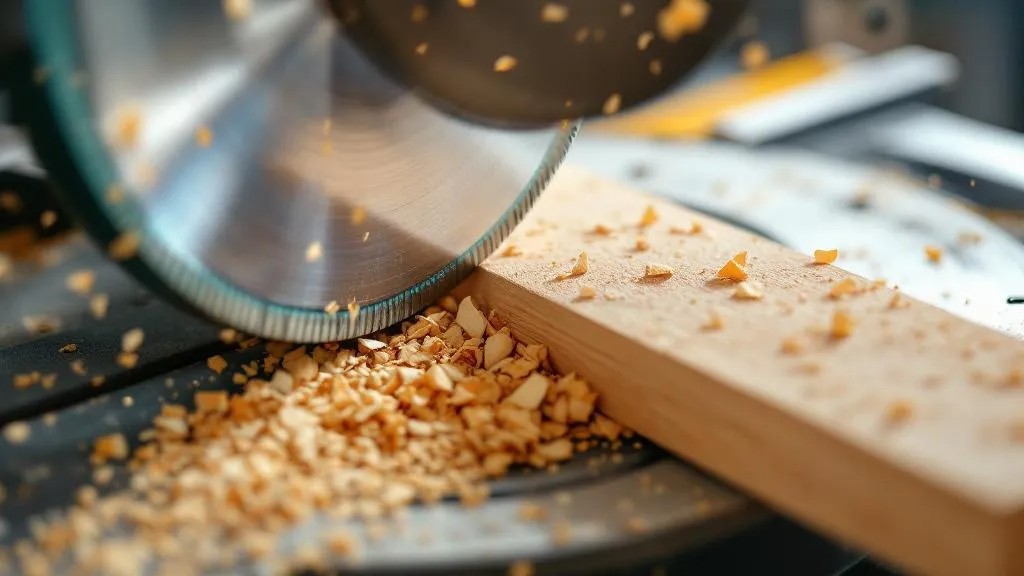
In the field of deep woodworking and high-precision manufacture of wooden products, the quality of the final product depends directly on the precision of the initial operations. Among the whole variety of machine tools used for cutting and preparing material, the sliding miter saw (often called simply a “slide miter”) occupies a special, irreplaceable place. This is not just a tool for cross-cutting; it is a precision machine capable of radically increasing the efficiency and accuracy of production processes, especially when working with wide and long blanks.
What is a sliding miter saw?
In essence, a miter saw is a specialized machine designed for the cross-cutting of boards, timber, moldings and other wooden elements at a strictly defined angle. What distinguishes the sliding model from an ordinary (stationary) miter saw is the presence of a horizontal rail mechanism or guide rods. It is precisely this mechanism, which allows the saw head to move horizontally relative to the fixed blank, that gives the tool its name and its main advantage. The saw blade does not simply lower onto the material but is also drawn through it, which makes it possible to process significantly wider blanks than with a standard miter saw with a fixed cutting point.
Fundamental importance for production.
In modern serial and small-batch production of furniture, joinery, window frames, doors and finishing elements, the accuracy of the cut is a critically important parameter. An inaccurate cut at the material-preparation stage inevitably leads to increased defects, the need for costly and lengthy rework and, ultimately, to a decline in the margin and competitiveness of the products. A sliding miter saw provides the degree of precision required for a perfect fit of joints, be they angle joints (45°), tenon joints or simple cutting to length.
Overcoming limitations.
For a woodworking enterprise regularly working with materials of various widths, the need for a sliding function is obvious. An ordinary miter saw can cope with narrow timber or trim, but as soon as it comes to wide furniture panels, worktop elements or wide floorboards, its capabilities are exhausted. The sliding mechanism makes it possible to produce a clean, single cut across the entire width in one pass, eliminating the need to turn the blank over or use less precise hand tools. This is a saving of time and a guarantee of uniformity of the parts.
Economic efficiency and productivity.
Investing in a quality sliding miter saw pays off through a sharp increase in labor productivity. The operator can quickly and accurately cut a large number of identical parts. The quick change of the tilt and swivel angle (functions possessed by practically all sliding models) makes it possible to switch promptly from one task to another. Reducing the time spent on cutting and minimizing material waste thanks to high positioning accuracy are the factors that make this tool economically advantageous for any professional workshop.
Cut quality and finishing cleanliness.
Quality sliding miter saws, fitted with appropriate saw blades and a rigid slide mechanism, provide flawless cut-surface quality. This is especially important for parts that will be visible in the finished product, or for those where the cleanliness of the end face is critical to the strength of the glued joint. The absence of chipping, tear-out and “fuzziness” on the end face is not just an aesthetic point but also a technical requirement for obtaining a reliable and durable product.
Versatility of application.
Although the tool’s main purpose is cross-cutting, its functionality is considerably wider. Thanks to the ability to adjust the swivel angle (miter angle) and the tilt angle (bevel angle) of the saw head, the sliding miter saw becomes a universal tool for preparing complex joints. The double bevelthat many modern models allow makes it possible to create “box” or “frame” joints without having to turn the blank over, which further increases the accuracy and speed of work.
Role in occupational safety.
One must not forget about safetyeither. Unlike hand-held circular saws, where it is difficult to ensure reliable fixing of the blank and stable guidance of the tool, a sliding miter saw involves rigid fixing of the material on the worktable and a controlled, predictable movement of the saw blade. This significantly reduces the risk of accidents and makes the cutting process more controlled and safe.
Operating principle and design of the slide mechanism
The heart of a sliding miter saw, distinguishing it from stationary models, is the horizontal-travel mechanism. Understanding its design and operating principle is critically important for the efficient use and maintenance of the machine. This mechanism determines how wide a board the machine can cut, and it also directly affects the accuracy, rigidity and durability of the entire assembly. The quality of the slide mechanism’s execution is a key factor by which a professional tool should be judged.
Main types of guides.
There are several design solutions for the slide mechanism, each of which has its own features. The two most common types are: two cylindrical guides (rods) and a mechanism based on a cantilever or levers. The design with two rods is the classic one and is the most common; in this case the saw head slides along two parallel, precision-polished steel rods. The second type, which uses a single massive cantilever or a lever mechanism, is often used to save working space, since it allows the saw to be placed close against the wall. In any case, the guides are subject to the highest requirements for straightness and hardness.
The role of the bearings and their quality.
To ensure smooth and precise sliding of the saw head along the guides, precision bearingsare used. Their quality directly affects the working process. Play, vibration or binding in the slide system are unacceptable, since they lead to an uneven cut, the appearance of steps or degraded surface quality. Professional models use high-quality linear bearings or ball bushings capable of withstanding significant dynamic loads and ensuring the stable position of the saw blade throughout the entire stroke.
Limiting the working stroke and locking.
The slide mechanism always provides the ability to lock the saw head at any point of the stroke. This may be necessary, for example, to perform an operation requiring repeated precise lowering of the blade in the same spot, or when the saw needs to be used as an ordinary (non-sliding) miter saw. A reliable and easily operated locking mechanism is a sign of a well-thought-out design. In addition, limiters are installed that prevent the saw head from moving beyond the working range, ensuring safety.
The problem of wear and maintenance.
Like any moving mechanism, the slide system is subject to wear. Dust and fine shavings are the main enemies of the guides. Professional machines are often equipped with guide-protection systems (for example, bellows covers or cleaning brushes) that minimize the ingress of contaminants onto the working surfaces. Regular maintenance, cleaning and lubrication of the guides are mandatory procedures for maintaining the tool’s accuracy. Ignoring these requirements inevitably leads to a deterioration in the smoothness of the stroke and, as a result, to a decline in cut quality.
Effect on the width of cut (the slide).
The main characteristic determined by the slide mechanism is the maximum cutting width. The longer the working stroke of the saw head, the wider the board that can be processed. Manufacturers state this parameter for cuts at 90° and at 45°. It is precisely the ability to process wide blanks (up to 300-400 mm and more) that makes the sliding miter saw indispensable in the manufacture of furniture and joinery, where wide glued panels are often used.
Damping and vibration absorption.
When working at high speeds and processing hardwood species, vibrationsinevitably arise. A quality slide mechanism not only ensures sliding but also effectively absorbs these vibrations, transmitting them to the machine’s massive base. The rigidity of the guides’ construction, their diameter and the way they are fastened to the frame all play a role in ensuring the stability of the cut. Any movement of the saw blade during cutting can lead to inaccuracy and a deterioration in surface cleanliness.
Calibration and adjustment.
Professional models of sliding miter saws provide the ability for precise calibration of the entire mechanism. This includes adjusting the parallelism of the guides relative to the table, the perpendicularity of the blade at the extreme points of the stroke and the elimination of possible play. The ability for precise adjustment is what distinguishes industrial equipment from domestic equipment. Regular checking and correction of the settings are critically important for maintaining the accuracy stated by the manufacturer under conditions of intensive use.
Comparison with other cutting methods.
Unlike a table saw or a hand-held circular saw, a sliding miter saw provides a controlled, repeatable and single cut across the entire width. A saw table requires pushing the blank through, which can cause displacement, while a hand-held saw always depends on the steadiness of the operator’s hand. The slide mechanism, on the other hand, allows the blade to be moved smoothly and with constant force through the material, ensuring the most accurate and clean end face possible. This is a key advantage in the context of manufacturing parts with minimal tolerances.
Cut precision and repeatability: the basis of product quality
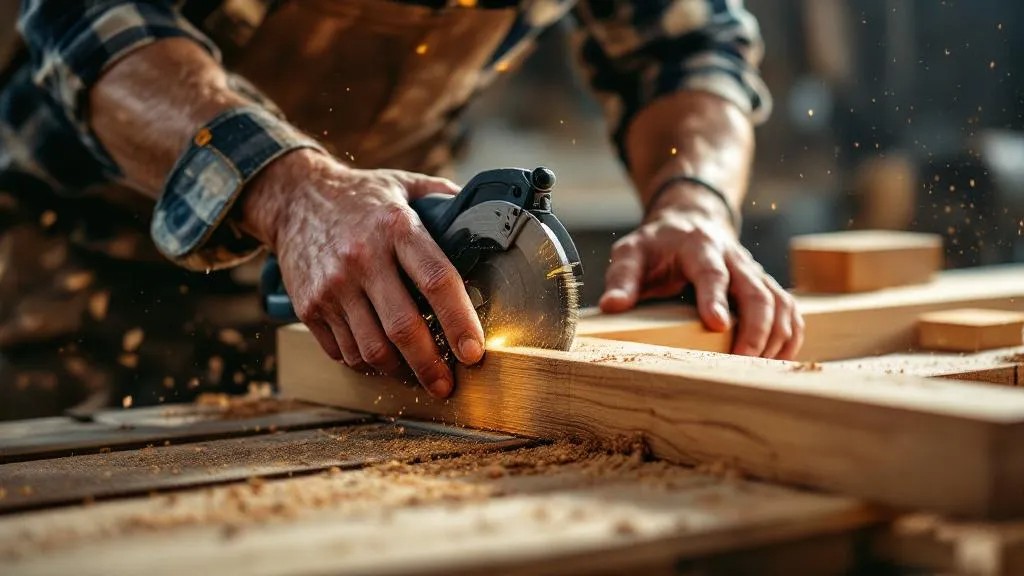
In the context of professional woodworking, the term “precision” has not merely a theoretical but a wholly practical meaning, directly affecting the functionality and appearance of the finished product. The sliding miter saw is a tool that is by its very nature created to ensure maximum precision and, no less importantly, repeatability of the cut. These two factors are the cornerstones in the production of high-quality joinery and furniture.
Precision as an assembly factor.
If parts intended for joining are cut with a deviation of even a fraction of a millimeter, this will inevitably lead to problems during assembly. At best, the joint will have a visible gap that has to be masked with filler or an excessive glue seam. At worst, the parts simply will not come together, requiring rework. A sliding miter saw ensures strict perpendicularity (90°) and angular accuracy (45°, 22.5°, etc.), which is vital for structures such as door and window frames, furniture carcasses or drawer frames.
Repeatability in serial production.
Repeatability is the machine’s ability to produce a multitude of parts of absolutely identical size and shape with minimal operator intervention. In conditions of serial manufacturing of products, for example when cutting thousands of elements for a furniture set, manual marking and cutting become inefficient and inaccurate. A sliding miter saw equipped with precision stops and measuring systemsallows the operator to quickly fix the required length and produce identical parts one after another.
The scale of deviations and their consequences.
Even an insignificant deviation of 0.5-1.0 mm on a single part can become critical if it accumulates in a complex product. For example, in a long frame with many crosspieces, an inaccurate cut of each of them will lead to a cumulative deviation of several millimeters on the final element. The sliding miter saw minimizes this risk, since its design (a rigid slide mechanism, a cast table) is intended to eliminate play and vibration, which are the main sources of errors.
Measuring systems and laser pointers.
To increase precision, modern professional miter-saw models are equipped with integrated measuring scales with fine adjustment, as well as laser cut-line pointers. A laser beam precisely coinciding with the plane of the blade allows the operator to visually monitor the position of the blank relative to the cut line, which significantly reduces marking time and increases the positioning accuracy of the material. At the same time it is important that these systems are correctly calibrated and regularly checked.
The role of the rigidity of the frame and table.
The accuracy of a miter saw depends not only on the slide mechanism but also on the overall rigidity of the construction. A massive, cast frame and a heavy worktable ensure stability and prevent displacement or vibration under load. Lighter, domestic models, on the contrary, may “spring” or vibrate, which is directly reflected in the quality and accuracy of the cut. Under production conditions, the reliability and massiveness of the construction is a direct guarantee of consistently high machining quality.
Compensating for the human factor.
Even an experienced craftsman can make a mistake in manual marking or hold the blank inaccurately. A sliding miter saw minimizes the influence of the human factor. Powerful clamps reliably fix the blank, and accurate, readable scales of the angle allow the operator to set the required parameters quickly and without error. Once the angle is fixed, the cutting mechanism ensures its precise reproduction across the entire batch of parts.
Calibration and verification.
An important part of working with a professional tool is regular calibration. All angles (90° to the table, 0° swivel, etc.) must be periodically checked with verification squares and angle gauges. The ability for quick and precise adjustment is an indicator of a tool’s class. In a production cycle where every minute counts, the ability to promptly check and correct the settings is critical for maintaining stable accuracy throughout the entire service life of the equipment.
Aesthetics and functionality of the finished product.
Ultimately, the precision provided by the sliding miter saw directly affects the aesthetics and functionality of the finished product. Perfectly matched frame corners, the absence of gaps in furniture joints, the accuracy of the elements’ dimensions – all these are signs of professional craftsmanship and high product quality, which ultimately increases its market value and the manufacturer’s reputation.
Extended working range: working with wide blanks
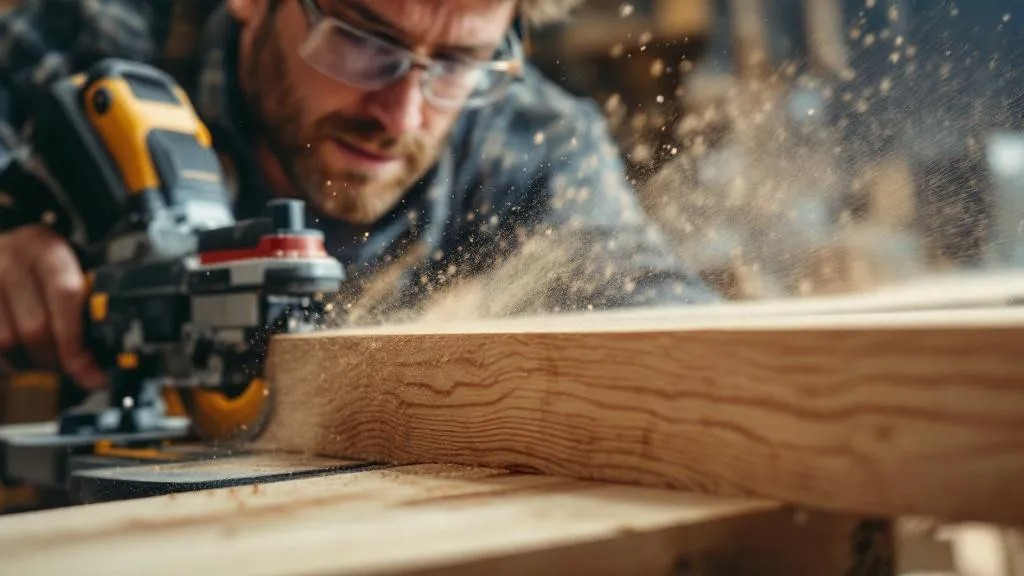
The key and perhaps most obvious advantage of a sliding miter saw is its extended working range, or, in other words, its ability to process significantly wider blanks compared to a classic miter saw without a slide mechanism. This capability is critically important for woodworking enterprises specializing in the manufacture of furniture, interior elements and wide joinery products.
Limitations of a standard miter saw.
A standard miter saw (without a slide) has a fixed axis of rotation, and its maximum cutting width is limited by the radius of the saw blade and the design of the protective guard. As a rule, even when using a blade of large diameter (for example, 305 mm), such a saw can cut a board no wider than 150-180 mm. As soon as work involves wide glued panels, wide windowsills, staircase steps or worktop elements, a stationary miter saw becomes ineffective.
The slide principle and range extension.
It is precisely the slide mechanism (the sliding of the saw head along horizontal guides) that makes it possible to overcome this limitation. Since the saw blade moves across the entire width of the blank, the maximum cut is determined not by the radius of the blade but by the length of the slide mechanism’s stroke. As a result, professional sliding miter saws with a 305 mm blade can provide a clean cross-cut of blanks 300-405 mm wide in one pass, depending on the model and design.
Application in furniture manufacturing.
For furniture manufacturing, where glued panels 300 mm wide and more are often used to make fronts, shelves or sides, the sliding miter saw is a mandatory tool. The need to turn a wide board over in order to cut it from both sides on an ordinary saw not only increases working time but also sharply reduces accuracy. It is practically impossible to align two cut lines perfectly, which leads to the appearance of a “step” in the center. The slide eliminates this risk, ensuring a single, clean cut.
Working with moldings.
Even when working with narrow but long moldings (trims, skirtings, cornices), the slide capability can be useful. If a long, thin mitered cut is required (for example, for a “mitered” joint at 45°), the slide makes it possible to do this smoothly and without jerks, which is extremely important for minimizing chipping on the surface of the material. In addition, when cutting wide decorative moldings with a profile, the slide ensures the preservation of the profile geometry along the entire cut line.
Effect on safety.
The ability to cut a wide board in one pass also increases safety. The operator does not need to perform additional manipulations with a heavy, bulky blank in order to turn it over for a second cut. The rigid fixing of the material on the machine table with clamps remains unchanged throughout the entire cutting process, which reduces the likelihood of displacement and of the operator’s hand coming into contact with the blade.
Choosing a tool by width of cut.
When choosing a sliding miter saw for a specific production, the maximum width of cut is a key parameter. If the enterprise regularly works with 300 mm blanks, it is necessary to choose a model that reliably provides a reserve in width, for example 320-350 mm. This will allow comfortable work without the risk of exceeding the machine’s capabilities. Manufacturers often state this parameter so that operators can accurately assess the tool’s capabilities.
Limitations on thickness.
It should be noted that the slide mechanism, although it extends the cutting width, does not always substantially affect the maximum cutting thickness. This parameter depends more on the diameter of the saw blade and the design of the protective guard itself. However, thanks to the deeper plunge of the blade afforded by the slide, some models can provide a thicker cut compared to a stationary miter saw with the same blade diameter, especially when cutting at an angle.
Using depth stops.
Another important function related to the working range is the cut-depth limiter. It makes it possible to use a sliding miter saw not only for through cuts but also for grooving, rebating or non-through cuts (for example, for half-lap joints). This significantly extends the machine’s functionality, turning it from a purely miter tool into a universal machine for certain milling operationsperformed across the entire width of the blank.
Functionality of angle joints: miter and bevel (Compound and Bevel)
The uniqueness of the sliding miter saw in the context of joinery and furniture production lies not only in its ability to process wide blanks but also in its multi-axis adjustment, which makes it possible to perform complex angle joints – miter (rotation of the table, Miter) and bevel (tilting of the saw head, Bevel), often simultaneously. This ability to perform compound cuts (Compound Cuts) makes the sliding miter saw indispensable in the manufacture of frames, boxes and decorative elements.
Rotation of the table (miter).
The miter function involves rotating the machine’s worktable relative to the fixed base and the operator. This makes it possible to cut a blank at any horizontal angle, usually from 0° to 45° in both directions, and in some models up to 60°. The most common angle is 45°, 45°used to join two parts “at a miter” in a right angle (90°). The accuracy of the miter setting is critically important, since even a small deviation will lead to a gap in the angle joint. Professional machines have clear scales with detents at the most frequently used angles.
Tilting of the saw head (bevel).
The bevel function consists in tilting the saw head and blade relative to the vertical axis. Usually a tilt of up to 45° is possible. 45-50°This capability makes it possible to create on the end face of the blank beveled edges (chamfers). The bevel is often used in combination with the miter to create complex angle joints (for example, when framing openings or manufacturing polyhedral products). The presence of a double bevel function (Double Bevel), where tilting is possible in both directions (left and right), significantly speeds up the work, since it eliminates the need to turn a long blank over.
The compound cut (Compound Cut).
The most complex and important capability is the compound cut, that is, the simultaneous use of miter and bevel. This is necessary for the manufacture of double-angle joints. For example, when making conical or pyramidal elements, or when trimming the ends of beams that converge not only horizontally but also vertically. Calculating and performing such cuts requires high machine accuracy. A sliding miter saw provides the necessary stability and precision of settings to perform such complex geometric tasks.
Application in the manufacture of frames and boxes.
The manufacture of frame structures (door frames, window sashes, picture frames) is a classic example of the application of the compound cut. It is necessary to achieve a perfect fit of the end faces at a 45° angle (miter) and, possibly, to make a bevel for decorative or technological purposes. The slide makes it possible to perform this precise cut even on wide profiles, guaranteeing that a decorative profile or bead will be perfectly matched across its entire width.
Clarity and ease of adjustment.
In a professional environment, where the speed of switching from one operation to another is important, the ergonomics and clarity of the angle-adjustment mechanisms play a big role. A quick but reliable locking of the table’s swivel angle, the presence of micro-adjustment for fine fitting and the absence of play in the tilt mechanisms – all these are signs of a high-class tool that ensures the repeatability of complex angles without wasting time on readjustment.
Calibration of angles.
As already mentioned, regular calibration of the angle scales is a mandatory condition for maintaining accuracy. The operator must periodically check that when 45° is set on the scale, the actual cutting angle really does correspond to 45° with the minimum permissible deviation. Using electronic angle gauges in addition to the built-in scales makes it possible to achieve maximum accuracy.
Comparison with manual methods.
Attempting to perform such complex and precise compound cuts with a hand tool or on a less specialized machine (for example, a benchtop circular saw) is extremely inefficient and unreliable. Only the rigid fixing of the material and the precision mechanism of the saw blade’s movement of a sliding miter saw make it possible to guarantee that each cut will be made strictly to the specified geometry.
Creating complex design elements.
In addition to standard structures, a sliding miter saw is necessary for creating complex design elements. For example, for the manufacture of polyhedral columns, octagonal frames or decorative friezes, where a precise and repeatable cut at non-standard angles is required. The ability to adjust all axes quickly and precisely allows the craftsman to move easily to the manufacture of unique, non-standard products.
Cut quality and cleanliness: reducing the need for rework
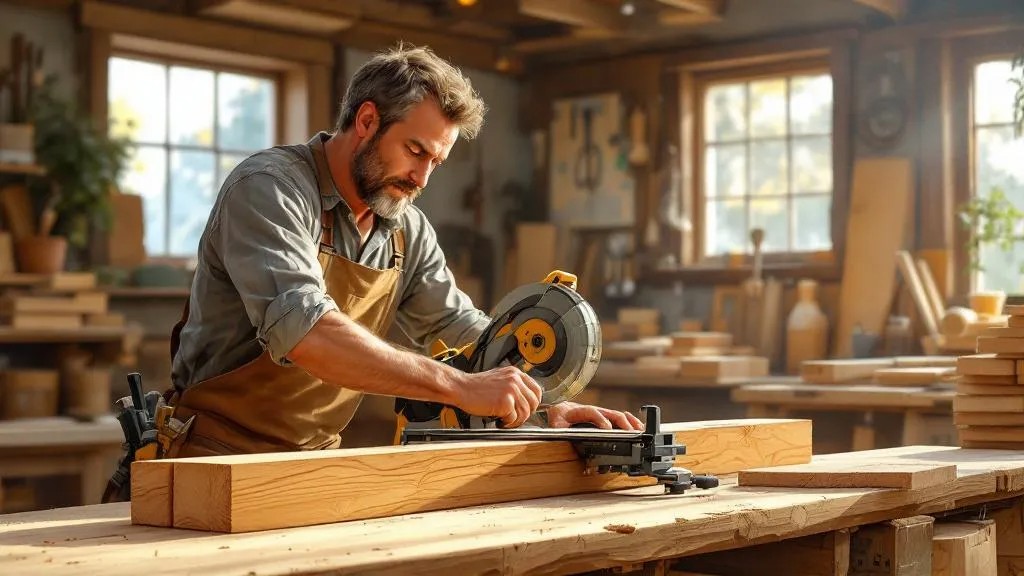
The cleanliness and quality of the cut surface is a parameter that directly affects the subsequent stages of processing and, ultimately, the labor costs and cost price of the finished product. A sliding miter saw, with correct setup and the use of an appropriate saw blade, is capable of producing a cut that minimizes or completely eliminates the need for additional sanding or rework of the blanks’ end faces.
The influence of speed and stability.
High cut quality is achieved through a combination of several factors in which the sliding miter saw surpasses other tools: high blade rotation speed, stability of the blade’s position (absence of run-out) and a controlled, uniform feed speed (the slide). When the operator smoothly draws the blade through the material, each saw tooth removes a uniform chip, which prevents tear-out, chipping and the formation of a “fuzzy” edge.
The choice of saw blade.
A key role in cut cleanliness is played by the correct choice of saw blade. For working with hardwood species, veneered or laminated materials, a blade is needed with a large number of carbide teeth (from 60 to 100 and more) and special geometry (for example, a trapezoidal tooth with a positive or negative rake angle). A quality sliding miter saw makes it possible to use such blades at maximum efficiency.
The problem of chipping at the edges.
Chipping is one of the most common defects when cutting, especially on the upper and lower edges of the material (at the point where the saw blade exits). The sliding miter saw, thanks to the ability to lower the blade smoothly and in a controlled manner, makes it possible to minimize the impact load on the fibers. In addition, many models allow the installation of additional sacrificial backings or inserts in the worktable, which support the wood fibers right up against the blade, preventing chipping.
The role of the mechanism’s rigidity.
Any lateral run-out or play of the saw blade (even microscopic), arising from insufficient rigidity of the slide mechanism or poor-quality bearings, immediately leads to a deterioration in surface cleanliness. The blade begins to “wander” in the cut, leaving an uneven, wavy trace. Professional sliding miter saws with massive guides and precision bearings guarantee that the blade maintains its plane throughout the entire cut.
Reducing finishing time.
The main economic benefit of a clean cut lies in reducing the need for rework. If the end face is perfectly clean, it can be used immediately for gluing or assembly, bypassing the stage of manual or machine sanding of the end faces. This significantly saves working time and consumables (sanding paper), which is critically important in serial production, where every minute saved is multiplied by thousands of parts.
Working with tricky materials.
A sliding miter saw is indispensable when working with tricky materialssuch as veneered panels, laminated particleboard or MDF. These materials are especially prone to chipping of the decorative coating. Smoothly guiding the blade and the ability to use high-precision fine-tooth blades make it possible to obtain a perfectly clean cut without damaging the laminate or veneer, which directly affects the appearance and quality of furniture fronts.
Accuracy of glued joints.
A quality glued joint requires maximum contact of the surfaces being glued. An uneven or “fuzzy” end face cannot ensure tight contact over the entire area, which reduces the strength of the glue seam. A clean, even end face obtained on a sliding miter saw guarantees the maximum contact area and, as a result, high strength and durability of the furniture structures.
Reducing waste.
Using a quality sliding miter saw also helps to reduce the amount of waste. A poor-quality cut requiring repeated trimming to correct the defect often means that an additional part of the blank has to be cut off, sometimes exceeding the permissible tolerance on length. A clean cut the first time preserves the useful length of the material, which is especially important when working with expensive wood species.
Productivity and efficiency of the work process
In conditions of an intensive production cycle at a woodworking enterprise, the productivity and efficiency of the working equipment are decisive factors of success. The sliding miter saw is a tool that, thanks to its design and functionality, provides a significant gain in the speed and efficiency of material-cutting operations.
Speed and single-stage cutting.
The most direct contribution to productivity is made by the cutting speed. The ability to cut a wide board in one pass (thanks to the slide) rather than two (with a turnover) reduces the time per operation by half and more. In addition, the operator does not need to spend time precisely aligning the second cut line. On the scale of a workshop, where hundreds of blanks are cut daily, this time saving becomes critically important.
Fast readjustment of angles.
Professional models of sliding miter saws are designed with the need for a quick change of cutting anglein mind. The swivel and tilt locking mechanisms are equipped with quick-clamp systems and fixed detents for standard angles (90°, 45°, 22.5°). This allows the operator to switch literally in seconds from cutting to length to cutting at an angle, which is extremely important when manufacturing a varied range of products or when working with batches of parts requiring different angle joints.
Optimizing the workplace.
Integrating a sliding miter saw into a stationary work station with table extensions and stops turns it into a highly efficient cutting center. The extensions make it possible to work with long timber and boards, and adjustable stops (which can take the form of digital measuring systems) guarantee that each subsequent part will have a precisely defined length without the need for manual marking and measuring.
Serial production and repeatability.
For the serial production of furniture or moldings, the high repeatability of the cut is a direct synonym for productivity. After setting the stop to the required length, the operator can simply feed the material, fix it and cut, knowing that each part will be identical. This eliminates downtime for quality control and part fitting.
Reducing operator fatigue.
The ergonomic design and the smoothness of the slide mechanism’s stroke also contribute to increased productivity by reducing the operator’s physical fatigue. The easy sliding of the saw head requires minimal effort, unlike having to push a heavy blank through a saw table or work with a bulky hand saw. Less fatigue means more consistent quality of work throughout the entire shift.
Minimizing defects.
As already mentioned, the precision of the sliding miter saw minimizes the percentage of defects. Every part cut correctly the first time with the required accuracy is saved material and working time that is not spent on rework. On the scale of a large production, a reduction in defects of a few percent gives an enormous economic effect.
Flexibility and multifunctionality.
The machine’s ability to perform both straight cross-cutting and complex compound cutsmakes it possible to use the same tool for a wide range of tasks, avoiding the need to switch to other equipment. This multifunctionality saves the time that would be spent moving material and readjusting other machines.
The importance of the dust-extraction system.
An integral part of an efficient work process is the dust-extraction system. A quality sliding miter saw is equipped with efficient ports for removing shavingsthat, when connected to an industrial vacuum cleaner or extraction system, maintain the cleanliness of the workplace and ensure better visibility of the cut line. Cleanliness is not only safety but also increased accuracy and speed of work.
Operational safety: a managed and controlled process
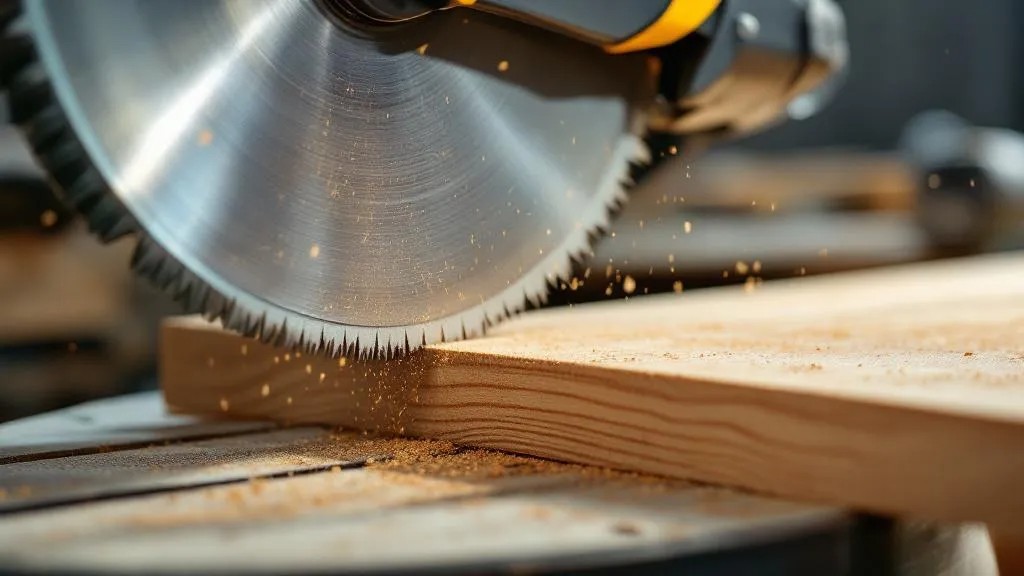
In professional woodworking, occupational safety is not merely a requirement but a prioritythat must be built into the design of every machine. A sliding miter saw is by its very nature one of the most safe tools for cutting, provided it is used and maintained correctly.
Stationarity and fixing.
A key safety factor of a miter saw is its stationarity. The machine is usually fastened to a massive workbench or stand, which excludes its displacement during operation. In addition, the blank is always reliably fixed on the worktable with built-in or additional clamps. Unlike hand tools, where the blank is held by hand, here the material is immobilized, which eliminates the risk of its sudden shift and contact with the saw blade.
A reliable protective guard.
The saw blade is always covered by an automatically retracting protective guard. The guard fully covers the blade in the upper (non-working) position. When the saw head is lowered, the guard automatically rises, exposing only the part of the blade that is in the cutting zone. This mechanism is the primary line of protection of the operator from contact with the rotating blade.
Controlled movement of the blade.
Unlike a table saw, where the operator pushes the blank toward the blade, or a hand saw, where the operator guides the tool, on a sliding miter saw the movement of the blade is fully controlled and directed by the slide mechanism. The saw head moves along a strictly defined trajectory. The operator only controls the smoothness of the feed and the lowering/raising of the head, which makes the cutting process predictable and controlled.
An instant braking system.
Professional models are often equipped with an electronic instant braking system (Brake System). This system allows the saw blade to stop practically instantly (within 1-3 seconds) after the power is switched off. This significantly reduces the risk of contact with the blade at the moment when it is still rotating by inertia, which is especially important during frequent, repetitive operations.
The position of the operator’s hands.
With correct use, the operator’s hands are always outside the dangerous zone of the cut and away from the line of the blade’s movement. One hand, as a rule, controls the feed handle, and the other may hold the blank, but exclusively outside the cut line and only after the material is fixed. The use of clamps makes it possible for the operator’s hands not to be in the immediate vicinity of the blade during cutting at all.
Protection against kickback.
The design of the miter saw, in which the saw blade cuts with a downward and forward motion (in the direction of the material), practically eliminates the possibility of kickback, which is a frequent hazard when working on table saws. Kickback occurs when the material pinches the blade and the blank is thrown back at the operator. On a miter saw this phenomenon is reduced to a minimum.
Vibration isolation and ergonomics.
Quality vibration isolation of the handle and the overall ergonomics of the tool also affect safety. Reducing vibration reduces fatigue in the operator’s hands and allows them to maintain control over the tool over a long period of work, which is an important factor in preventing errors.
Requirements for lighting and cleanliness.
An important aspect of safety is ensuring good visibility of the cut line. Many models are equipped with built-in work-zone lighting or a laser pointer. Cleanliness of the workplace and the effective removal of shavings are also necessary to avoid the operator slipping or the mechanisms becoming clogged.
It is important to remember: safety when working with a miter saw, as with any other professional tool, requires strict compliance with the instructions, the use of personal protective equipment (safety glasses, ear protection) and regular checking of all protective mechanisms.
Criteria for choosing a professional sliding miter saw for production
Choosing a sliding miter saw for a professional woodworking company is an investment decision requiring a careful analysis of production needs and the equipment’s technical specifications. A mistake in the choice can lead to limitations in the work process, a decline in quality and rising operating costs.
Maximum width and depth of cut.
This is a fundamental criterion. Determine the widest blank (boards, panels) that you plan to process regularly, and choose a model with a reserve in slide travel. If you work with large-section timber, the maximum depth of cutis also important. Remember that angle cuts (45° miter and bevel) reduce both of these parameters.
Quality and design of the slide mechanism.
Assess the rigidity and smoothness of the stroke of the mechanism. Choose models with massive, thick guides or reliable cantilever systemsequipped with high-quality bearings. Play or binding is a direct sign of low quality and future problems with accuracy. Preference should be given to designs with minimal maintenance of the guides or with good protection of them from dust.
Accuracy of the angle mechanisms (bevel and miter).
Check the accuracy and repeatability of the angle locking. A professional machine should have clear, easily readable scales, reliable detents at standard angles and the ability for fine micro-adjustment. The presence of a double bevel function (Double Bevel) significantly increases productivity and ease of work. The adjustment mechanisms should be metal and reliablerather than plastic.
Power and type of motor.
For intensive work with hardwood species and large blanks, a powerful motor is required (as a rule, with a direct drive or a belt drive, but a reliable one). Pay attention to the presence of a soft-start system, which reduces the starting current and the jerk of the tool, and to a speed-stabilization system under load, which is critically important for cut cleanliness.
Ergonomics and ease of use.
Assess the comfort of the handle, the placement of the controls and the accessibility of the locking mechanisms. In conditions of serial work, these factors affect the speed and fatigue of the operator. The presence of built-in lighting and a laser pointer improves control and accuracy. A quick blade-change system is also an important convenience.
Efficiency of dust extraction.
Make sure that the miter saw has an efficiently designed dust-extraction system. A wide port and the correct placement of the openings for removing shavings, especially in the cutting area, are necessary for maintaining cleanliness and visibility. It is desirable for the port to be compatible with standard industrial extraction systems.
Reliability and brand.
Choose equipment from well-known manufacturersspecializing in professional tools. As a rule, such brands guarantee high-quality components, the availability of spare parts and technical support. Read the reviews of other production companies, not just private craftsmen.
Additional accessories and systems.
Pay attention to the ability to use additional accessories:
- Table extensions and adjustable stops.
- Clamps and other devices for fixing.
- Digital measuring systems or angle displays.
Price and cost of ownership.
Compare not only the initial pricebut also the cost of ownership, which includes potential costs for repairs, replacement of wear parts (bearings, brushes) and the cost of high-quality saw blades. A more expensive but reliable tool often turns out to be more advantageous in the long term because of its durability and less downtime.
Prospects for use and integration into the production line
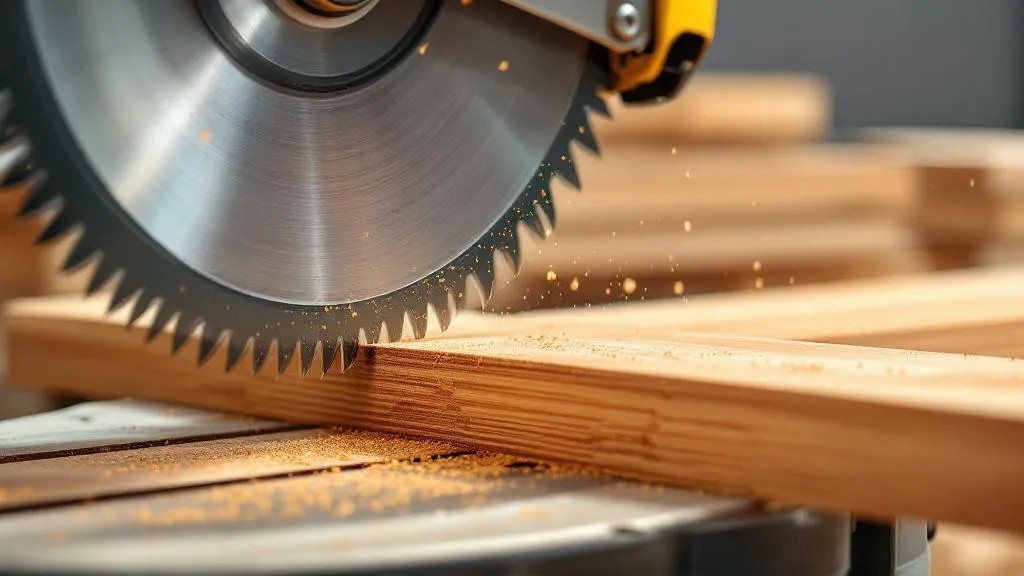
A sliding miter saw is not just a separate machine; it is an element that must be harmoniously integrated into the overall production line of a woodworking enterprise. Its role and prospects for use extend far beyond simple cross-cutting, making it a key node for preparing material in high-precision production.
The role of the material-preparation node.
In an ideal production scheme, the sliding miter saw functions as the first high-precision machine after the primary cutting (for example, on a band saw or panel saw). It is here that the raw material (a board or timber) receives its first precision end face and is cut to a defined length with minimal tolerances, being prepared for further operations – gluing, profiling on a milling machine, drilling or assembly.
Modular organization of the workplace.
For maximum efficiency, the sliding miter saw should be installed on a stationary modular system. This system includes:
- A massive, vibration-damping workbench.
- Table extensions on both sides (the length should correspond to the maximum length of the blanks being processed).
- A system of measuring stops, preferably with a digital indicator, for quickly and accurately fixing the length.
Such an organization of the workplace turns the miter saw into a mini cutting centerthat makes it possible to process material quickly, accurately and safely.
Integration with automated systems.
At large enterprises using CNC equipment, the precision provided by the sliding miter saw becomes critically important for the subsequent stages. If the blank does not have exact dimensions on entry, this can disrupt the operation of an automatic milling center or drilling machine. The miter saw provides the necessary single standard of part preparation.
Specialization and diversification of production.
The presence of a sliding miter saw opens up for the company the possibility of diversifying production. Thanks to its capability for complex compound cuts, it is possible to master more complex and high-margin products, such as designer furniture, complex staircase railings, exclusive windows and doorsthat require maximum precision of angle joints.
Staff training.
Fully unlocking the potential of a sliding miter saw requires qualified personnel. It is necessary to conduct regular training of operators not only in the technique of safe work but also in the methods of precise angle adjustment, machine calibration and the correct choice of saw blades for various materials (solid wood, MDF, laminate).
Long-term reliability and repairability.
The prospects for using the tool in the long term depend on its repairability. When choosing a tool, it is necessary to consider the availability of spare parts (especially for the slide mechanism and the motor), the availability of service support from the manufacturer and the ability to carry out precise adjustment after long-term use or repair.
The environmental aspect and disposal.
In the context of modern requirements, one should also take into account the environmental aspect. An efficient dust-extraction system not only increases safety but also makes it possible to collect and dispose of wood waste centrally. In addition, a reduction in the percentage of defects (due to precision) is a direct measure of saving natural resources.
Thus, the sliding miter saw is not just a cutting tool. It is a technological core at the beginning of the production cycle that guarantees precision, quality and high productivity in the manufacture of a wide range of joinery and furniture products.