Real benefits of automation in woodworking and common myths

In woodworking and the manufacture of wooden products, time does not stand still. Methods that yesterday seemed the pinnacle of technology may already be inefficient or simply outdated today. Today’s market demands from manufacturers precision, speed and consistently high quality of products. And it is at precisely this moment that the spotlight turns to automation.
Automation is not merely a nod to fashion or a way to show off high-tech equipment. It is a strategic decision capable of radically transforming the production process, taking a company to a new level of profitability and securing it a confident place among the leaders of the industry. However, like any major technological transformation, automation has become surrounded by numerous myths and misconceptions. In this article we take a detailed look at the real, tangible benefits of introducing automated systems into woodworking, and also debunk the most popular myths that prevent company managers from deciding to modernize.
Unrivaled precision and consistent quality 📏✨
Automated equipment, in particular computer numerical control machines (CNC), delivers a level of precision unattainable with manual or even mechanized work.
The secret lies in the fact that the machine performs an operation strictly according to a set computer program, eliminating the human factor, fatigue or errors due to inattention. For example, when milling complex contours or drilling mounting holes, an automated center guarantees that every part is identical to the previous one to within tenths of a millimeter.
This is critically important, especially when working with custom products or serial production, where even minimal deviations can lead to problems at the assembly stage. In the manufacture of furniture, doors or window frames, where a perfect fit of elements is required, such consistency of quality becomes a competitive advantage. When all parts come together without adjustment, assembly time is reduced and the risk of defects is minimized.
Manual processing, even with the highest craftsman qualification, always carries a certain degree of variability. Automation, on the other hand, standardizes the process, making it predictable. The manufacturer gains the ability to promise the customer not just high quality, but guaranteed, reproducible quality in every batch of products.
Continuous quality control, which is often integrated into automated lines by means of sensors and computer vision systems, makes it possible to detect defects and deviations almost instantly, without waiting for a faulty blank to reach the final stage. This allows the process to be corrected promptly and saves costly raw material.
The precision of automated systems also has a positive effect on the service life of the finished product. The more precisely the elements are fitted, the lower the internal stresses, the better the glued joints work and the more durable the structure as a whole. Thus, automation is an investment not only in production speed, but also in the reputation of a reliable manufacturer.
One should also not forget about optimizing material consumption. Thanks to precise cutting and milling calculated by special software, the amount of waste (offcuts) is minimized. This aspect not only reduces the cost of production but also makes it more eco-friendly and resource-saving.
Ultimately, the consistently high quality ensured by automation leads to a reduction in complaints, increased customer loyalty and, as a result, higher profit for the company. This is a long-term effect that cannot be achieved by relying on manual labor alone.
A sharp rise in productivity and order turnaround speed 🚀⏱️
Introducing automated systems is the most direct and effective way to increase the throughput of production without expanding staff or increasing working hours.
Automated machines and production lines work without fatigue, breaks or a drop in pace. A person needs time to rest, reset and think through a task. A robot or CNC machine, once it has received a program, executes it at the maximum speed the equipment is designed for. This makes it possible to process far larger volumes of raw material per shift than was previously possible.
The point is not only the speed of the operation itself, but also the reduction of auxiliary time. Automated quick tool-change systems, automatic feeding and unloading of blanks, and centralized process control reduce the time an operator used to spend manually on preparatory and finishing stages. In serial production this delivers a colossal gain.
The ability to work in multi-shift mode with minimal human involvement is another indisputable advantage. Some highly automated complexes are capable of running practically around the clock, requiring only periodic monitoring and replenishment of the raw-material supply. This allows enterprises to increase several times over the volume of output, responding quickly to seasonal or sudden surges in demand.
Modern automation software (for example, CAD/CAM systems) makes it possible to move from designing a product to its actual manufacture as fast as possible. As soon as the drawing is ready, the control program for the machine is generated almost instantly, which reduces production preparation time from hours to minutes.
This is especially relevant for companies working with individual orders (furniture to a design project, complex interior elements). Fast changeover and the ability to efficiently process even small batches make such production flexible and highly profitable. The enterprise is no longer tied to mass, uniform production.
As a result, the company gains the ability not only to produce more, but also to significantly shorten order lead times. In the face of fierce market competition, this is often the decisive factor for a customer when choosing a supplier. Fast order fulfillment without loss of quality is the calling card of a modern, efficient woodworking operation.
Thus, automation becomes a productivity multiplier, allowing an enterprise to grow, enter new markets and increase its market share, relying on the speed and efficiency of its processes.
Saving raw material and reducing production waste ♻️📉
Wood is a valuable, often expensive resource. Any irrational use, defects or excess waste directly affects the cost price of the finished product and the overall profitability of the enterprise. Automation offers a systematic solution to this problem.
Software for optimal cutting (nesting) is one of the key automation tools in this context. It calculates the best arrangement of parts on a standard sheet of material (for example, plywood, MDF or furniture panel) so as to minimize the amount of unused offcuts left over.
Unlike manual or even semi-automatic cutting, where the operator relies on eye and simple layouts, specialized software uses complex mathematical algorithms, computing thousands of options in a matter of seconds. The result is a noticeable, often percentage-measurable, reduction in raw-material consumption.
The cutting accuracy of automated machines also plays a big role. Minimizing the margin of error means that every part is cut to exact size the first time. There is no need to remake a blank or additionally machine it, which inevitably leads to extra sawdust and waste.
In addition, automated tool-monitoring systems (monitoring the wear of saws and cutters) and processing modes make it possible to avoid defects caused by poor-quality cutting tools or incorrectly selected speed and feed parameters. A defect is always a loss of material. Reducing defects is direct savings.
Reducing waste is not only a financial benefit, but also a simplification of waste logistics. The volume of sawdust and offcuts that need to be disposed of or recycled is reduced. This lowers the costs of storage, transport and, where necessary, the pressing or incineration of waste.
Thus, by investing in automation, an enterprise is effectively investing in more efficient use of its main resource. Amid constantly rising prices for wood and timber, these savings become an important factor of financial stability and competitiveness. Saving raw material is a constant, recurring source of profit.
Improving occupational safety and working conditions 🛡️🧑🏭
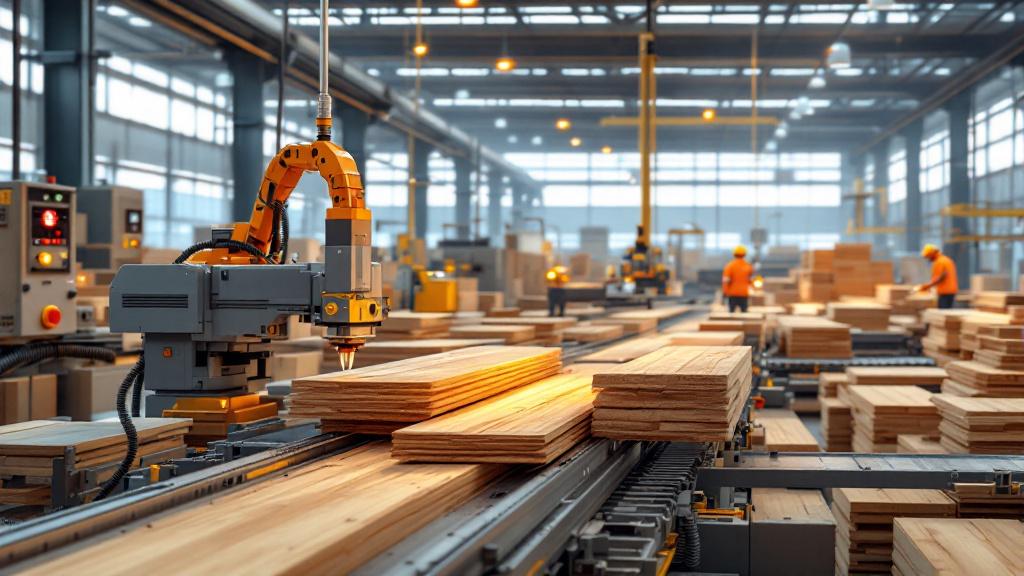
Woodworking has traditionally been considered an industry with an elevated level of workplace injuries because of the specifics of the equipment used: high-speed saws, cutters, as well as the need to move heavy and large blanks. Automation radically changes this scenario.
The main principle of automation with regard to safety is the elimination of direct contact between the operator and the hazardous zones of operating equipment. In modern automated CNC centers, cutting saws and robotic lines, blanks are fed, processed and unloaded automatically or with the help of manipulators.
The operator moves from performing direct, physically dangerous work to a function of control, programming and supervision. Their workplace moves outside the risk zone, to the control panel. This practically eliminates injuries from accidental contact with the cutting tool, ejection of a blank or clothing being caught.
Automation also significantly reduces the physical load on employees. Moving heavy panels and logs, as well as the repeated repetition of monotonous movements that cause occupational diseases (problems with joints, spine), is now entrusted to conveyors, lifting tables and industrial robots. This is not only humane but also profitable: a healthy, well-rested employee works more efficiently.
The environmental working conditionsalso improve. Automated equipment is often fitted with more efficient dust-extraction and soundproofing systems. As a result, the level of dustiness in the shops is reduced and noise pollution decreases. The working environment becomes cleaner and more comfortable.
Integrated safety systems in automated equipment, such as light barriers, emergency stop buttons and interlock systems that trigger when protective covers are opened, operate automatically, independent of the operator’s attention or fatigue. This creates an additional level of protection.
The introduction of automation is a demonstration of a responsible attitude by company management toward its employees. This not only complies with modern occupational safety standards and requirements but also increases the company’s attractiveness as an employer. Employees, feeling that their health and safety are being cared for, show greater loyalty and motivation to work.
Thus, improving occupational safety through automation is not a side effect but a fundamental advantagethat affects operating costs (lower insurance payouts, sick-leave pay) and the moral and psychological climate within the team.
Production flexibility and the ability to individualize products 🎨🧩
One of the most widespread myths about automation states that it is suitable only for mass, uniform production. The reality, however, is this: automated CNC equipment is a tool that provides unprecedented flexibility.
Unlike narrowly specialized mechanical machines that can perform only one or two operations, modern CNC machining centers (for example, 5-axis ones) are capable of performing a wide range of tasks on a single blank: sawing, milling, drilling, grooving, sanding and even engraving.
This multifunctionality makes production exceptionally flexible. Switching from making one part to a completely different one requires not a lengthy physical changeover of the equipment, but only the loading of a new control program into the CNC system. This process takes minutes.
Such switching speed is critically important for companies operating on a “make-to-order” basis or producing products with a high degree of customization. An enterprise can easily and profitably produce small batches or even single, exclusive items without losing speed and efficiency.
The ability to adapt quickly to changes in design, material or dimensions allows a woodworking operation to be more responsive to the demands of the market and designers. This opens the door to working on complex architectural projects, exclusive furniture and intricate interior elements, where uniqueness matters.
Software for automation makes it possible to promptly introduce changes into a project. A designer or process engineer makes edits to the CAD model, and the new control program is generated automatically. This shortens the “design-to-production”cycle, giving the company an advantage in the speed of bringing a new product to market.
The flexibility of automation also makes it possible to optimize warehouse stock. Instead of producing large volumes of identical items “for the warehouse,” a company can respond promptly to real orders, working on a “Just-In-Time” principle. This reduces storage costs and minimizes the risks associated with illiquid stock.
Automation thus turns production from a clumsy mechanism into a maneuverable toolcapable of working efficiently with both large and small batches, opening up new market niches for the business that require an individual approach and high technology.
Improved control over production processes (Monitoring) 📊💻
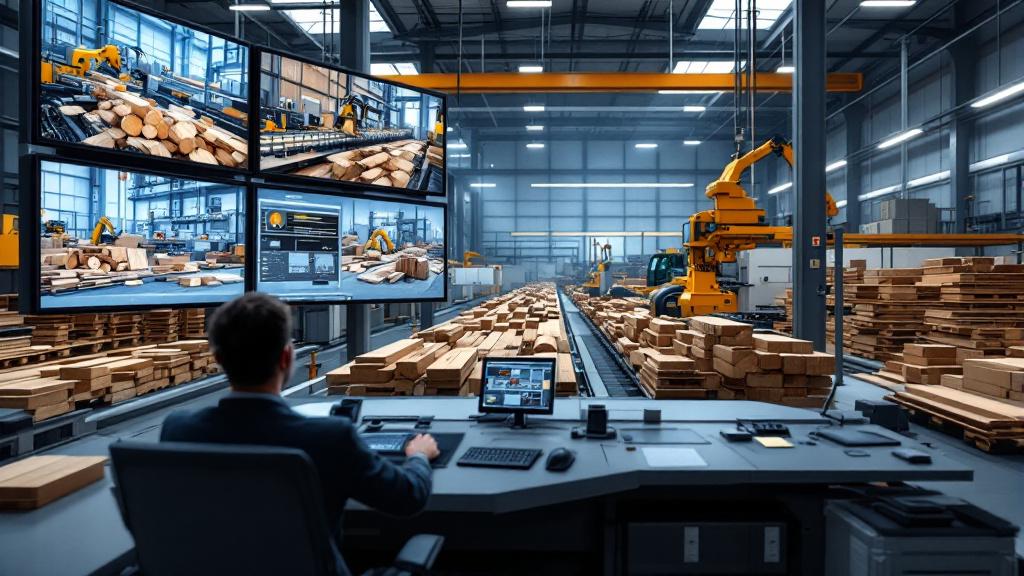
In a non-automated or poorly mechanized production, a manager often receives information about the state of affairs after the fact, from reports or visual inspection. Automation introduces into production digital control and makes it possible to make decisions based on objective real-time data.
Modern automated systems and CNC machines are integrated into the overall production management system (for example, MES or SCADA). They constantly collect huge arrays of data: processing speed, downtime, the number of parts produced, energy consumption, tool condition, changeover time and even spindle vibrations.
This data flows instantly into a single center, where it is analyzed and visualized. A manager or process engineer can at any moment look at the key performance indicators (KPIs) for each machine or the entire line as a whole. For example, one can find out precisely the overall equipment effectiveness (OEE), which is the most important indicator of its efficiency.
Proactive maintenance becomes possible thanks to constant monitoring of the equipment’s condition. The system can warn in advance that some unit of the machine is starting to operate with deviations (for example, the bearing temperature has risen or the motor current has increased). This makes it possible to schedule maintenance before a serious breakdown and costly downtime occur.
Identifying bottlenecks in production is greatly simplified. If a delay occurs at some stage, the system will show exactly where the problem arose: in the feeding of raw material, in a specific machine operation or at the unloading stage. With accurate data, one can eliminate not the consequence but the cause of low productivity.
Accounting and traceability of each part or blank are also greatly simplified. Systems can assign unique identifiers (barcodes or RFID tags) to each blank and track its path from the raw-material warehouse to the finished product. This is critically important for quality control and fulfilling warranty obligations.
In the end, the digital control that automation brings turns a woodworking enterprise into a “smart” production. Decisions are made on the basis of facts and figures rather than intuition or rough estimates. This ensures optimal resource management and maximum predictability of the result.
Reducing dependence on highly skilled workers 🎓🔄
A shortage of experienced, highly qualified workers is one of the most acute problems for many woodworking enterprises. Automation offers a way out of this situation by redistributing roles and requirements for personnel.
An automated machine, especially a CNC one, performs the most complex, precise and repetitive operations that previously required years of experience and painstaking manual work (for example, machine setup, precise grooving, complex milling). This knowledge and skill is “embedded” in the program rather than in the head of an individual craftsman.
The operator of an automated complex must now possess different skills. Instead of being a person of “golden hands,” they become a technical specialist: they must be able to load the program, check that it is executed correctly, ensure the supply of material and carry out basic maintenance. These skills are simpler and faster to masterthan becoming an experienced cabinetmaker.
Thus, automation lowers the entry threshold for new employees into working positions that previously required lengthy training. This makes recruitment and staff rotation.
easier. However, this does not mean that highly qualified employees become unnecessary. Their role is transformed. They move from manual labor to work on improving efficiency: they engage in programming the machines, optimizing technological processes, developing new products and training less experienced colleagues. This increases the intellectual value of their work.
Less dependence on a narrow circle of old craftsmen makes production more resilient to resignations, illness or other personnel problems. If one operator trained in basic CNC skills is out of action, they are easier to replace than to find a person capable of manually setting up a complex mechanical machine.
In addition, automation helps reduce the number of errorsrelated to the human factor. The fatigue, bad mood or inattention of a human operator do not affect the accuracy of a computer-controlled machine.
As a result, the company gains a more stable workforce, reduces the risks associated with staff shortages and can use the potential of its most experienced employees more effectively, directing their talents toward strategic tasksrather than routine.
Optimizing production space and logistics 🏗️📦
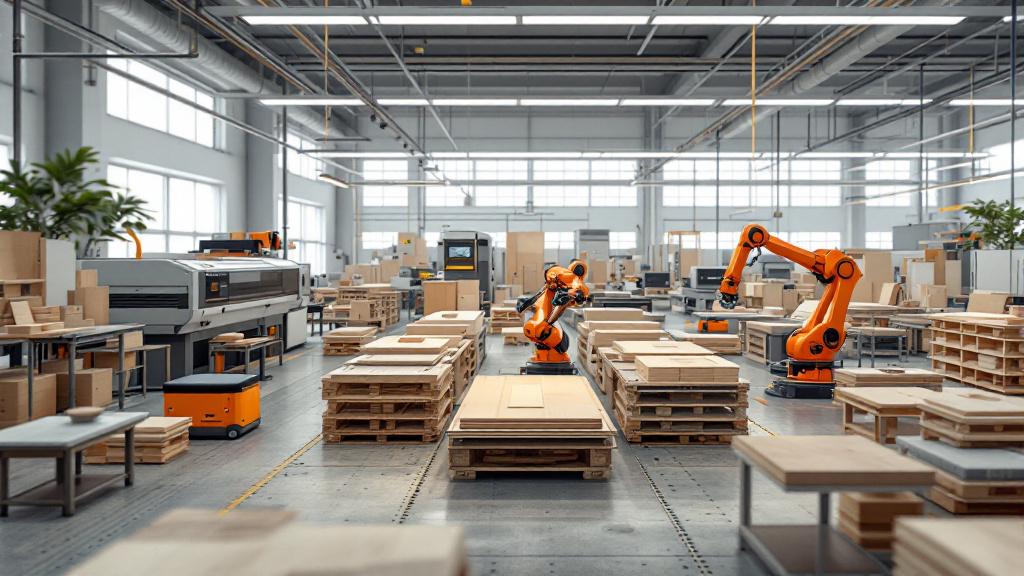
Automation makes it possible to take a fresh look at the organization of space in production and the internal transport logistics, which leads to substantial savings.
Multifunctional CNC machining centers are capable of replacing several specialized machines (a sawing, milling and drilling machine). Instead of three or four different pieces of equipment occupying a significant area, a single compact complexis installed. This makes it possible to free up production spacethat can be used to expand the product range, organize more spacious work areas or even be rented out.
Automated transport systems and stacking systems (conveyors, lifts, industrial robot manipulators) eliminate the need for wide aisles for forklifts and operators moving blanks by hand. The process of moving material becomes more streamlined, compact and fast.
The integration of storage systems is also an important part of automation. Automated warehouses (for example, vertical warehouses for sheet material) make it possible to store a far larger volume of raw material in a smaller area and provide fast, automated delivery of the required blank straight to the machine. This eliminates errors when searching for and transporting material.
Optimizing the layout of equipment on an automated line, where the machines are arranged in a logical sequence, makes it possible to minimize unnecessary movements of material between operations. This reduces cycle time and lowers the risk of damaging blanks during transport.
In addition, the higher productivity of automated equipment often means that producing the same volume of output requires less equipment overall. This also affects the size of the required production space.
Thus, automation contributes to creating a more compact, orderly and efficient production. Savings on rent or the ability not to build additional workshops are significant capital and operating advantages that directly affect the total cost of ownership of the production.
Integration and digitalization of business processes 🔗🌐
Production automation is not an isolated process. It is a key element of the digital transformation of the entire enterprise, ensuring seamless integration of the production shop with other departments.
The data generated by CNC machines (on material consumption, operating time, the number of finished products) becomes the basis for the operation of other information systems:
- ERP systems (Enterprise Resource Planning): Receive accurate data on the actual consumption of raw material and the time spent on production. This allows the procurement department to plan stock replenishment more accurately and the finance department to calculate the cost of production more precisely.
- CRM systems (Customer Relationship Management): Receive up-to-date data on the status of order fulfillment, which allows the sales department to give customers accurate deadlines and information about product readiness.
- PDM/PLM systems (Product Data Management/Product Lifecycle Management): Receive data on the actual parameters of the manufactured part, which is important for maintaining a complete product history and its subsequent servicing.
This information connectivity eliminates “gaps” and “blind spots” in company management. All departments work with a single, reliable source of information, which eliminates data duplication and errors associated with manual input.
Project management becomes more transparent and controllable. As soon as an order enters the system, it is automatically broken down into technological operations, and the production management system (MES) assigns them to specific machines and optimizes the sequence.
Automatic reporting is another significant advantage. Instead of spending hours manually compiling tables, the system itself generates reports on productivity, defects, downtime and equipment utilization efficiency. Management can receive a daily or hourly snapshot of the state of production automatically.
The digitalization initiated by automation also opens up opportunities for remote control and diagnostics. A specialist can monitor the operation of machines, make adjustments to programs or even diagnose faults while in another city or country, which is especially important for international service and support.
Ultimately, automation integrates the production shop into the company’s digital ecosystem , making business processes transparent, fast and easily scalable.
Real myths about automation in woodworking and their debunking ❌💡
Like any new technology, automation has become surrounded by numerous misconceptionsthat often serve as the main obstacle to modernization. It is important to understand where reality ends and myths begin.
1. Myth: Automation is only for large, mass production.
Reality: This was true decades ago. Today, thanks to the development of CNC machines, robotic manipulators and modular systems, automation has become accessible and cost-effective even for small and medium-sized enterprises. The flexibility of CNC makes it possible to economically produce even single, exclusive items or small-series batches. The main advantage of modern systems is fast changeover, which minimizes non-productive time expenditure, making it ideal for individual orders.
2. Myth: It is too expensive, and the payback will take a long time.
Reality: The initial investment is indeed high, but it should be regarded as strategic capital. The payback calculation should take into account not only the increase in volumes but also the multiplier effect from:
- Reducing defects and waste (raw-material savings).
- Reducing the payroll for manual operations.
- Reducing cycle time and accelerating capital turnover.
- Improving quality and reducing the number of complaints. In practice, with a correct calculation, the payback period of highly efficient automated equipment is often between 3 and 5 years.
3. Myth: Automation will lead to total job cuts.
Reality: Automation changes the requirements for personnelrather than eliminating them entirely. Low-skilled, physically hard and dangerous jobs disappear. New, high-tech positions appear:
- CNC operator-programmers.
- Specialists in servicing and repairing automated lines.
- Process engineers for optimizing processes. The company’s task is to retrain its staff, raising their qualifications rather than simply cutting jobs. Experienced craftsmen become mentors and program developers.
4. Myth: It is difficult and slow to implement, and hard to train staff.
Reality: Modern CNC equipment has intuitive software. Leading suppliers always include in the delivery package comprehensive training, which takes from a few weeks to a few months. The hardest part is the reengineering of the production processes themselves, that is, a review of the entire technology. Companies that have successfully undergone automation note that, with the help of qualified integrators, the process goes considerably faster than it seems.
5. Myth: CNC machines cannot work with a “living” material such as wood.
Reality: Modern CNC machines and systems are equipped with sensors and correction systemsthat can take into account natural defects, changes in moisture or density of the wood during operation. The software makes it possible to create complex trajectories of tool movement that are perfectly suited to working with the specific characteristics of wood. Moreover, it is precisely automation that ensures perfect repeatability even in complex processing, which is critically important, for example, in the manufacture of bent-laminated products.
Increasing competitiveness and business scalability 📈🏆
The final, integral result of all the listed advantages of automation is a significant increase in the competitiveness of the company on the market and the creation of a solid foundation for its scaling.
Competitiveness is made up of several factors in which an automated enterprise wins:
- Price: Reducing the cost price through raw-material savings, optimizing labor costs and increasing productivity makes it possible to offer more favorable prices for the customer while maintaining high margins.
- Quality: Guaranteed, stable product quality that does not depend on the human factor is the most important argument in favor of choosing this particular supplier.
- Lead time: The ability to respond quickly to orders and reduce the production cycle to a minimum makes it possible to win tenders and attract customers for whom speed of fulfillment is critical.
Automation also makes it possible to scale up quickly production. If a company receives a large or new contract, it can easily increase output simply by switching to two or three shifts, or by adding another easily integrated module to the digital line. Scaling occurs linearly and predictably.
Moreover, automation allows an enterprise to enter new marketsthat require stricter quality standards (for example, export markets or premium segments). Products manufactured with high CNC precision meet the most stringent international requirements and expectations.
The introduction of automation is, in essence, a move to a different league of business. The company stops competing with small workshops based on manual labor and takes its place alongside the technologically advanced leaders of the industry.
A bulleted list of key strategic benefits:
- Long-term stability: Reduced dependence on staff shortages and the wear-out of key specialists.
- Innovation potential: The ability to quickly master the production of new, complex products and experiment with materials.
- Attractiveness to investors: An automated production is more transparent, manageable and has clear growth metrics, which makes it more attractive for external investment.
Automation in woodworking is not a luxury but a necessary condition for survival and prosperity in today’s dynamic market. It is a strategic choice that provides a long-term competitive advantage and sustainable growth.