Why Smart Cutting-Layout Planning Minimizes Waste in Wood Products: The Path to Efficient Production

In woodworking and the manufacture of wooden products, where every cubic metre of raw material is a valuable resource, smart cutting-layout planning is not merely one stage of the production process, but its fundamental element, directly determining the economic efficiency of the entire enterprise. Ignoring this step, or approaching it superficially, inevitably leads to excess material consumption, a larger volume of waste and, as a result, an unjustified rise in the cost of the finished product. This is the point where theory meets practice, and the precision of calculations translates into real financial gain.
Cutting-layout planning is essentially the solution to a complex spatial puzzle, in which parts of the required dimensions must be arranged on the source timber so as to minimise the area of “empty” space that ends up as useless offcuts. Every millimetre saved during sawing turns into tangible savings across a large order or a long production cycle. This is precisely where one of the key levers for controlling product cost lies.
Deliberate, detailed planning allows us not just to “squeeze” parts onto a board or beam, but also to account for critically important factors such as timber defects (knots, cracks, rot), grain direction and texture features. Poor placement of blanks relative to defects means that some already-sawn parts have to be rejected, and that is a double loss: loss of material and loss of time on unnecessary processing. Quality planning makes production more predictable and controllable.
Imagine you are working with valuable timber species whose cost can be very high. In that case the yield of finished product from raw material (the material utilisation ratio) becomes a critical indicator. Improving this ratio by even a few percent through optimised cutting can bring the enterprise substantial profit. Poor cutting is essentially the “burning” of expensive materials.
Planning also directly affects labour productivity. A clearly developed cutting map, created with the equipment’s capabilities and the sequence of operations in mind, reduces marking time, minimises the number of machine changeovers and lowers the likelihood of errors caused by the human factor. The operator does not have to make decisions “on the fly” — they simply follow the optimised layout.
Moreover, modern production is rarely limited to a single type of product. Material often has to be cut for several orders at once, using source boards and beams of varying length and width. Comprehensive, multi-criteria cutting planning makes it possible to combine these tasks, finding the most advantageous combinations and putting even the smallest, yet high-quality, offcuts to use — offcuts that would otherwise simply be sent to waste.
Smart cutting-layout planning is therefore not just a matter of thrift, but a strategic tool. It allows several key goals to be achieved at once: reducing raw-material costs (the main expense item in woodworking), increasing the material utilisation ratio, improving product quality by working around defects, and optimising production time. This is the first and, perhaps, the most important step towards economically sustainable and competitive production of wooden goods.
The Business Case: How Every Percent of Waste Affects Financial Performance
Talk of minimising waste in woodworking is often taken for granted, or treated as a secondary matter concerned solely with ecology. In reality, however, it is a question with direct and highly tangible financial consequences. For an enterprise working with large volumes of timber, every percent of waste reduction translates into thousands, and sometimes millions of euros saved over a year. The business case for smart cutting is so obvious that decision-makers are simply obliged to factor it into strategic planning.
Suppose the industry average waste rate during sawing is, say, 15%. If, by introducing optimised planning, we can reduce this figure to at least 10%, it means that from the same volume of purchased raw material we obtain 5% more finished product. Measured in cubic metres of expensive timber, that is a colossal difference. Those 5% do not simply “go into the bin” — they turn into potential profitthat would have been earned from these additional products.
It is important to understand that waste is not simply unused material. It is material that has already been paid for: purchased, delivered, possibly stored and even pre-processed (for example, dried). Thus, the cost of every chip or offcut already includes not only the direct raw-material expense but also part of the indirect costs — logistics, drying, warehouse rent. When this material is sent to waste, the enterprise loses not only its purchase cost but all the associated expenses as well.
Cutting-layout planning aimed at minimising waste makes it possible to increase the useful yield ratio (UYR), which is one of the key performance indicators of sawmilling and woodworking production. The higher the UYR, the lower the raw-material cost per unit of finished product. This gives the enterprise a significant competitive advantage, allowing it either to set prices that are more attractive to the customer or to increase its own margin.
In addition, there are costs directly related to waste: it has to be collected, stored and, in most cases, disposed of. Disposal of industrial waste is a separate cost item, comprising removal charges, environmental levies and potential fines for non-compliance. By reducing the volume of waste, the enterprise automatically lowers these operating costs.
Bulleted list of key financial benefits:
- Direct reduction of raw-material costs: Extracting the maximum number of blanks from each unit of material.
- Increased profit: Additional finished product from the same volume of purchase.
- Reduced indirect costs: Lower spending on logistics, storage and drying of material that will ultimately go to waste.
- Lower operating costs: Savings on the collection, storage and disposal of industrial waste.
Smart cutting-layout planning is therefore not merely a “battle for tidiness”, but a direct path to financial stability and growth. It is a tool that makes the production process as lean and efficient as possible — critically important in today’s highly competitive market.
The Impact of Raw-Material Geometry and Dimensions on the Complexity of Cutting Optimisation

As a raw material, timber has one fundamental feature that sets it apart from many other industrial materials: it is not uniform in shape or quality. The source material — logs, beams, boards — has a natural geometry that always brings certain constraints and difficulties to the cutting process. Understanding and accounting for the geometry and dimensions of the raw material is the cornerstone of successful optimisation and waste minimisation.
Let us start with the log. It is a cylinder, often of imperfect shape (taper, ovality, curvature), inside which the valuable timber is located. Depending on the chosen sawing method (for example, through-and-through, cant, or sector sawing) and the log diameter, the waste rate can vary greatly. Through-and-through sawing, though simple, often produces more waste because of the need to trim edges to obtain edged material. More complex schemes, such as cant sawing, when calculated correctly, achieve a higher yield of usable product.
When it comes to sawn timber (boards, beams), the task becomes more complicated by the need to fill the rectangular or square shape of the source blank as efficiently as possible. Cutting optimisation here comes down to the so-called “nesting problem” — how to arrange many small parts on a large plane with the least loss. The greater the difference in size between the source material and the required parts, the harder the task.
The size and length of the source boards play a huge role. If manufacturing requires many short parts while long boards are on hand, efficient cutting will place the parts so as to use the short but sound sections between defects. If, however, the parts are long and the boards are short, this can be a signal to change the specification or technology — for example, to switch to a glued joint to obtain the required length.
Moreover, the thickness of the source material also matters. If the required part thickness is less than the board thickness, planning must consider the possibility of multi-layer cutting — resawing the board into two or more thinner blanks after the initial cut to length and width. This approach requires additional analysis and software, but can significantly increase the UYR.
Incorrectly accounting for geometry — for example, using overly wide source material for narrow parts, or trying to cut long blanks from short offcuts — leads to inevitable, easily preventable losses. Smart planning should include stock analysis and matching it to order requirements, choosing the best combinations to minimise remnants that cannot be used later. Applying the modular principle in product design often helps, as it allows the use of standard, optimally cut blank sizes.
Using Timber Defects and Flaws as a Factor in Cutting Optimisation
As a natural material, timber always has flaws and defects — knots, cracks, rot, worm holes, warping. On the one hand, these features reduce material quality and require removal, but on the other, with a skilled approach, they can be used as key reference points for cutting planning, turning potential waste into the basis for optimisation. You cannot simply cut a part from the middle of a board without looking at its edges and internal structure.
The traditional approach often consists of simply cutting off the defective sections and working with what remains, which leads to the wasteful use of long and wide blanks. Optimised cutting-layout planning turns this process around: first a quality assessment of each board or beam is carried out, defects are marked (manually or with scanners), and only then does the system or operator seek the optimal way to place the required parts between these defective zones.
This requires shifting the emphasis from “cutting out the reject” to “cutting out the clean”. If we need to obtain several short blanks and a board has a large knot in the middle, the most logical solution is to saw the board precisely through the centre of that knot, obtaining two clean but shorter blanks that can then be used efficiently. Otherwise, we might lose a significant part of the material trying to “work around” the defect in a suboptimal way.
In the manufacture of joinery and building products (for example, window or door beams), so-called length-jointed blanks (finger-jointed) are often used. In this case, defective sections are cut out and the clean short pieces are joined with a mini finger joint to form a strong, long beam. Cutting planning here aims not only to minimise waste, but also to maximise the yield of clean short pieces of the required cross-section that can be sent for gluing.
The integration of machine-vision and defect-scanning systems with cutting software is the pinnacle of this technology. The scanner determines the location, size and type of the flaw, and the software instantly calculates thousands of cutting options, choosing the one that ensures the maximum yield of clean blanks within all the specified constraints. This makes decisions possible that a human could never make “by eye”.
Timber defects thus cease to be mere “rejects” and become an information field for the optimisation system. Skilled cutting planning that accounts for these defects allows not just to work around them, but to do so with maximum benefit, turning what used to be waste into a useful blank suitable for further use in other products or assemblies.
The Role of Software and Algorithms in Achieving Maximum Efficiency
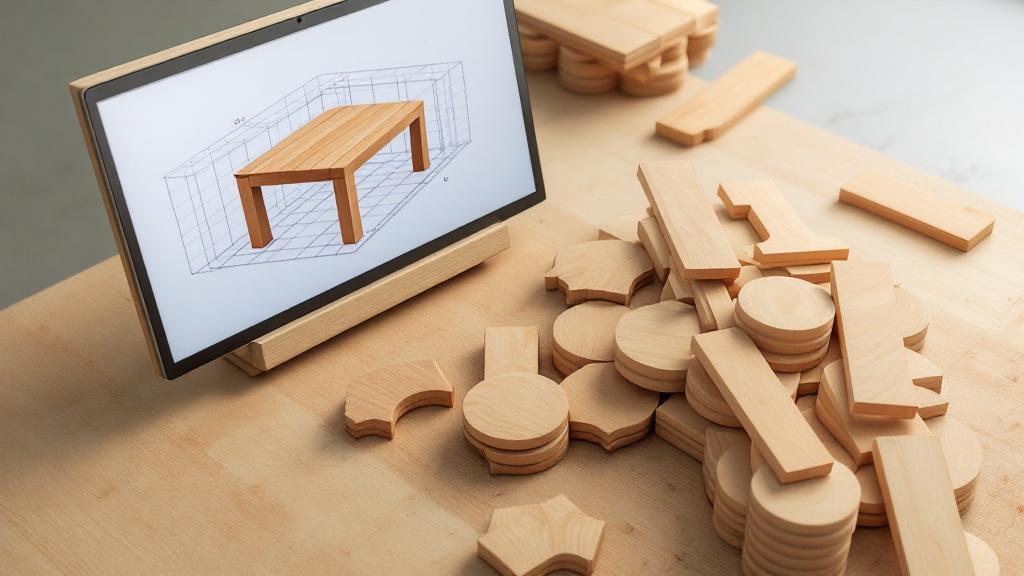
Manual cutting, relying on operator experience and simple marking, will always be limited in its efficiency. The human brain, for all its sophistication, cannot instantly compute hundreds and thousands of possible ways of placing parts across a large quantity of source material. This is precisely why the use of specialised software and complex mathematical algorithms has become not just an advantage but a necessity for achieving maximum efficiency and minimising waste in modern woodworking production.
Cutting optimisation programs (so-called optimisers) work on the basis of complex mathematical models that include linear programming methods, genetic algorithms, heuristic approaches and other computational techniques. The program’s task is to take as input a list of available raw material (its dimensions, quantity, and often information about defects) and a list of required parts (their dimensions, quantity and, possibly, priority), and to output an optimal cutting map.
The main advantage of this approach is speed and precision. An optimiser can analyse thousands of placement options in a matter of seconds and select the one that ensures the highest useful yield ratio (UYR). Unlike a human, the program does not tire and makes no calculation errors. It always finds the most efficient solution within the given conditions.
Modern optimisers are capable of working in multi-criteria mode. This means they can take into account not only waste minimisation but also other important factors:
- Grade and quality: Placing more valuable parts on sections of timber with better quality.
- Type of cut: Accounting for grain direction and texture (radial or tangential cut) to ensure the required appearance and stability.
- Economic priority: Giving preference to cutting parts for more expensive or urgent orders.
- Technological constraints: Accounting for the tool’s kerf width and the minimum size of offcuts that can be reused.
Implementing such software requires an initial investment and staff training, but these costs pay off very quickly. Increasing the UYR by even 2–3% in large-scale production can fully cover the cost of the software suite within a year. In addition, automated cutting significantly reduces production preparation time and makes it possible to respond promptly to changes in orders.
The software also provides full traceability and accounting. Every board, every remnant can be registered and recorded, which allows these offcuts to be used in subsequent cutting cycles, further reducing the volume of non-recoverable waste. Cutting optimisers are thus not merely an auxiliary tool but a central link in a strategy of lean, resource-efficient production.
The Principles of “Nesting” and Their Application in the Production of Furniture Panels and Profiled Parts
In the manufacture of furniture panels, worktops and complex profiled parts, where curved or non-rectangular shapes must be cut, a key role in waste minimisation is played by the technology known as “nesting”. This approach is not just linear-cut optimisation, but the two-dimensional, and sometimes three-dimensional, placement of parts on a source panel or wide board.
The principle of nesting is to arrange parts with a complex contour as tightly together as possible, using the space between them with the greatest efficiency. Whereas traditional cutting of a rectangular blank would leave rectangular waste, with nesting, for instance, a rounded part can be placed in the recess of another, also rounded or curved, blank — like pieces of a jigsaw.
This technology is especially important when working with sheet materials or wide glued panels. For example, in the manufacture of curved furniture fronts, chair seats, or decorative elements, where standard linear cutting would be extremely inefficient. Nesting software takes into account the complex geometry of the parts, the width of the cutter or saw, and finds the optimal arrangement.
Advantages of nesting in the context of waste minimisation:
- Material savings: Reducing the “empty” gaps between parts, especially for curved shapes.
- Higher UYR: Achieving the maximum useful yield ratio even on expensive materials.
- Efficient use of remnants: The program can automatically “fill” the remaining free space with small, secondary parts or decorative elements.
Applying nesting requires the use of CNC (computer numerical control) machinesthat are able to precisely follow the cutting path set by the optimisation program. This links the cutting-planning process directly to the production equipment, ensuring high precision and repeatability.
An important aspect is also accounting for grain direction. If a part must have a specific texture or direction of strength, the nesting program must respect this constraint, rotating parts only within the permissible angle. Nesting is thus a comprehensive approach that combines geometric optimisation, technological constraints and quality requirements, making it an indispensable tool in the production of high-quality parts of complex shape.
Managing and Reusing “Usable” Waste
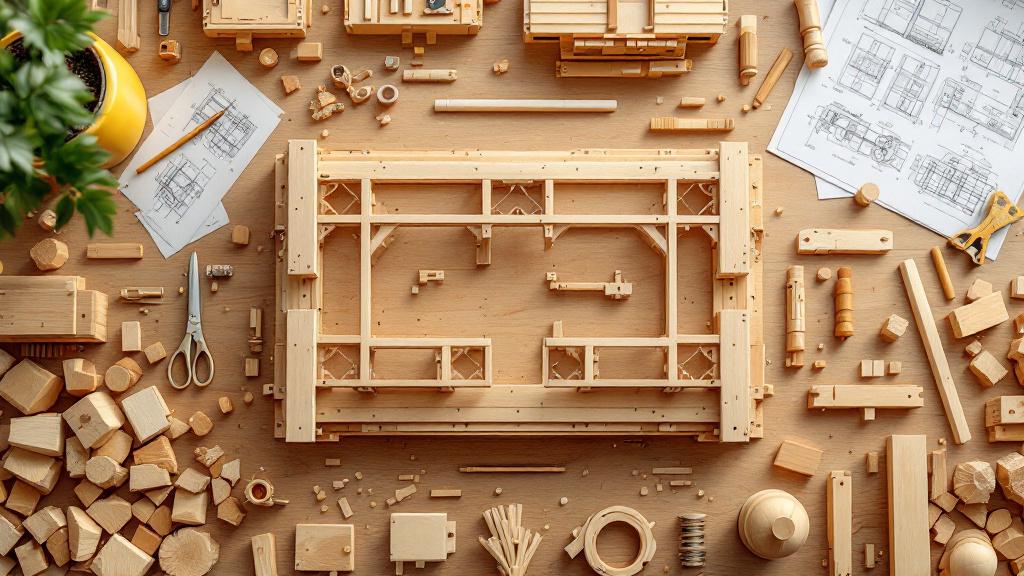
Even the most perfect cutting plan cannot completely eliminate waste. However, the key distinction of efficient production lies not only in minimising the total volume of offcuts, but also in managing these remnantsso as to maximise the share of so-called “usable” waste — that which can be reused. Turning potential rubbish into valuable raw material for other products is an important element of lean production.
Usable waste is essentially offcuts and pieces of timber that are too small for the main product, yet of sufficient quality and dimensions to be used in the production of other, smaller parts or auxiliary products. Examples include:
- Blanks for small components: Dowels, wedges, small fasteners, handles, plugs.
- Raw material for gluing: Short but clean pieces that can be finger-jointed to obtain long-length material (for example, in the production of furniture panels or window beams).
- Packaging and auxiliary elements: Backing strips, spacers, packaging elements for transporting finished products.
Smart cutting-layout planning should include not only optimisation for the current order, but also a strategy for handling remnants. The optimiser program can be configured to first try to “fill” the gaps on the cutting map with parts from subsequent, lower-priority orders. If that is not possible, it should aim to produce offcuts with the most convenient geometric parameters for reuse (for example, a specific standard width or length).
Efficient management of usable waste requires:
- An accounting system: Precise recording of the dimensions, species and quality of every offcut that can be reused.
- A separate storage area: Organising a convenient and systematised store for usable waste.
- Continuous analysis: Regularly matching the available remnants against current and future production needs.
Bulleted list of actions needed to manage waste:
- Sorting by size and species: Storing usable waste separately for quick retrieval.
- Introducing “secondary” cutting: Developing separate processes for using short and narrow offcuts.
- Integration into planning: Including a database of usable waste in the optimiser program, so that it is used first, ahead of new, more expensive material.
Usable waste is therefore not a problem but a hidden reserve. Managing it skilfully allows not only the volume of rubbish to be reduced but also purchases of new raw material for the production of small yet necessary parts to be substantially cut, which directly affects the overall economics of the enterprise.
The Relationship Between Cutting Planning and the Stability of the Finished Product
It is a mistake to assume that cutting planning affects only economics and waste. In fact, it has a direct and critical impact on the quality and stability of the finished product. Choosing the right section of timber, accounting for grain direction and the features of the cut — all of this is set precisely at the cutting stage and determines how durable and deformation-resistant the final product will be.
The key factor here is the direction of the annual rings (texture). Timber has anisotropic properties, meaning that its physical and mechanical characteristics differ along and across the grain. Moisture, temperature and mechanical loads all affect timber differently depending on how the element is cut.
- Radial (quarter) cut: Obtained when the cutting plane passes through the centre of the trunk. Such boards have higher stability across their width, are less prone to warping and cracking during drying. They are often used for high-quality parquet, window beams and other products requiring increased geometric stability.
- Tangential (flat) cut: The cutting plane runs tangentially to the annual rings. Such boards are more susceptible to shrinkage and swelling across their width, but have a more pronounced and attractive texture.
Smart cutting-layout planning must always take these specification requirements into account. If the manufacture of a window beam requires a radial cut, the optimiser must position the blanks in the source material so as to ensure an annual-ring angle of at least 45–60 degrees to the face surface. This may slightly reduce the UYR compared with simple through-and-through cutting, but in return it ensures the necessary durability and prevents deformation of the structure.
Incorrect cutting — for example, using a tangential cut where a radial one is required — can lead to the following problems:
- Warping: Deformation of the part (bowing, twisting) after manufacture or during use.
- Cracks: The appearance of surface or through cracks due to uneven internal stress.
- Deterioration of appearance: Uneven shrinkage and swelling lead to gaps forming in the joints.
Cutting planning is therefore not only about quantity, but also about quality. In deciding how to saw the material, the enterprise effectively determines how reliable and stable its product will be. This is the guarantee that the finished product will meet the stated standards and will not disappoint the customer.
The Impact of Optimised Cutting on Environmental Responsibility and Company Image
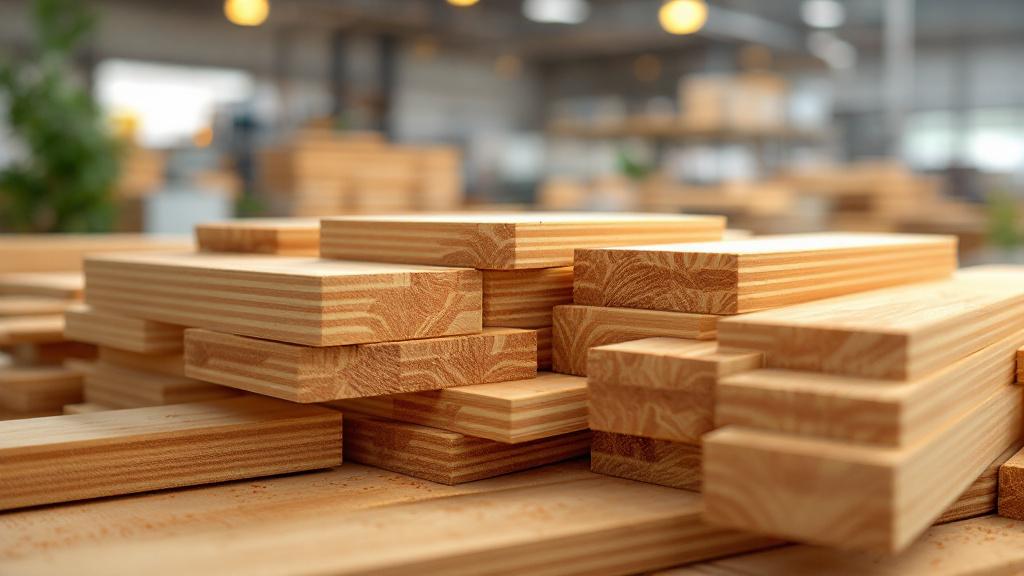
Amid growing public attention to ecology and sustainable development, environmental responsibility is becoming not just a fashionable trend for an enterprise but an important factor in its image and competitiveness. Smart cutting-layout planning aimed at minimising waste plays a key role here, demonstrating the company’s responsible attitude to natural resources.
Timber is a renewable but not limitless resource. The more efficiently an enterprise uses every cubic metre of purchased raw material, the fewer trees are needed to produce a given volume of product. A high useful yield ratio (UYR) becomes a direct indicator of resource efficiency and responsible forestry.
From a PR and marketing standpoint, the ability to declare waste minimisation as part of one’s corporate policy is a strong argument. Customers, especially in Europe and North America, increasingly favour suppliers who can confirm their commitment to the principles of sustainable development. A company that manages its waste efficiently and demonstrates a high UYR gains:
- A stronger image: Positioning itself as an environmentally responsible manufacturer, which is especially important when working with FSC-certified timber.
- A competitive advantage: The ability to use “green” marketing to attract eco-conscious customers.
- Regulatory compliance: Easier compliance with national and international environmental standards and requirements.
In addition, waste minimisation is directly linked to a reduction in carbon emissions. A smaller volume of waste means less material that needs to be transported, disposed of or incinerated (if the waste is not used as fuel). Each of these stages involves energy consumption and greenhouse-gas emissions. By optimising cutting, the enterprise indirectly reduces its carbon footprint.
The cutting-planning process, including precise accounting for and reuse of usable waste (as discussed in Section 7), also contributes to the development of a circular economy within the enterprise. Material that would previously have been thrown away remains in the production cycle, reducing the need for primary raw material.
Investment in cutting-optimisation technology is thus not merely an investment in savings — it is an investment in sustainability and reputation. In today’s world, where information spreads instantly, an environmentally responsible stance backed by real production indicators is an invaluable asset for any woodworking enterprise.
Development Prospects: Integrating Cutting Planning with Production and 3D Modelling
The cutting-planning process is constantly evolving, and its future is inseparable from integration into the enterprise’s overall digital ecosystem . The transition from simple 2D optimisation to 3D modelling and full interaction with equipment opens new horizons for waste minimisation and efficiency gains.
Modern trends are leading to cutting planning becoming an integral part of CAD/CAM systems (computer-aided design and manufacturing). A part is not simply designed — its optimal placement on the source material is determined at once, within the 3D model.
- 3D modelling of raw material: In the future, scanners will be able to create a precise 3D model of every log or board, including internal flaws (using X-ray or ultrasound). The optimiser will be able to make decisions about sawing the log (primary cutting) and the subsequent cutting of boards (secondary cutting) within a single three-dimensional model, allowing the UYR to be raised to its physical maximum.
- Integration with equipment: The optimised cutting map is transmitted to the CNC machine directly. The machine automatically positions the material, accounts for the kerf width and performs the cut without operator intervention. This eliminates marking errors and ensures precise conformity to the plan, minimising technological waste.
- Dynamic optimisation: In real time, the system will be able to adjust the cutting plan depending on hidden defects discovered during cutting or changes in order priorities. For example, if a hidden flaw is found, the system instantly recalculates the plan for the remaining material to obtain the maximum of useful blanks.
Another important direction is integration with the inventory management system (ERP/MRP). This makes it possible to plan cutting based not only on current stock but also on future deliveries, as well as on the needs of all the enterprise’s departments. The system can automatically generate purchase orders based on the most efficient plan for using available resources.
Software will become ever more “intelligent”, using machine learning to analyse thousands of previous cuts and select the most successful strategies for similar tasks. Artificial intelligence will be able not only to find the best option but also to recommend changes to the product design in order to simplify and optimise cutting even further.
In conclusion, smart cutting-layout planning is not an end in itself, but a constantly improving process. The use of high-tech tools and integration into the digital environment allow woodworking companies not merely to reduce waste, but to create the leanest, most cost-effective and environmentally responsible production possible — ready for the challenges of the future.