
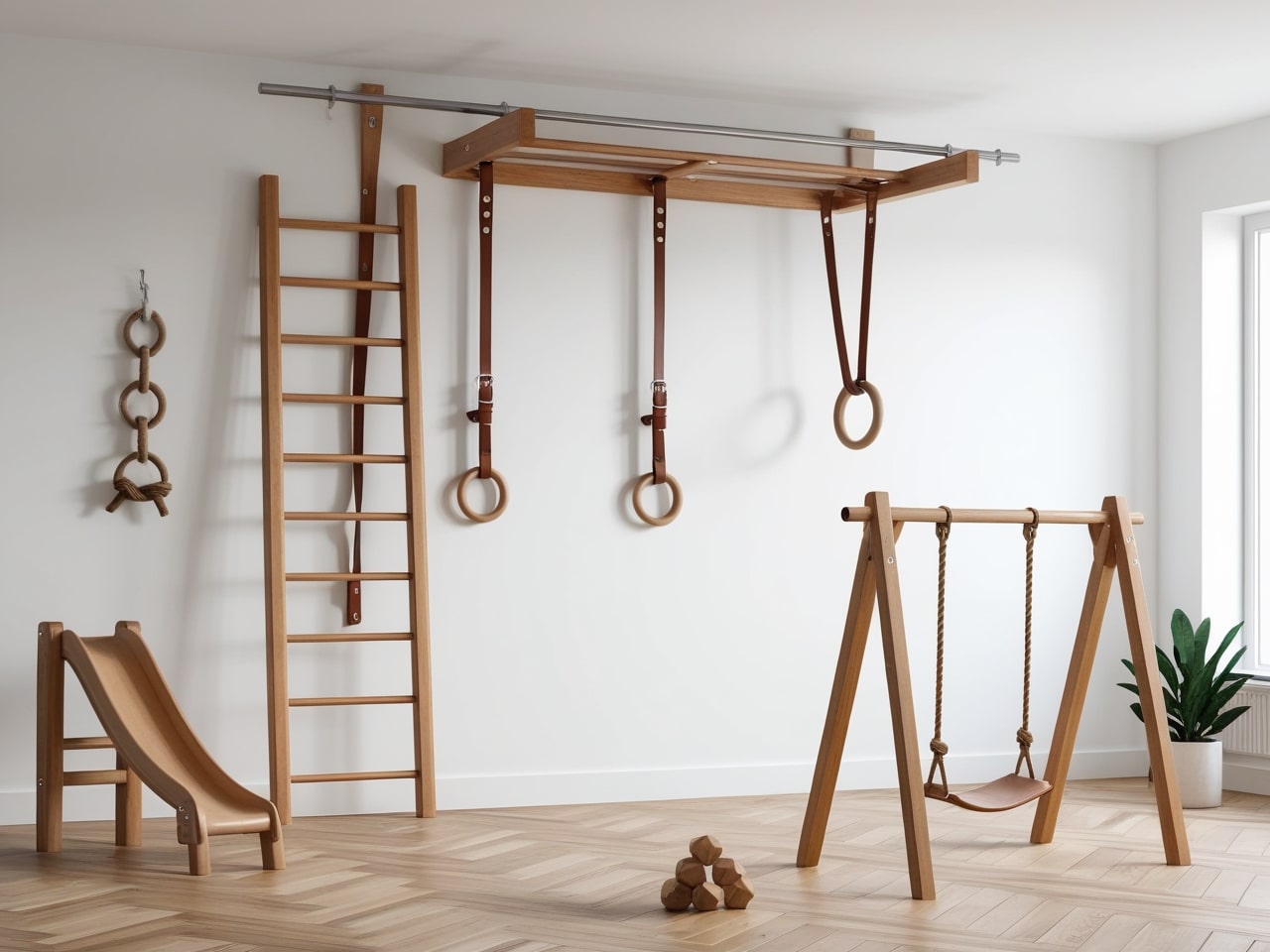
Wooden Sports Goods
Wooden sports goods are training gear and equipment made from hardwood solid timber, plywood, MDF, particleboard and MFC, engineered for real-world loads. Wall bars, gymnastic rings, parallel bars, balance boards, push-up handles, benches, outdoor rigs — all of it is produced both by the piece and in batches for fitness centres, sports schools, gyms and home workouts. Below is a look at which species and materials sports gear is made from, why wood beats plastic and metal, how production works, how long it takes and who these products suit.
Manufacturing wooden sports goods: key features and capabilities
Wooden sports goods are a whole layer of training products, from a simple push-up handle to a multifunctional wall bar. This kind of gear stands in large fitness centres, in school gyms and in private home workout corners alike. Gymnastic rings, wall bars, balance boards, parallel bars, benches — each item closes its own task: strength, flexibility, coordination, endurance. One client needs a single pull-up bar for the garage, another needs a full set for an entire gym, and both orders are equally routine work.
Why wood at all, rather than metal and plastic? To begin with, it is a pure natural material with no chemistry — and sports gear is in contact with skin, sweaty palms and heavy breathing under load, so extra fumes are the last thing you want here. Next comes strength and durability: a correctly chosen species will comfortably hold an adult’s weight for years. Add the look: sanded and lacquered wood feels warm and alive, not institutional. And beauty comes at no cost to function — the finish protects, it does not merely decorate.
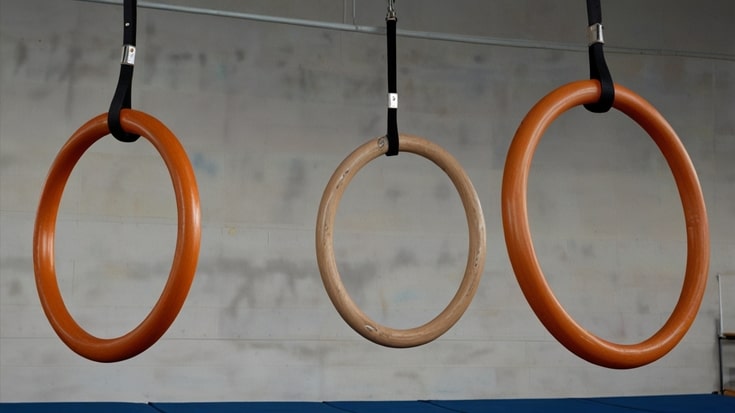
Wood also has a purely practical trump card — it works more gently under the hand. A grip on wooden rings does not slip with sweat the way metal does, and it does not freeze your palms in winter. The body tires less, there are fewer calluses, and the risk of slipping off is lower. Gymnasts and CrossFitters know this: ring competitions have historically used wood, and not for looks but because the hand feels the apparatus with it. The same principle works on bars, rails and handles — anywhere a firm, comfortable contact matters.
Gymnastic rings
Wall bars
Push-up handles
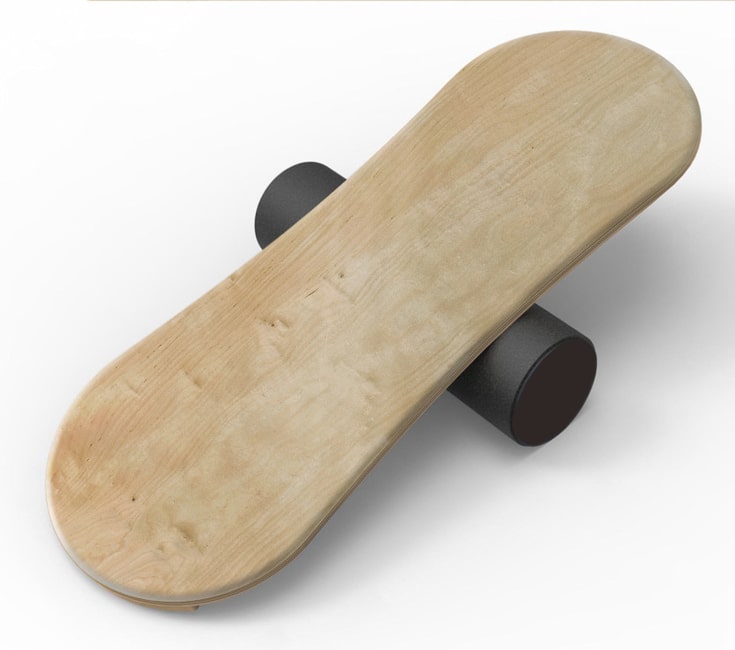
Balance boards
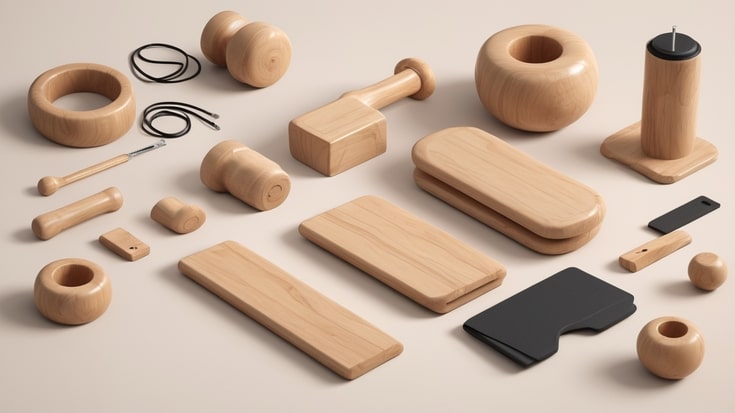
Fitness products
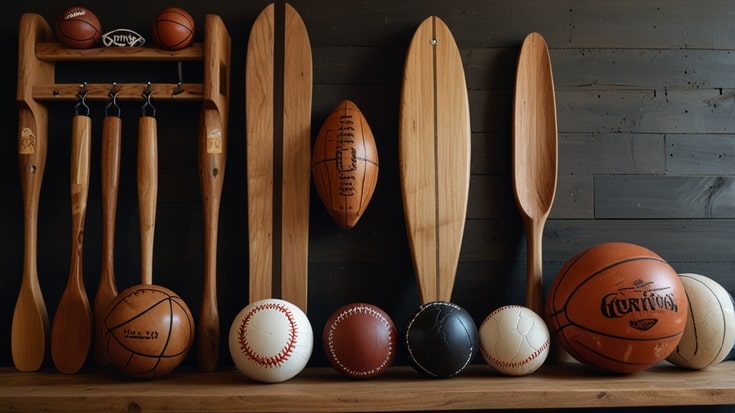
Training products
Features of wooden sports goods production: from materials to technology
The manufacture of wooden sports equipment rests on three pillars: strength, safety and a clean look. And while appearance is self-explanatory, strength and safety here are no abstraction but a matter of the health of whoever hangs from the apparatus. That is why only kiln-dried, selected timber goes into the work, with no cracks or knots in critical spots. Every item is designed with a load margin — not “just enough” but with a confident reserve, because it is a real person who ends up on the bar, not a calculated one, sometimes with a jerk.
The species is not chosen at random. For rings, wall-bar rungs and other load-bearing elements we use hardwoods — oak, beech, ash. They are dense, abrasion-resistant and do not “flex” under weight, unlike soft pine, which is unfit for loaded parts. Such timber holds both static and jerk loads typical of pull-ups and hanging. Where the load is lighter — side panels, decorative elements — more affordable materials are acceptable too, and that is sound engineering economy, not cost-cutting at the expense of the job.
Then come the subtleties that are invisible in a photo but decide everything. The wood is dried and processed so that the part does not warp or crack over time — otherwise the apparatus becomes dangerous. Fasteners are chosen with the same safety margin: a weak ring in the chain nullifies the strength of the whole item. The surface is finished by sanding and sealed with lacquer not only for the look — a smooth coating prevents splinters, repels moisture from the palms and does not fade in the sun if the apparatus stands by a window or outdoors.
A separate story is inspection before shipment. Sports equipment is not a bookshelf: if something is wrong, you find out at the worst possible moment under load. That is why every item is checked — geometry, fixings, the absence of sharp edges and burrs. Comfort here is part of safety: if a handle is uncomfortable or an edge cuts the palm, a person instinctively changes their grip and risks slipping off. Precise machining of every part is exactly about making the apparatus predictable and free of surprises.
How wooden products are manufactured
Stages of producing wooden sports goods: from project to finished item
The path from enquiry to finished apparatus consists of several steps. The first is the design. Here the material, dimensions, shape and the load the item must bear are determined. This stage matters more than it seems: an error in the calculation shows up not on paper but under a person’s weight. If the client has special wishes — a non-standard wall-bar height, a colour to match the gym interior, a layout for a specific room — they are built in right here. A sports centre with corporate branding can perfectly well get equipment in its own palette rather than the standard “same as everyone else”.
Once the design is approved, the material is purchased. Loaded parts, as already noted, use hardwoods — oak, ash, beech. The timber then goes through processing: cutting and sawing to size, milling, sanding, preparation for assembly. At this same stage, techniques that extend the item’s life are applied — impregnations and compounds that reduce wear and keep the wood from cracking with humidity swings. Put simply, the apparatus is prepared for years of daily use before it is even assembled.
The finished parts go to assembly. Here the fit is checked meticulously — play and gaps are unacceptable in sports apparatus; they turn into squeaks, loosening and potential breakage. Reliable fasteners are fitted, sized for jerk loads. If the design calls for a finish, the item is painted or lacquered — both for looks and for protection from moisture, sweat and sun. Only after that does the apparatus look and work as intended, not like a half-finished “you sort out the rest” piece.
The final step is quality control, and with sports equipment this is no formality. Every item is tested for strength, stability and compliance with safety norms: the apparatus must withstand not only weight but the dynamics of movement. Passed the check — it heads to the client. Failed — it goes back for rework, not shipped out as “good enough”. In sport the price of such carelessness is too high, so this stage is never skipped.
Wooden sports goods: what keeps the quality up
The main argument for wooden sports gear is the naturalness of the material, with no compromises. No off-gassing plastic, no questionable impregnations in the skin-contact zone. For someone who trains every day, this is no trifle: gear you touch with sweaty hands an hour a day must be safe in composition as much as in strength. Wood settles this question on its own, and skilled processing adds durability to the eco-friendliness.
The second point is technology. Modern machines, including CNC, deliver a precision you cannot repeat by hand, and for sports apparatus precision equals safety. Even grooves, identical fastener holes, verified geometry — all of this makes it possible to assemble even complex structures such as multi-section wall bars or balance boards, where the load is distributed unevenly. Then a set of finishing operations comes into play — sanding, painting, lacquering — and the result is an item with a smooth surface and years of wear resistance in reserve.
Another strong side is versatility. The same apparatus often works for several disciplines at once. Gymnastic rings are equally at home in classic gymnastics, in CrossFit and in a home strength workout. A balance board from a rehab room easily migrates to the nursery as a coordination trainer. A wall bar is both a warm-up apparatus and a base for add-on equipment. That is why wooden sports gear is chosen by professional clubs, by schools and by ordinary families for the home or the country house.
The benefits of working with professionals
Modern equipment
Panel saws, CNC and milling machines — precision, speed and quality guaranteed

Extensive experience and expertise
We know how to handle wood and sheet materials — reliably, precisely, professionally

Fast order fulfilment
Fast and without compromising quality. We value your time and our commitments

A full range of services in one place
Cutting to size, sawing, milling, sanding, painting, assembly — all in-house, with no middlemen
Trusted materials and consumables
We work only with quality materials, so you can be confident in the result
An individual approach to every client
We work to your drawings, create a machining program for the task and account for every detail
Advantages of partnering on wooden sports goods production: quality, reliability and an individual approach
What does the client end up with in the end? Gear made for their task, not fitted to someone else’s standard. Made to order means the room dimensions, the specifics of the training and even small things such as the trainer’s preference for grip or height are all taken into account. Ready-made gear from a shop offers no such flexibility: it either fits by size or it does not. Here the item is designed from your situation, so it sits in place without compromise.
Gyms and clubs find this especially handy. There the equipment is part of the image: a client walking in takes in the space with their eyes, and wooden gear in a single palette works on the impression no worse than the finishings. Wall bars are made to match the wall or logo colour, rigs are laid out for a specific area, and rings and hangers are adapted to low ceilings or a cramped zone where ready-made gear simply would not fit. The result is a gym that looks whole rather than a warehouse of mismatched machines.
And of course, service life. Sports gear in a gym lives in a harsh regime: dozens of people a day, jerks, weight, humidity from sweat. Cheap gear gives up in a season under such conditions. Quality hardwood with skilled processing holds this load for years, and per year of service it works out cheaper than regular replacement. For a business where equipment downtime means lost clients, reliability is worth more than a moment’s saving at purchase.


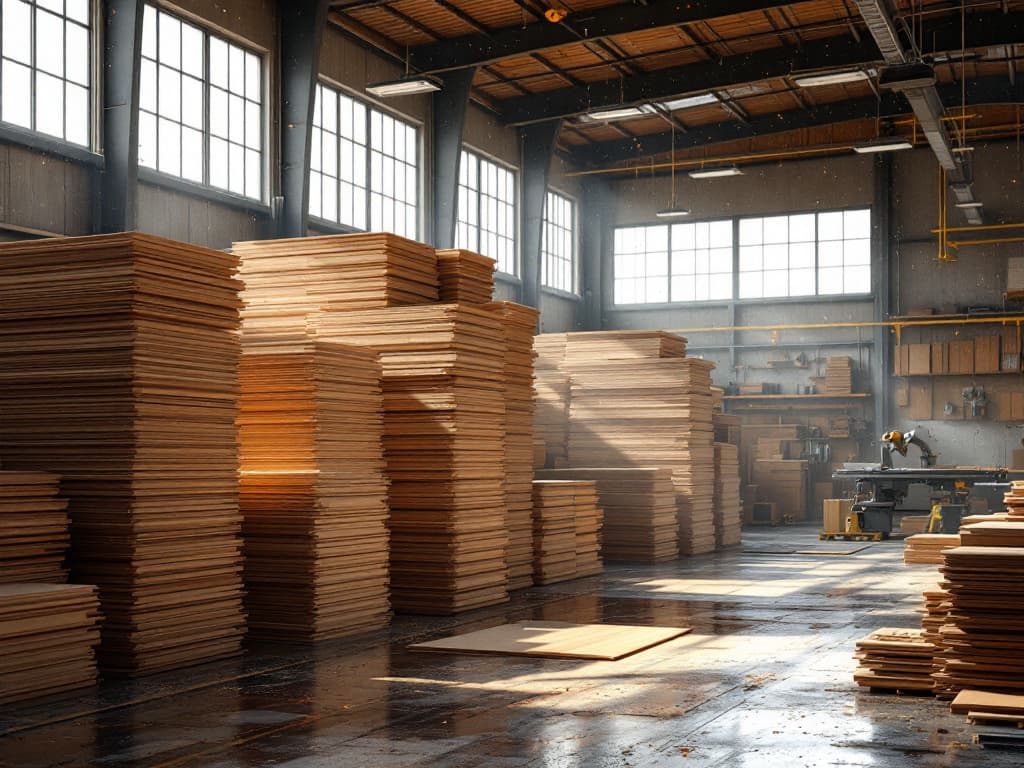

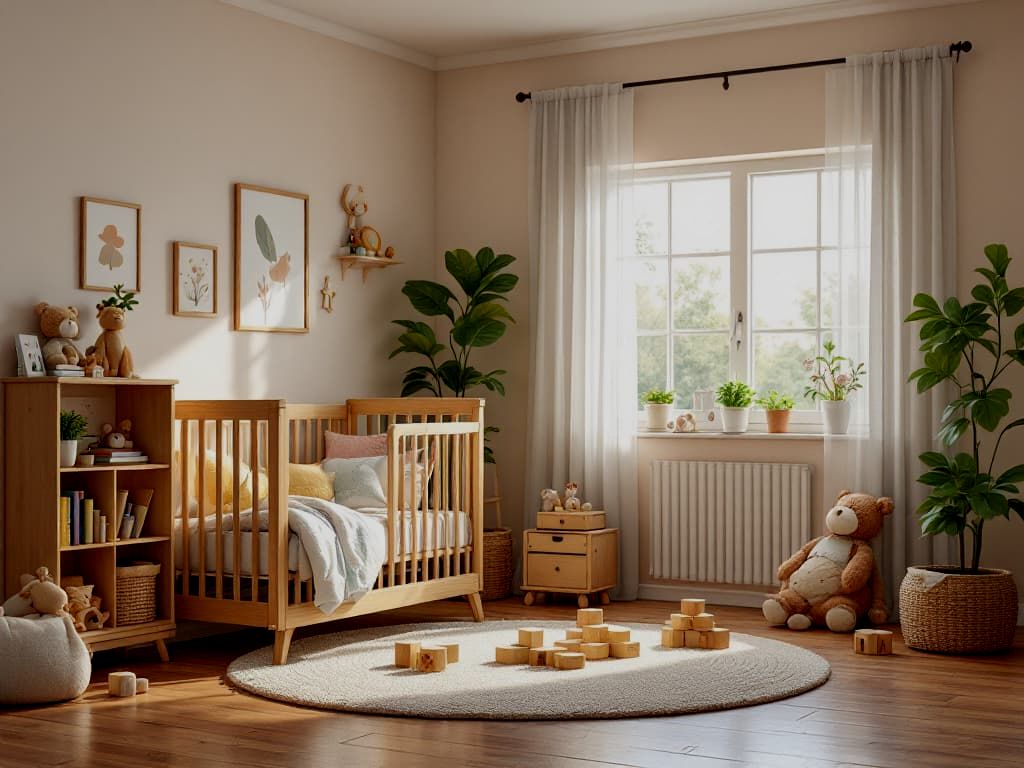
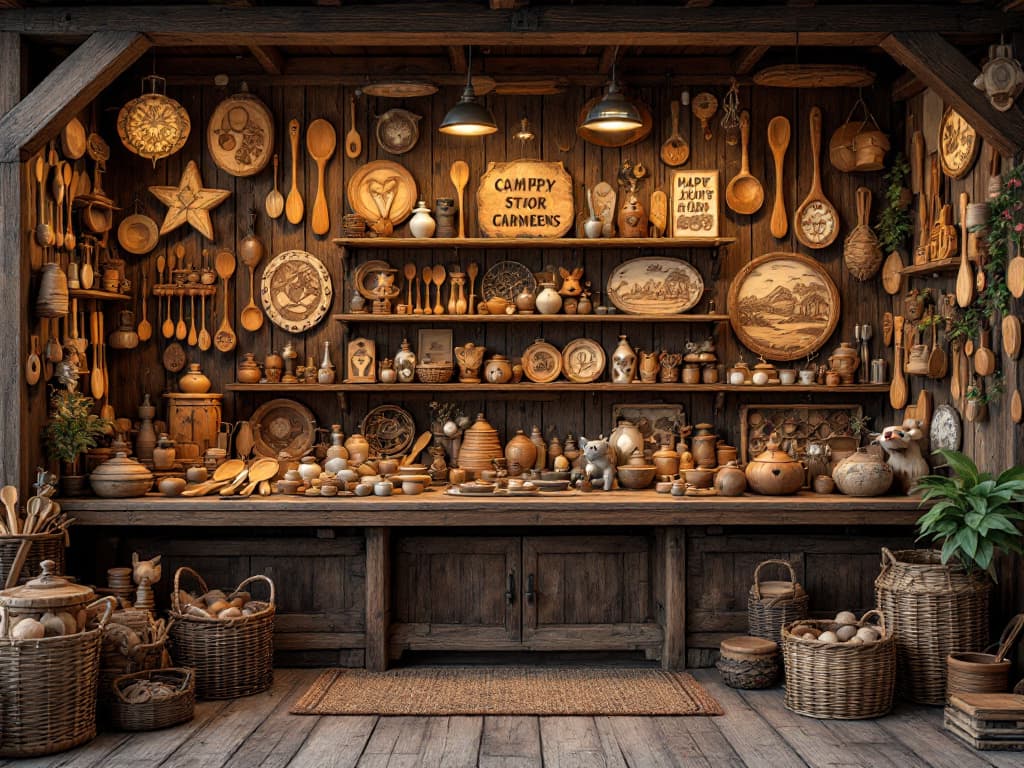

The variety of the wooden sports goods category: from fitness to gymnastics
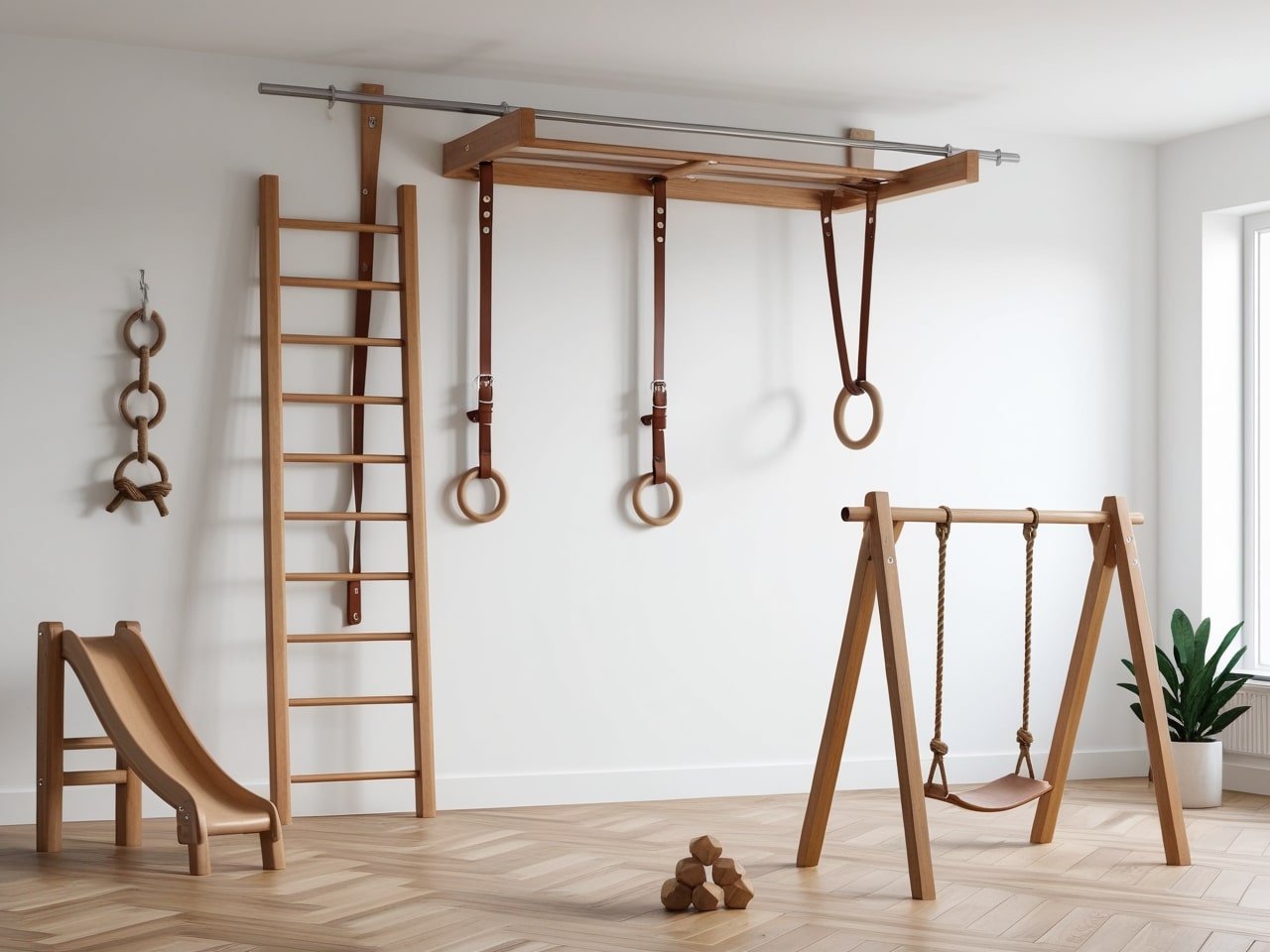
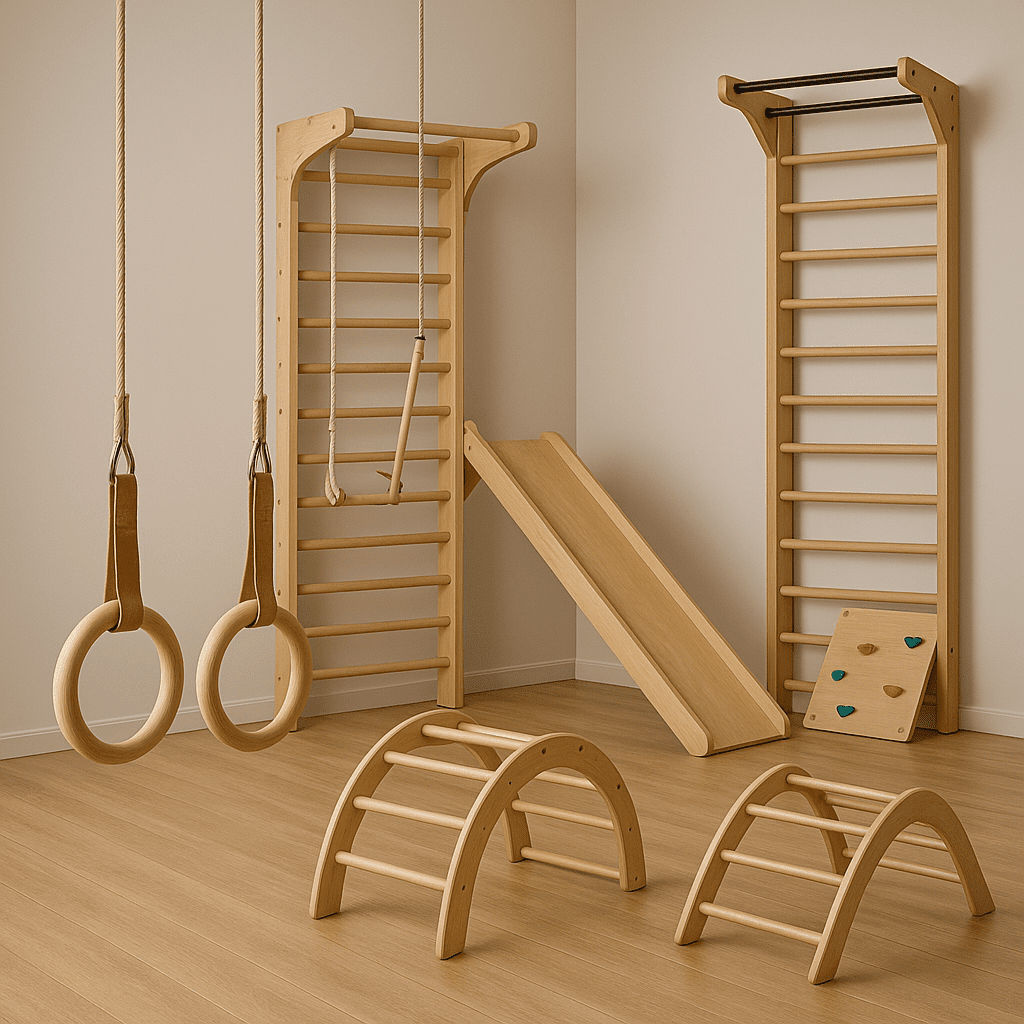
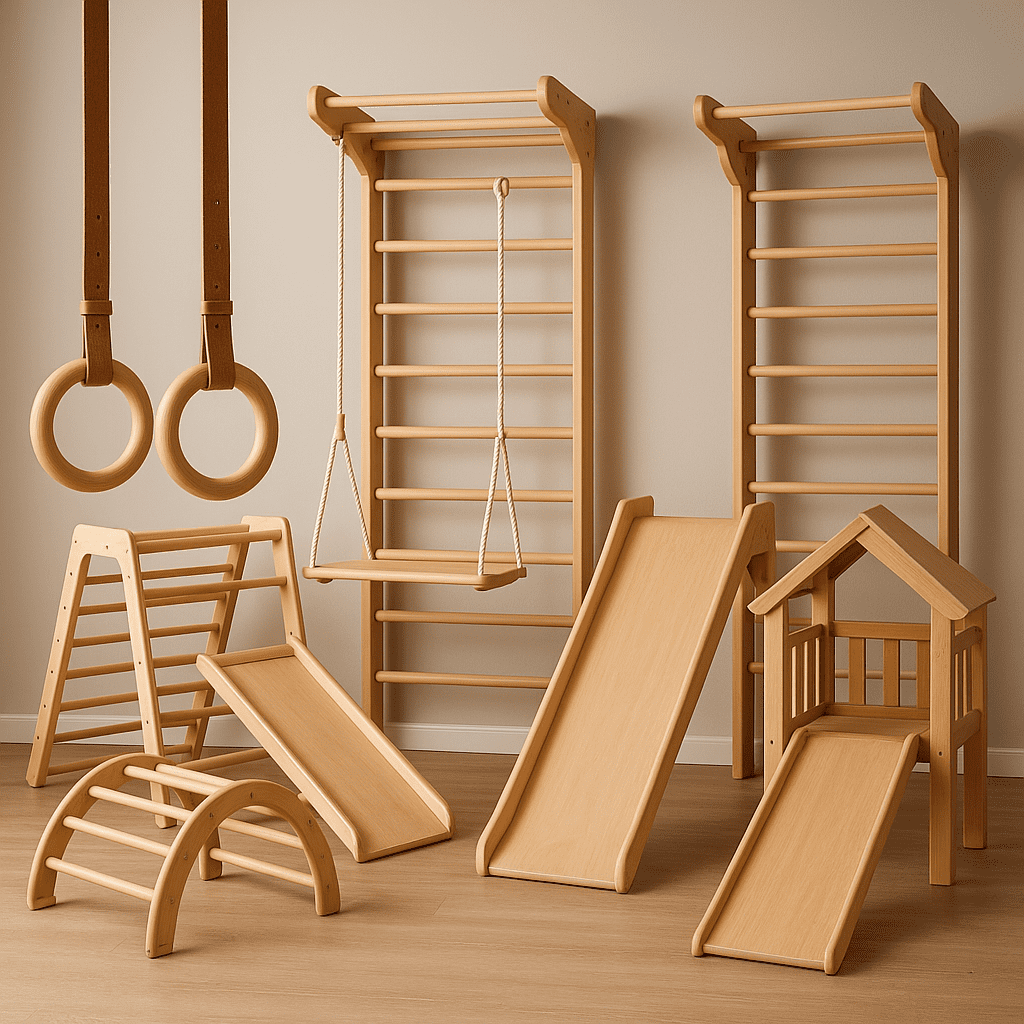
The range of wooden sports gear is wider than it seems at first glance. The category flagship is the wall bar: essentially a base to which add-ons attach, and at the same time a standalone trainer for strength, flexibility and endurance. A wooden wall bar beats a metal one not only in its warm look: wooden rungs are more pleasant to grip, do not slip with sweat and do not chill the hands, and fitting one into a home interior is far easier than a painted pipe. For a nursery it is also safer — a warm surface, rounded edges, no icy metal.
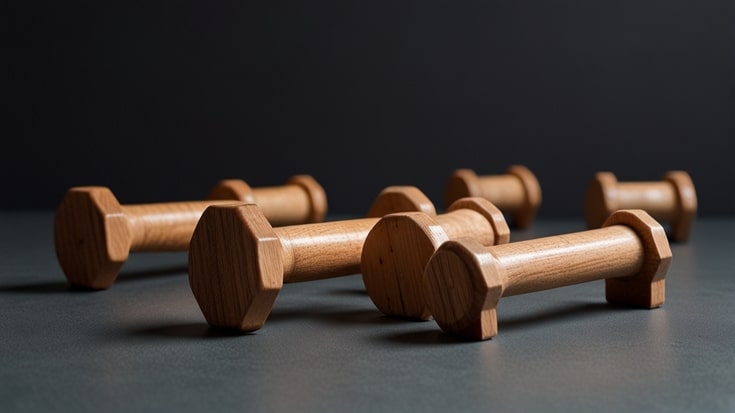
Next come gymnastic rings — an apparatus where wood holds first place for objective reasons. In gymnastics and CrossFit wooden rings are valued for a firm grip and the fact that chalk lies on them evenly while the hand does not slip. Further down the list — balance boards for coordination, push-up handles that spare the wrists, benches for working with weights. Each of these items targets its own muscle group and its own task, and together they form a full set for a gym or a home corner.
The outdoor line stands apart — pull-up bars, parallel bars, sit-up benches, workout rigs and children’s play areas. Here wood faces heightened demands for water resistance: the apparatus stands under rain and sun year-round, so it is impregnated and coated with compounds for outdoor use. But the result is worth it: a wooden area in the yard or at the country house looks like a living part of the landscape rather than an industrial structure, while staying fully functional.
Our portfolio — finished products
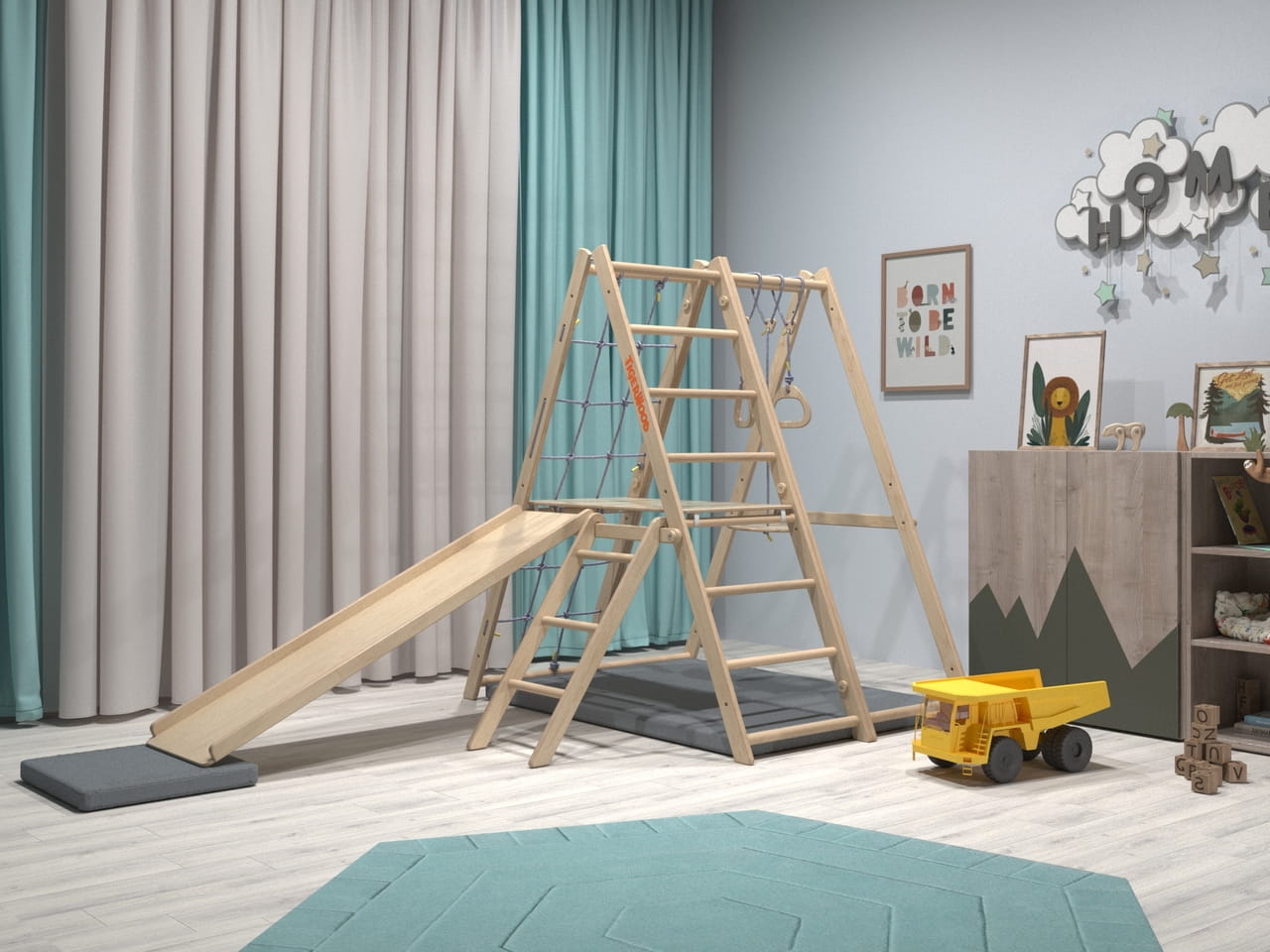
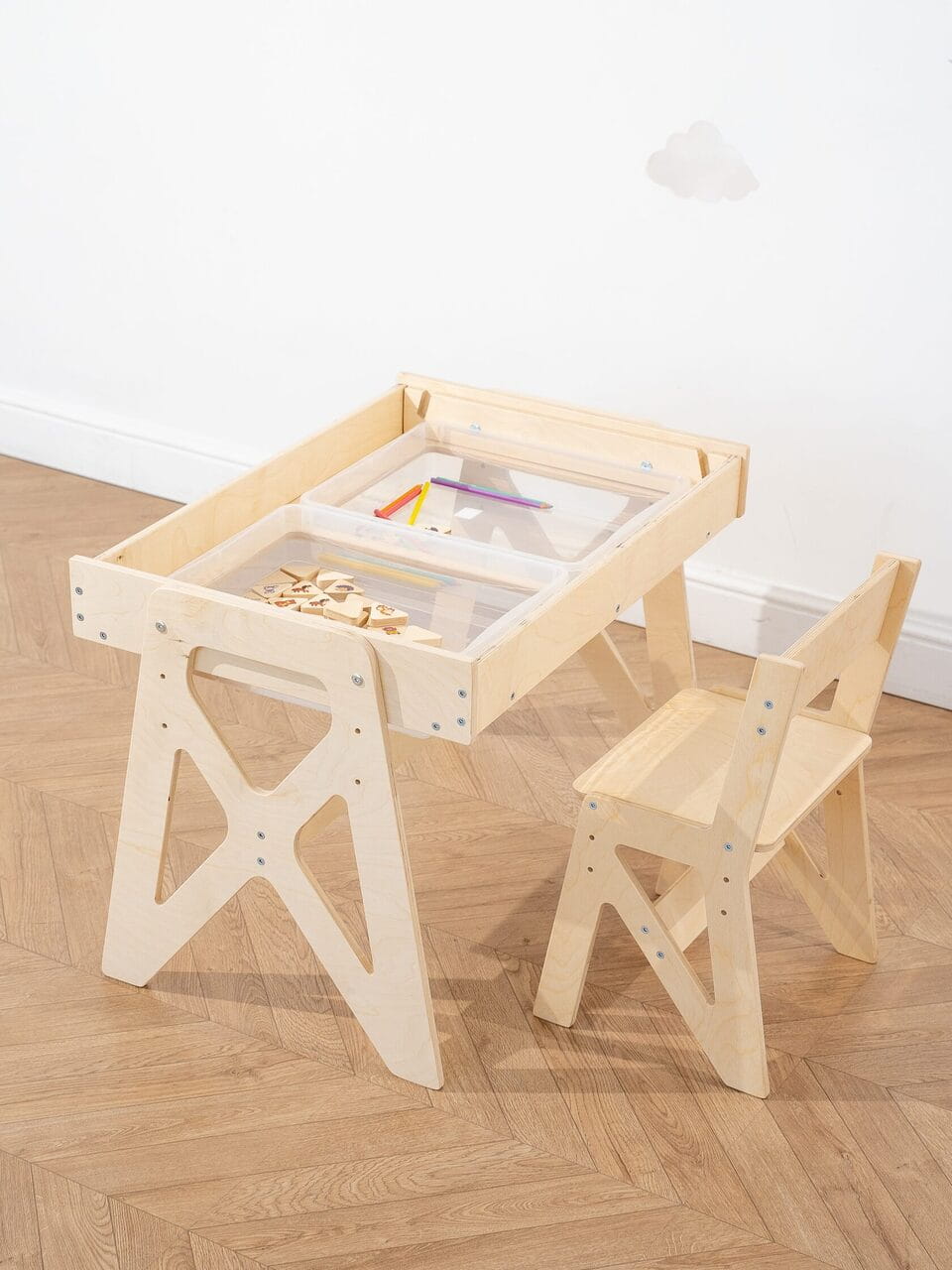


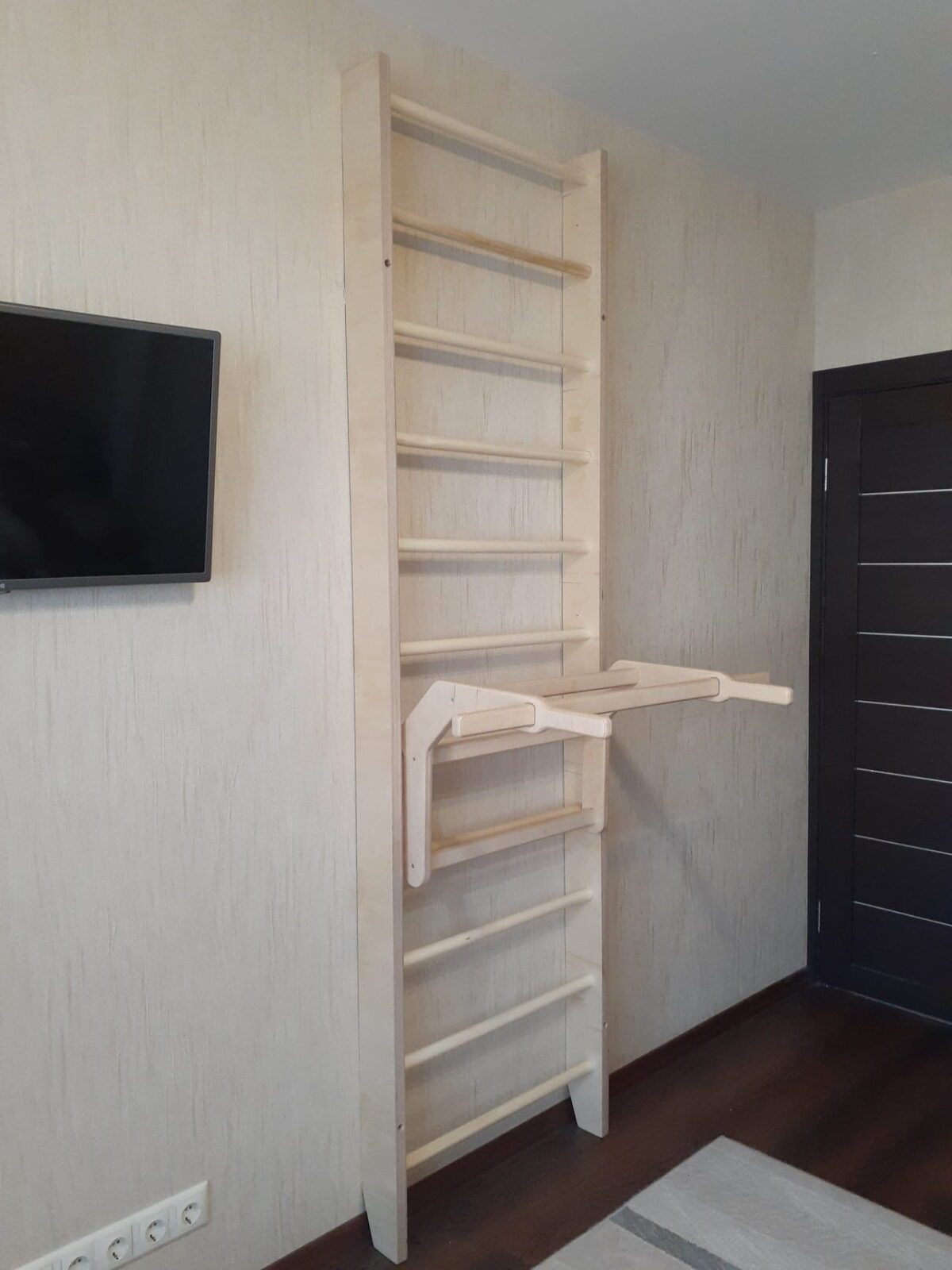
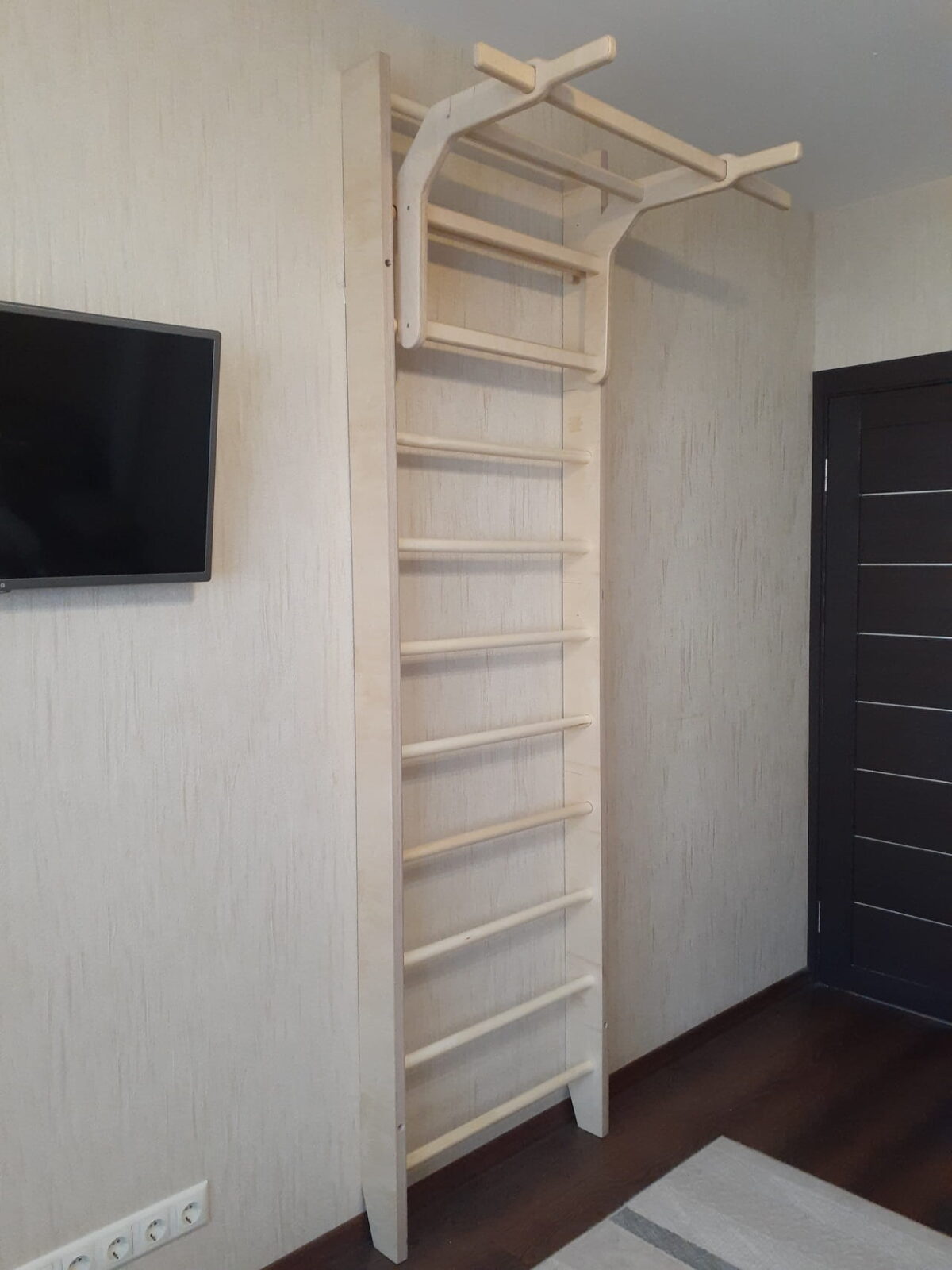
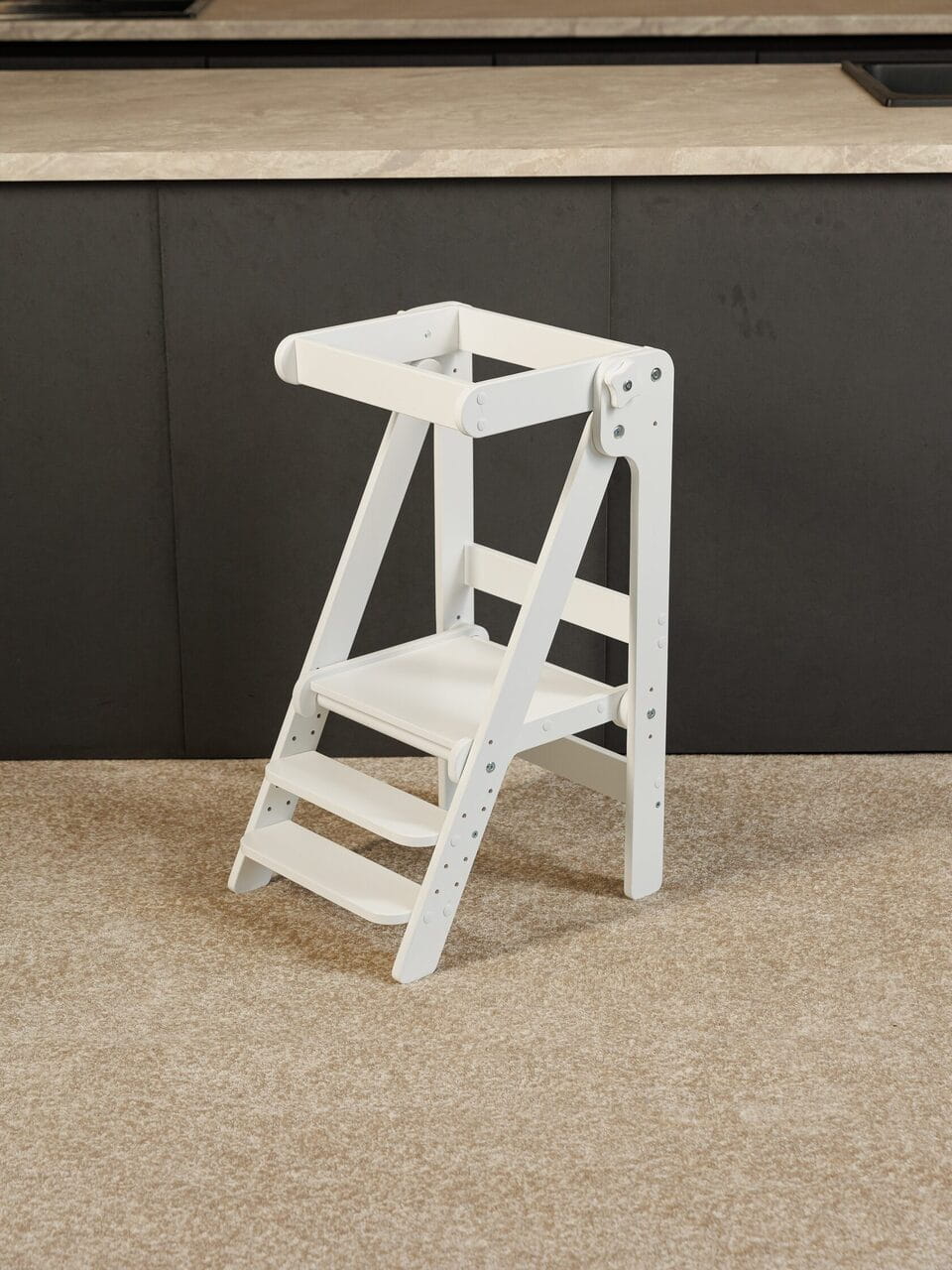
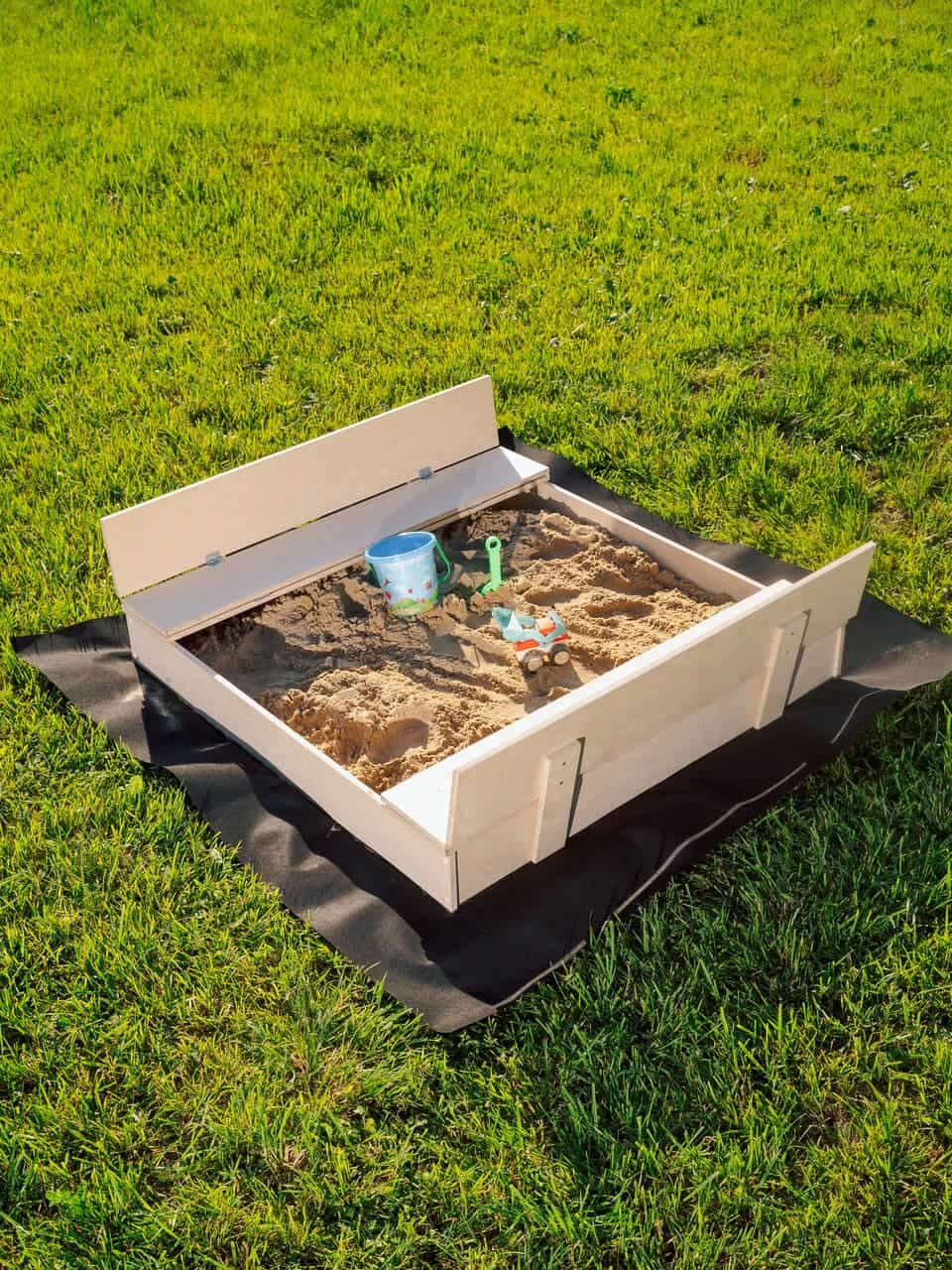

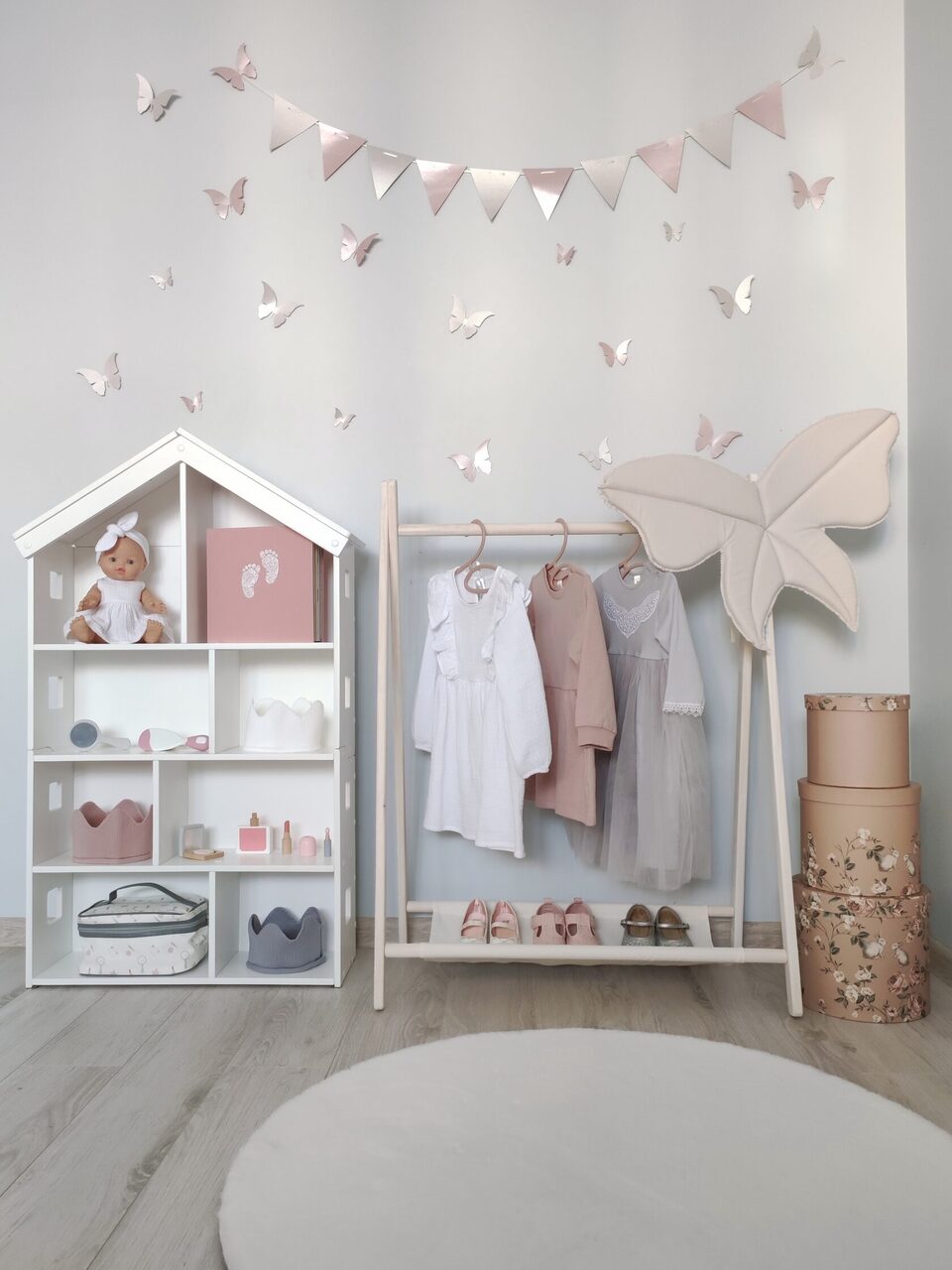

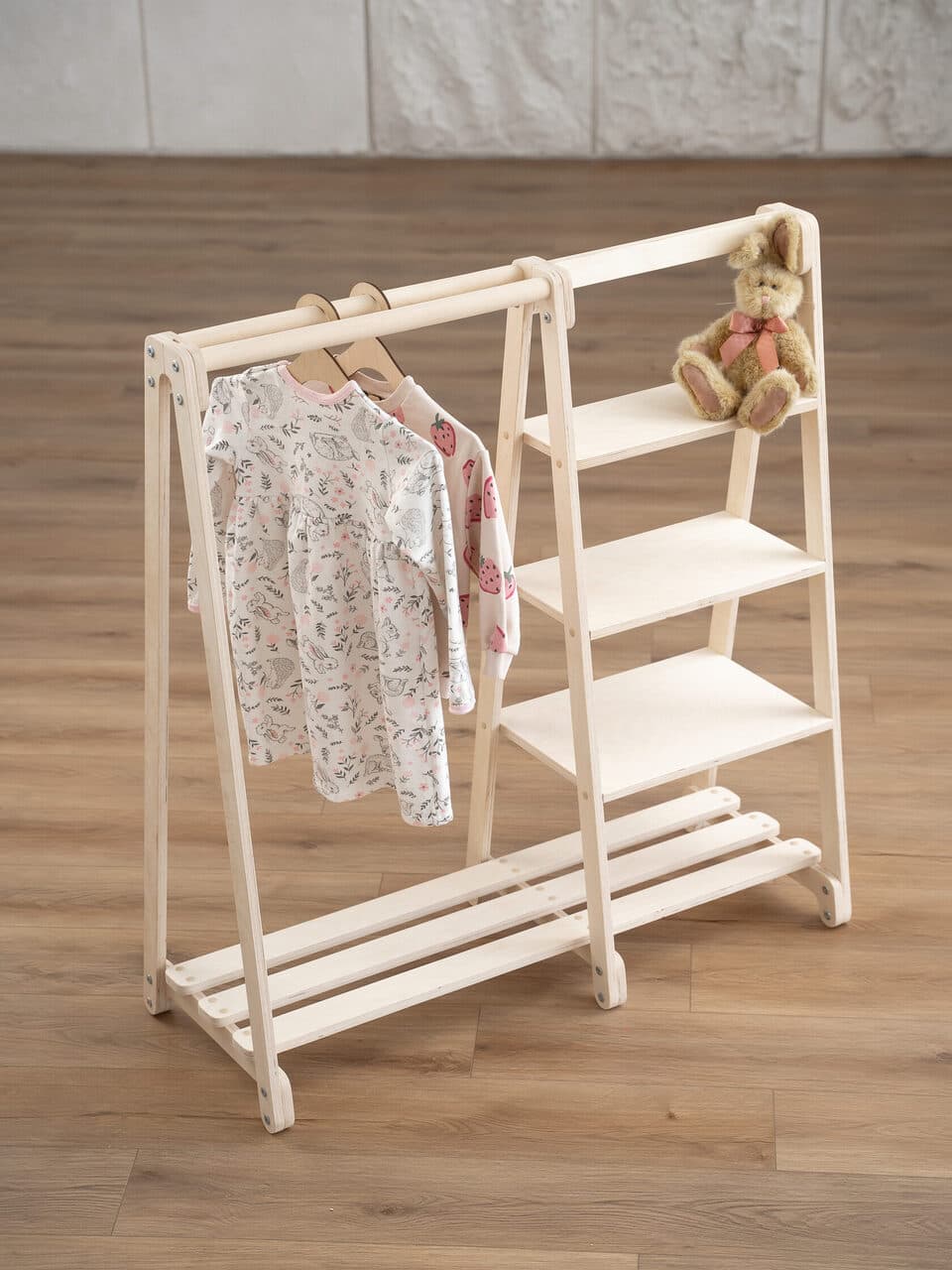
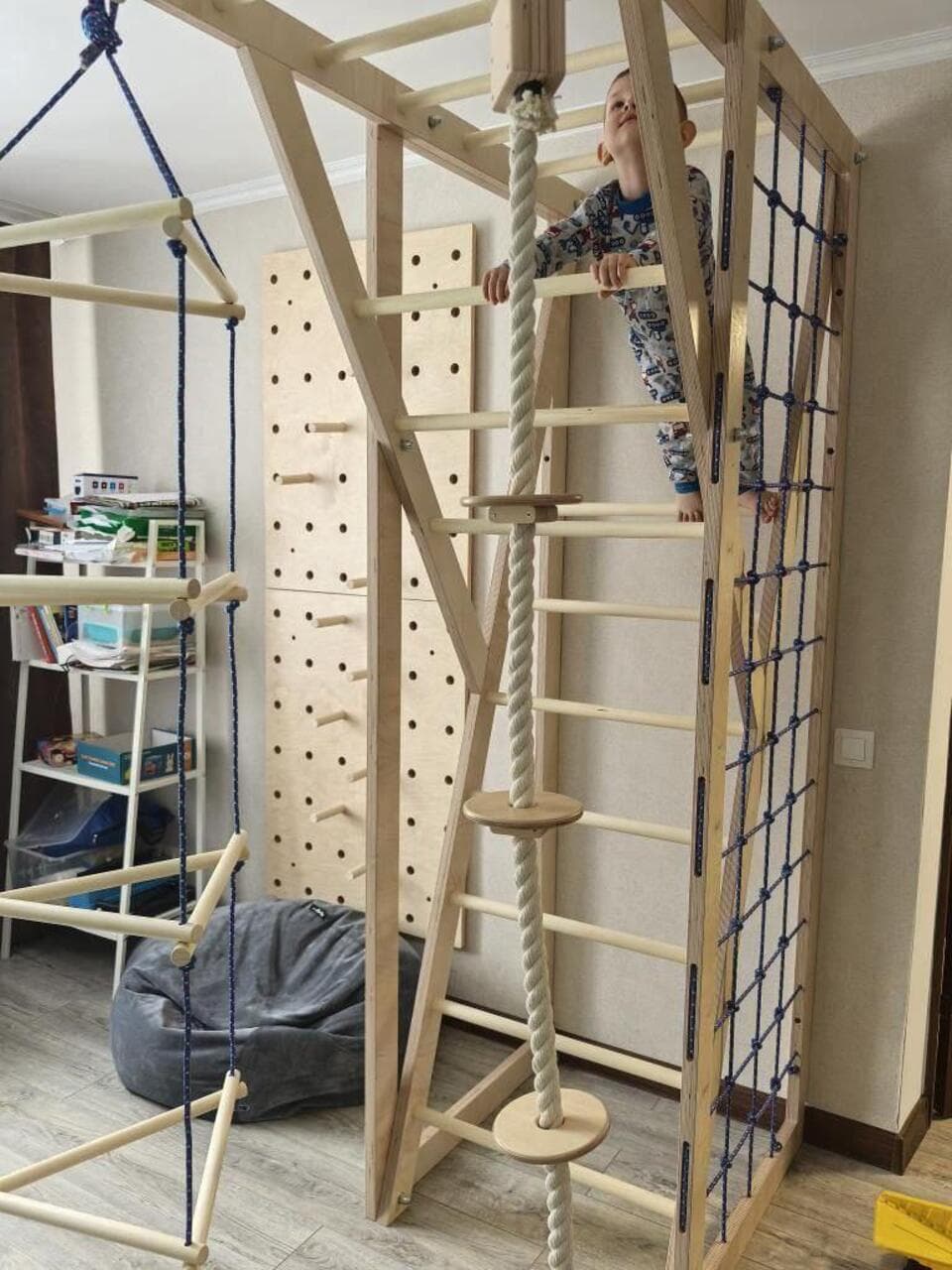
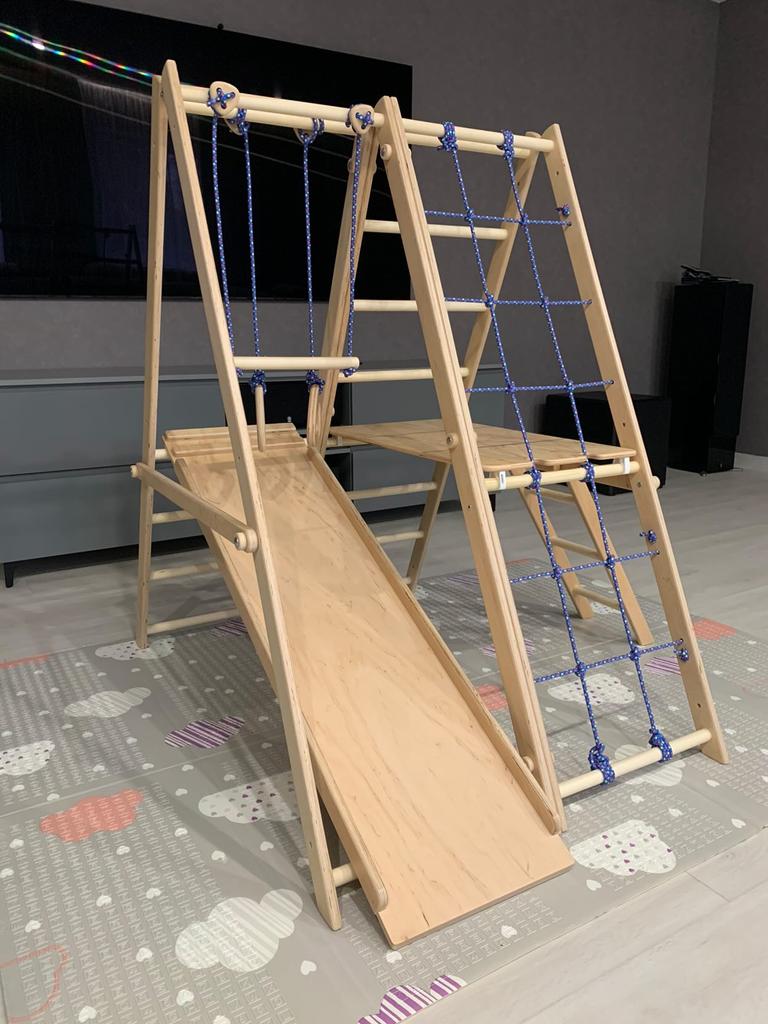

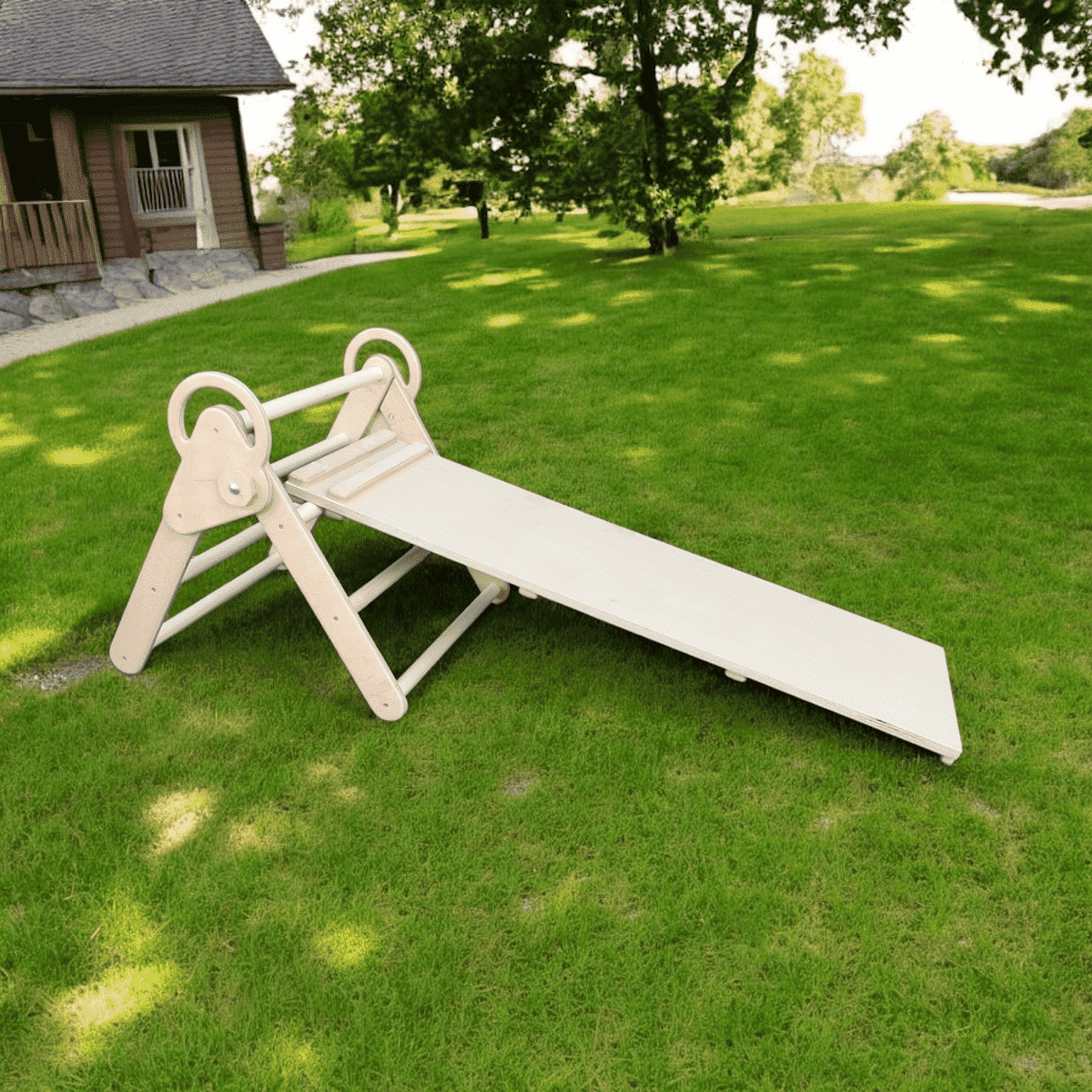

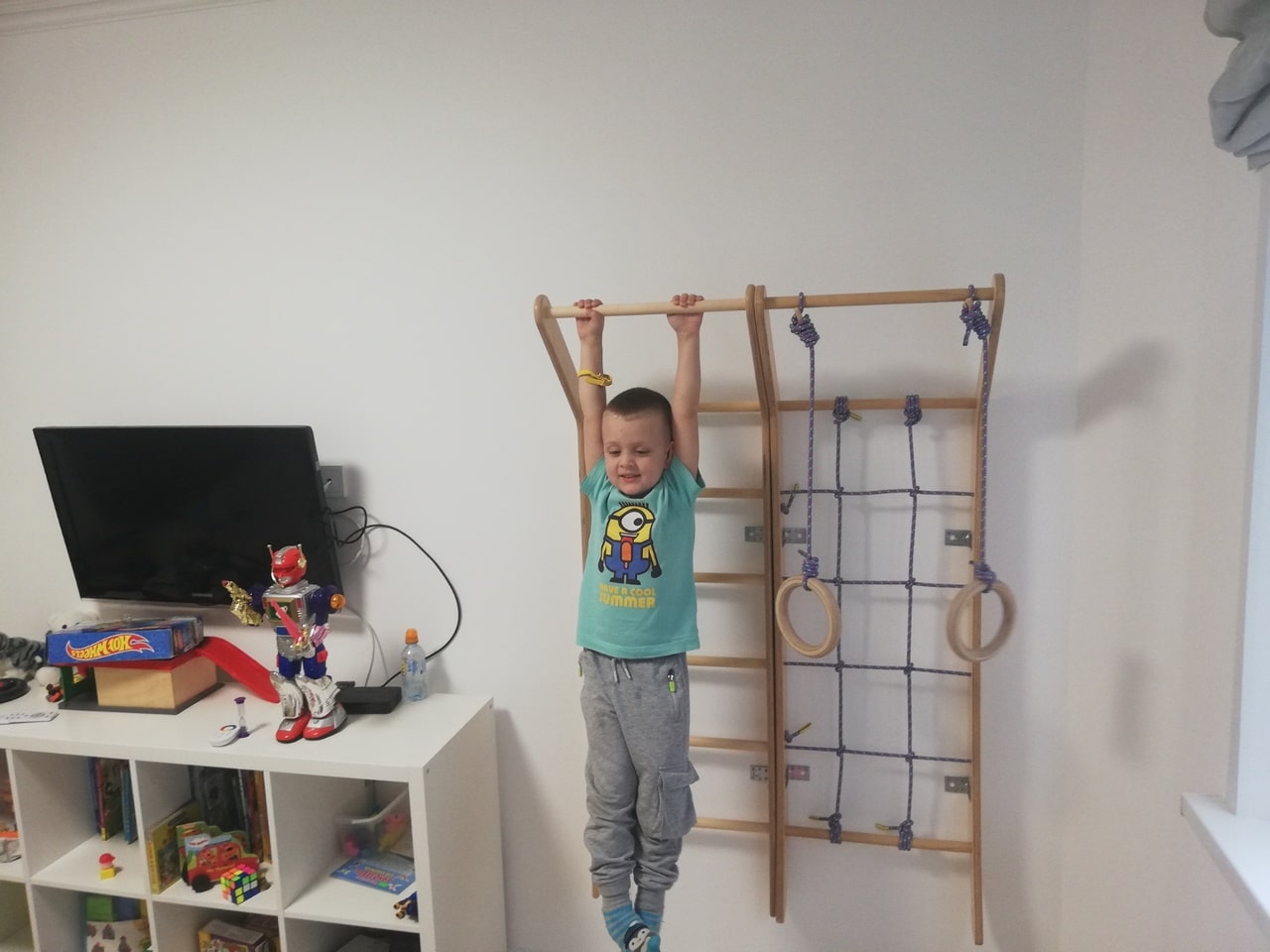


Examples of work: creating unique wooden sports goods for clients across Europe
So that the conversation does not stay in generalities, here are a few typical orders from practice — they went to various sports centres and gyms across Europe. What unites them is that in every case we considered not only “will it hold or not” but also how the apparatus would look in the space. Function and appearance go hand in hand here: the client cares both that the equipment works for years and that the gym impresses the visitor from the doorstep.
One large fitness centre ordered a series of identical wall bars for a modern gym interior — it was important that all sections looked like a single set, with no mismatch in shade or geometry. Higher-strength material went into the work, and the timber was additionally treated against cracking and warping: apparatus by panoramic windows gets both sun and humidity swings, and without such protection it would behave unpredictably. In the end the gym got a durable set that both holds the load and keeps its looks.
Another order was a batch of gymnastic rings for a sports school where children train on the apparatus. Here safety and hygiene were put first: the rings were treated with a compound that stops bacteria multiplying on a surface touched daily by dozens of hands. The geometry and fixings were separately verified so the load would spread evenly and the hanger would not work loose over time. For a school this is critical — the gear there is not spared, and the reserve of reliability must be built in with a surplus.
Whether it is a single balance board to order or the assembly of a whole outdoor rig, the principle is the same: attention to the small things that in sport translate into safety. It is precisely from such details — the right species, verified fasteners, honest inspection — that gear is built which you can trust with a person’s health under load.
Who uses a carpentry workshop’s services

Furniture makers

Interior designers

Advertising companies

Exhibition stand builders

Art studios

Cafés and restaurants

Construction firms

Retail equipment manufacturers
Furniture factories

Private craftsmen

Custom orders

Manufacturing companies

Museums and exhibition halls

Architects

Theatres and film studios

Educational organizations

Children’s products manufacturing

Repair specialists

Online stores

Sole proprietors
Who the client is for wooden sports goods: from sports centres to small-wholesale orders
Who orders wooden sports gear? The circle is wide. On one side — organisations: sports centres, fitness clubs, schools, clubs, rehabilitation rooms. They need equipment that will survive intensive use and yet not spoil the gym’s look. On the other — the reputational side matters to them too: wooden gear reads as “expensive and tasteful”, which for a paying club is part of the marketing. So the choice of wood here is about more than function; it is about how the establishment wants to look in the visitor’s eyes.
Small studios — yoga, stretching, children’s fitness, functional training — gravitate to wood especially readily. Their stake is atmosphere: a warm, quiet, “homey” space holds a client better than a cold weights hangar. Wooden gear sets exactly this tone. And often, for the visitor, the feeling of cosiness and care matters more than the amount of iron in the gym — people return to where they enjoy being.
A separate and growing segment is private clients. People increasingly set up a sports corner at home or at the country house, and wooden gear suits this perfectly: it does not clash with the interior of a living space, serves for a long time and does not look like a foreign body in the living room or on the terrace. Plus the option to order non-standard — a wall bar exactly to the ceiling height, rings for a specific mount, a colour to match the furniture. A universal shop model will not allow that, but making to order does easily.
Overview and key features of wooden sports goods
High quality and versatility of wooden sports goods
In recent years wooden sports gear has ceased to be exotic and taken its place alongside the familiar metal. More and more centres and gyms across Europe deliberately choose wood — not out of fashion, but because it closes several requests at once: strength under load, years of service life and a pleasant look that works on the establishment’s atmosphere. The result is a rare combination where practicality and aesthetics do not argue but reinforce each other.
Production covers the whole range — from an apparatus for a home corner to the outfitting of an entire gym or a school sports facility. Rings, wall bars, balance boards, handles, benches, outdoor rigs: behind each stands the same approach to comfort, safety and durability. And it is not about “making it pretty once” but about gear that survives daily pull-ups, jerks and the weight of dozens of people without working loose. It is precisely the everyday load that is the main exam for sports equipment.
Safety and eco-friendliness of wooden sports goods
Eco-friendliness is not an empty slogan on a label but a tangible property. Wooden apparatus does not smell of chemistry, releases nothing into the gym air and is safe for someone who literally hangs on it for hours. There is a pleasant physical bonus too: wood does not chill the hands. In winter you would not want to grab a metal bar with bare palms in an unheated room, but a wooden one — by all means. Add the light shock absorption of the fibre, which softens part of the impact load on the joints, and it becomes clear why even those who once chose only metal are switching to wood.
Wood also lends itself excellently to processing, and this opens up scope for the finish. Sanding brings the surface to a smoothness at which splinters do not happen; lacquer and paint not only set the look but create a protective barrier. Thanks to this the apparatus is not afraid of moisture from sweat, gym dust and ordinary dirt — a wipe is enough and it is like new again. Wood properly sealed with a coating does not darken or swell for years, which means the gear stays both usable and tidy throughout its long life.
Why are wooden sports goods in demand among clients?
Demand for wooden sports gear rests on a simple combination: it both works as it should and looks good. It is chosen not only for the naturalness of the material but for that very atmosphere which metal and plastic are powerless to create. An iron machine solves its task and stops there. A wooden one does the same but additionally works on the space — it becomes part of the interior rather than just equipment dumped in a corner. For an establishment competing for the client through impression, this is a tangible plus.
An individual approach and made-to-order production
And, perhaps, the key thing — all of this can be done for a specific request. A wall bar of non-standard width for a niche, rings with a particular grip diameter, reinforced treatment for outdoor use, a colour to match the club’s branding — any of these wishes are built in as early as the design stage. The client does not have to adapt their space to a ready-made apparatus; on the contrary, the apparatus is designed for their space and task. That is the point of made-to-order production: to get exactly what is needed, not the nearest similar thing off the shelf.
Wooden sports goods: a breakdown for the client
Next — practice with no generalities: which species make what, how the load is calculated, how gear for the home, the gym and the outdoors differ, how much it costs and takes in time, and which mistakes are most often made when ordering. All of it from real work, not from an advertising brochure.
Wood species and what is made from them
Choosing the species for a sports apparatus is first of all about safety, and only then about look and price. Soft pine will do for decorative side panels and light parts, but hanging a loaded bar on it is asking for trouble. Hardwoods — oak, beech, ash — work under weight and jerk without bending or cracking, which is why all the load-bearing elements fall to them. Below is a short cheat sheet to make clear where each material is appropriate.
| Material | Where it is used | Feature |
|---|---|---|
| 🌳 Oak | Bars, rings, load-bearing parts | Very strong, abrasion-resistant |
| 🪵 Beech | Rings, handles, parallel bars | Dense, pleasant to grip |
| 🌲 Ash | Wall bars, rigs, loaded joints | Springy, holds jerk loads |
| 🪵 Birch plywood | Balance boards, side panels, platforms | Strong, does not delaminate |
| ⬜ MDF / MFC | Decor, unloaded elements | Even surface, budget-friendly |
If you are unsure of the choice, it is easier to describe the apparatus and its usage regime — the suitable material will be suggested. It often turns out that costly solid wood is needed only for loaded parts, while the rest is comfortably made from plywood with no loss of reliability.
Load and strength: how it is calculated
The main difference between sports equipment and ordinary furniture is that it is calculated for dynamics, not for a static weight. A person does not just hang on the rings: they swing, jerk, drop off and hang on again. In these moments the load multiplies well beyond their own weight. That is why the apparatus is designed with a confident reserve — not “exactly to 100 kilograms” but with a margin that covers jerks, mistakes and years of material fatigue.
The weak link in such a structure is almost always the fasteners and joints, not the wood itself. That is exactly why they get special attention: anchors, hinges and hangers are chosen with the same margin as the load-bearing parts. One underestimated bolt can nullify the strength of the whole item, however sound the wood around it. That is the difference between a garage DIY job and an apparatus you can trust with your health.
Gear for the home, the gym and the outdoors
The same apparatus for different conditions is made differently, and this is no whim. Home gear is about compactness and looks: it must fit into a room and not clash with the interior, and the loads there are usually more modest. Gym gear is about durability: dozens of people a day, intensive use, so strength and coating wear resistance are the priority. Outdoor gear is about weather resistance: here protection from moisture, sun and temperature swings plays the key role.
Confusing these categories is a typical mistake. Home gear taken outdoors without the appropriate treatment will grey and crack in a single season. Outdoor gear placed in a room will be excessively heavy and rough. That is why, when ordering, it is clarified right away where the item will live — the material, the coating and the design of the fixings all depend on it.
Coatings and surface treatment
The finish on a sports apparatus carries a double function: protection and grip. Too smooth a glossy lacquer on rings or a bar slips with sweat — that is dangerous. So in the grip zone a matt or slightly rough surface is often left, one that chalk lies on well. The other parts are sealed with lacquer or oil for protection from moisture and dirt. For outdoor gear, weatherproof compounds are used that do not fade or wash off in the rain.
Before any coating the surface is thoroughly sanded — this is not cosmetics but safety. Under-sanded wood threatens splinters, and on an apparatus you grab with your palms a splinter is a common and painful thing. A well-finished surface is pleasant to the touch and does not catch the skin even in a sharp movement.
Lead times and what makes up the price
The exact price and lead time are calculated for a specific order, but their components are clear. The cost is affected by the wood species, the complexity of the design, the batch volume, the type of treatment and the urgency. A simple apparatus costs less than a multi-section rig, and a series works out cheaper per piece than a single item. Below are lead-time guidelines so you can plan.
| Order type | Lead-time guide |
|---|---|
| 🤸 Rings, handles, small gear | from 2–4 days |
| 🧗 Wall bar | from 5–7 days |
| 🏋️ Rig with add-on equipment | from 10 days |
| 🌳 Outdoor rig / play area | by arrangement |
| 📦 Serial batch | by arrangement |
The longest part is usually not assembly but the drying of the coating and, for complex orders, the making of tooling for a series. If the gear is needed by a date — a gym opening, the start of the season — it is wise to get in touch early and allow a small time buffer.
Common mistakes when ordering
Most problems arise not in production but at the task-setting stage. Here is what most often prevents getting the right result the first time.
- ❌ Did not specify where the apparatus will stand. Home and outdoor gear are made differently — without this a slip in the treatment is possible.
- ❌ Measuring “by eye”. A wall bar not sized to the ceiling height — and it has to be redone or trimmed.
- ❌ Saving on the species for load-bearing parts. Soft wood under load is a direct risk.
- ❌ Forgot about wall mounting. The wall type (concrete, brick, plasterboard) determines the anchors and the very possibility of installation.
- ❌ Last-minute urgency. The drying of the coating cannot be sped up without loss of quality.
It is no disaster if some of this is not accounted for — that is exactly what the conversation before the start is for. A competent manufacturer asks these questions himself before the work begins, not after, when fixing things is already costly.
Installation, delivery and acceptance
It is not enough to make a sports apparatus — it must be fixed correctly, and safety depends on this no less than on the strength of the item itself. Wall-mounted structures such as wall bars require reliable fixing to a load-bearing wall, and the type of anchors is chosen to match the wall material. Plasterboard, for example, does not hold such a load on its own — you need to reach a load-bearing base. These nuances are talked through in advance so that on site it does not turn out there is nowhere to hang the apparatus.
Delivery is arranged across Europe; large and outdoor structures are often transported disassembled and put together on site. On receipt it is worth inspecting the item right away: check the geometry, the tightness of the fixings, the absence of chips and cracks. A properly packed apparatus arrives undamaged, but a quick acceptance check is a healthy habit, especially when it comes to load-bearing equipment.
Care of wooden gear
Wooden apparatus is undemanding, but a couple of simple rules noticeably extend its life. It is enough to wipe the surfaces of sweat and dust — moisture should not stand on wood for long. Once a season it is useful to inspect the fasteners and tighten any loosened joints: from constant dynamics any joints eventually work loose. If the coating in the active grip zone has worn through, it is easy to renew — this restores both the protection and the pleasant texture.
- 🧽 Wipe off sweat and dust, do not leave moisture on for long.
- 🔧 Once a season check and tighten the fasteners.
- 🖌️ Renew the coating in active grip zones as it wears.
- ☀️ Protect outdoor gear from constant standing water, renew the protective compound.
- ⚖️ Do not exceed the apparatus’s rated load.
One-off order or a series
The format of work is flexible. A private client for the home usually needs one or two items — they are made by the piece for a specific room. Gyms, schools and club chains more often require a batch of identical gear, and here tooling comes into play that speeds up production and guarantees all items are identical. On a series the price per piece also drops. Both formats work — the only difference is in the preparation and the lead time.
Many come with a single trial order and then return for additions — and this is easier if the apparatus has already been through production: the parameters and colour are known, and the new item is matched to the existing one. So even a one-off order often becomes the start of a long collaboration.
Glossary: sports equipment terms
A short decoding so you can speak the same language as production and describe the task more precisely.
| Term | What it is |
|---|---|
| 🧗 Wall bar | A wall-mounted frame with rungs, a base for add-on equipment |
| ⭕ Gymnastic rings | A suspended apparatus for gymnastics and CrossFit |
| ⚖️ Balance board | A platform for training coordination and balance |
| 🤸 Push-up handles | Handles that take the load off the wrists |
| 🔩 Anchor | A fastener for fixing the apparatus to a wall or floor |
| 🌦️ Weatherproof coating | A compound to protect outdoor wood from moisture and sun |
More questions about wooden sports gear
Will a wooden pull-up bar hold an adult man? Yes, if it is made from a hardwood and fixed correctly. The apparatus is designed with a load margin covering both the weight and the jerks. What matters is not only the bar itself but the reliability of the wall fixing.
Won’t the apparatus dry out and crack in a heated flat? The timber is dried to working moisture content in advance, so in ordinary room conditions the item is stable. Sharp swings and proximity to a radiator are still best avoided — as with any wooden thing.
Can I order gear for children? Yes, and it is a frequent request. Children’s gear is made with reduced dimensions, rounded edges and heightened attention to the safety of the fasteners and the surface treatment.
Is it realistic to reproduce a model I like? Most often yes — from a photo or a sample, adjusted for your dimensions and materials. A ready example serves as a starting point, then the design is adapted to the task.
If your question is not on the list, it is easier to ask directly during the discussion. Wooden sports goods are convenient precisely because the whole path from idea to finished apparatus is led by a single maker, responsible for the result in full.
Why wood works out cheaper than metal in the end
On the price tag a wooden apparatus often looks dearer than a metal analogue, and many stop there, not counting further. But it is worth counting. Metal gear in the intensive regime of a gym wears through its paint, rusts where chipped, and tubular grips chill the hands and slip with sweat, so some visitors simply avoid them. A wooden apparatus from a hardwood serves for years, is easily restored rather than thrown out when the coating wears, and all that time works for comfort and for the establishment’s image. Per year of service life and per client retained, the difference in starting price pays off many times over.
For a private client the logic is the same, only on a domestic scale. A cheap pull-up bar bought on a marketplace lasts until the first serious jerk or the first outdoor season. An apparatus made from the right wood for the specific conditions survives both, and is even handed down, as they say, by inheritance. Saving at the start almost always turns into a second purchase — and a second purchase costs more than one done right.
Wood in rehabilitation and children’s sport
There are areas where gear is treated with special scrutiny, and wood is valued there not for aesthetics but for its properties. In rehabilitation and therapeutic exercise, gentle contact, the absence of cold and slippery surfaces and the predictability of the apparatus all matter. Balance boards, low wall bars and coordination platforms made of wood work more delicately than metal and are psychologically perceived more calmly by patients — less of a “weights gym” feeling, more trust in the process.
In children’s sport, safety comes to the fore. A warm surface, rounded corners, the absence of sharp edges and toxic chemistry — for a children’s zone these are not wishes but requirements. A wooden apparatus meets them naturally, and skilled processing adds resistance to the fact that children do not spare the gear. It is no accident that wall bars in children’s rooms and nurseries are more often wooden: with them both parents and carers rest easier.
Add-on equipment and modularity
The strong side of a wall bar is that it rarely stays on its own. A pull-up bar, parallel bars, a sit-up bench, a board and rings are hung on it — and from a single frame a whole training rig grows. When ordering, this is worth thinking through in advance: if you provide fixings and a strength reserve for the add-ons, the wall bar will not have to be redone later. A modular approach saves both space and money — instead of five separate apparatuses you get one base with a set of accessories.
For gyms this is also flexibility. The configuration can be changed to suit current tasks: today a zone for functional training, tomorrow for a children’s group. Well-thought-out modularity turns stationary gear into a construction kit that adapts to the schedule and the audience rather than dictating them. In the design, such scenarios are built in from the outset so that a finished item does not have to be drilled on site.
Branding and gym styling
A sports gym today competes not only on training programmes but on atmosphere, and here wooden gear becomes a marketing tool. Apparatus in a single palette, with a logo on a visible part, with a coating in the corporate colours — all of it works on recognisability and on the impression the client takes away and posts on social media. Ready-made shop gear does not allow such personalisation, but making to order does easily.
Branding is not necessarily about loud logos. Sometimes it is simply a neatly maintained style: one species, one shade, a single geometry throughout the gym. Such a space reads as considered and expensive, even if the budget was moderate. Wood here plays the long game — it does not age as fast as fashionable finishings, and years later still looks appropriate.
Workout and outdoor areas
The outdoor line has grown noticeably in recent years: courtyard workout zones, country-house rigs, park areas. Wood works especially organically here — it fits into the landscape, does not heat up in the sun the way metal does, and creates a sense of a natural rather than an industrial space. But the demands on it are higher: the apparatus is under the open sky year-round, so water-resistant treatment and correct installation into the ground or onto a base become critical.
Such projects are usually comprehensive: pull-up bars, parallel bars, monkey bars and benches are combined into a single zone with a considered logic of movement between the apparatuses. They are designed with account of the loads, the weather and the fact that the area will be used by people of varying fitness without an instructor’s supervision. Here the strength reserve and safety come to the fore even more strictly than in a gym.
Quality control and warranty
Control is built into the process, not tacked on for show at the end. On intake the material is checked: species, moisture, the absence of cracks and defects in loaded zones. Along the way — the geometry and fit of the parts. On output the apparatus is tested for strength and stability, the fixings and surface are inspected. Only after passing all stages does the item go to the client, not “broadly ready, it’ll arrive — we’ll sort it out”.
A warranty on such products is not just a marketing line but a consequence of this control. When an item has passed through one pair of hands and been checked at every stage, standing behind it is not frightening. And if a question does arise, it is easier to resolve precisely because responsibility is not smeared across contractors: there is someone to ask. For the client, that is real peace of mind.
To bring it all together: wooden sports goods are gear in which strength, safety and a pleasant look do not argue with one another. It is enough to describe the task and the conditions where the apparatus will work — the rest will be broken into stages, calculated for the load and brought to a finished item you can trust with a person’s health.
Orders for marketplaces and brands
A separate category of clients are those who sell sports goods under their own brand: marketplace sellers, sports-gear shops, manufacturers who find it more convenient to outsource the joinery part. For them it is important not only the quality and price per piece but the consistency of the batch, packaging to the platform’s requirements and predictable delivery times. Production for such a request works as outsourcing: the client handles sales and the brand, while the partner takes on the making, control and completion.
The benefit here is that you do not have to invest in your own workshop, machines and staff for the sake of a series of wooden apparatuses. The tooling for the run is prepared once, then batches come out identical, and scale is grown without emergencies. For a growing brand this is a way to test demand and reach volume without freezing money in production assets.
Combined materials in a single item
Not every apparatus is made entirely of solid wood — often it is wiser to combine. Load-bearing parts of hardwood, side panels and platforms of strong plywood, decorative elements of MDF, metal reinforcements and fasteners where there is no doing without them. Such a hybrid approach lets you keep strength where it is critical and not overpay for solid wood where a simpler material is enough. At the same time the weight of the finished item drops, which is convenient both for installation and for delivery.
A skilled combination of materials is exactly the engineering work the client need not see, but whose result they feel in the price and reliability. The manufacturer’s task is to distribute the loads so that each material stands in its place and works to purpose, rather than “oak for oak’s sake” throughout the item.
Seasonality and order planning
The sports line has its own peaks. Before the start of the school year, demand grows for gear for schools and clubs; in spring outdoor and country-house projects pick up; towards the New Year holidays — home apparatus as gifts. In these periods the production queue is tighter and lead times naturally stretch. If an order is tied to a date — a gym opening, the start of the season, a specific event — it is wiser to get in touch early and book the time rather than count on production at the last moment.
Regular clients gain in this sense: their tasks are already familiar, and a slot in the schedule is easier to agree in advance. Planning solves half the problems with lead times in general — it spares you the rush that always comes at the expense of quality, especially at the coating-drying stage.
How to choose a manufacturer
If you are choosing whom to trust with a sports-gear order, there are several signs by which a serious approach is visible. They are simple, but they weed out most dubious options.
- ✅ Asks about the usage conditions and the wall type before the work begins, not after.
- ✅ Names the wood species and explains why exactly it suits your load.
- ✅ Designs with a strength reserve, not “just enough” by weight.
- ✅ Pays attention to the fasteners and installation, not only the item itself.
- ✅ Gives clear lead times and price in advance and confirms the warranty.
A good contractor asks the right questions himself — a sure sign that he is thinking about the safety of your apparatus, not only about shipping it out quickly. In sport the price of carelessness is too high, so meticulousness at the start is only a plus here.
Why rings are historically made of wood
An interesting fact: at major gymnastics competitions the rings are traditionally wooden, and this is no tribute to the old days. Wood has optimal grip with chalk and skin — the hand does not slip even at the limit of the load, and the grip stays predictable. Plastic is more treacherous in this respect: it is either too smooth or turns sticky with sweat. Metal chills and slips. Wood, though, was found by experience as the golden mean decades ago, and since then nothing better has been devised for this apparatus.
The same principle explains why wooden handles, bars and rails are valued outside gymnastics too. Where a long, confident contact of the palm with the apparatus matters, the natural texture of wood beats synthetics simply by feel. This is not nostalgia but ergonomics, proven by millions of repetitions.
Production ecology and waste
The eco-friendliness of wooden gear begins not in the gym but in the workshop. Skilled cutting minimises waste: large offcuts go to small parts, shavings and trimmings do not turn into mountains of rubbish. Wood itself is a renewable material, and an item made from it does not become a disposal problem at the end of its service life, unlike plastic. For clients to whom the environmental agenda matters — and there are ever more such among sports brands — this is a tangible argument, not just a pleasant bonus.
Add to this the long service life: a thing that works for years and is restored instead of replaced is in itself more eco-friendly than disposable solutions. Less thrown away, less produced anew — simple arithmetic, equally good for the environment and for the budget.
How to start an order
Starting is easier than it seems. It is enough to describe what you need: which apparatus, for the home, gym or outdoors, for what loads and into what space it will go. Even without a drawing and exact dimensions, this is enough to sketch out the design, material and lead time. If there is a photo of a model you like or the approximate dimensions of the room — even better, the conversation goes more to the point. Then the task is translated into the language of a project, the species and treatment are selected, and the price and lead time are named before the work begins.
The discussion itself commits you to nothing and often turns out useful in itself: at this stage details surface that the client had not thought about — the type of wall fixing, the reserve for add-on equipment, the nuances of outdoor use. Such a conversation saves both money and time and removes half the questions before the apparatus even goes into production.
What materials are used to make wooden sports goods?
Loaded parts use hardwoods — oak, beech, ash. They are dense, abrasion-resistant and hold weight without bending. Soft species are not used for load-bearing elements — only where there is no load.
What treatment do the wooden items undergo to increase their durability?
The surface is sanded to smoothness and then sealed with lacquer, oil or paint. The coating protects from moisture, sweat and sun, removes the risk of splinters and noticeably extends the apparatus’s service life.
Can wooden sports goods be ordered as custom items?
Yes, that is the main format of work. The dimensions, shape, colour and type of treatment are selected for your room and task — from a wall bar for a specific ceiling height to rings with the required grip diameter.
How safe are wooden sports goods?
Every item is designed with a load margin and checked before shipment — geometry, fixings, the absence of sharp edges. The material is natural, without harmful chemistry, so the apparatus is safe both in strength and in composition.
How long do wooden sports goods last?
With adequate care — many years, even in a regime of daily use. Hardwoods and a protective coating hold the load for a long time; occasionally it is worth inspecting the fasteners and, if needed, renewing the coating.
Are wooden goods suitable for outdoor use?
Yes, but with a caveat: outdoor use requires reinforced treatment — impregnations and coatings for external application that protect from rain, sun and temperature swings. With such protection, pull-up bars and rigs stand comfortably in the yard year-round.
What advantages do wooden goods have over plastic or metal ones?
Wood is more natural and does not chill the hands, gives a firm grip without slipping from sweat, slightly cushions the load on the joints and simply looks more pleasant. Metal and plastic win on price but yield on comfort and atmosphere.
Can sports equipment be ordered for the home?
Yes, a home corner is one of the most frequent requests. A compact wall bar, rings, parallel bars or a balance board are made for the specific room and mount, so the apparatus fits both a room and a country-house terrace.
What does the process of ordering wooden sports goods involve?
First the task and conditions are discussed, then the material and dimensions are selected, a project is prepared for your requirements and only then is the making launched. If there are special design wishes, they are built in at the design stage.
Is there a warranty on wooden sports goods?
Yes, the products come with a warranty — both a confirmation of quality and peace of mind for the client. The terms are agreed for the specific order depending on the type of item and the usage regime.
Reach us in whatever way suits you best
Call us, message us on a messenger app or reach out via social media — choose whichever way suits you
🗺️ We accept orders from clients across Europe
💬 Useful information and articles
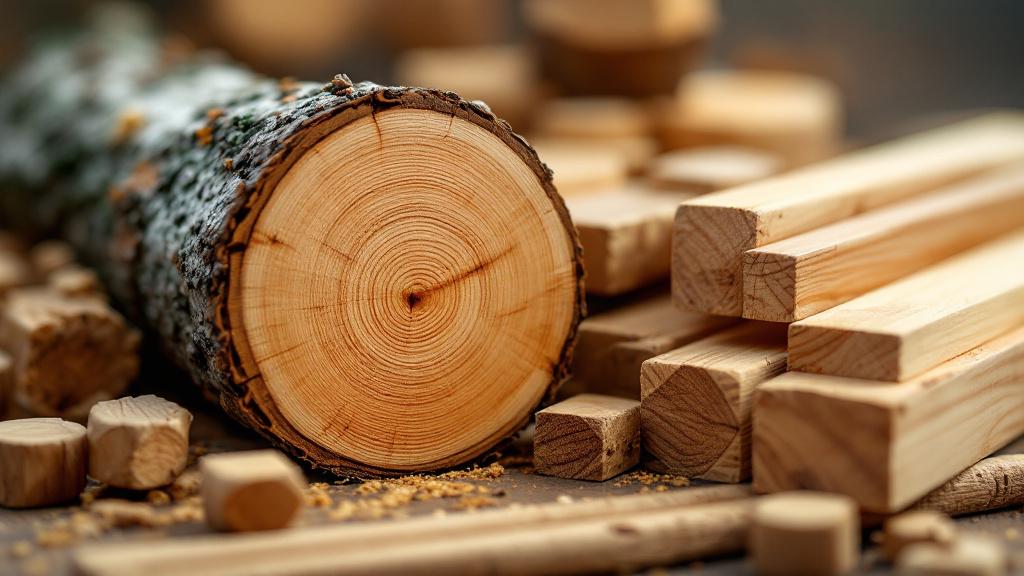
Eco-friendly and safe materials for modern wood production
Eco-friendly and safe materials for modern wood production In recent years we increasingly think about what the things around us are made of. A home, furniture, a floor, a kitchen, a

How to Correctly Choose Between Plywood, MDF, Particleboard, and MFC for Different Tasks
How to Correctly Choose Between Plywood, MDF, Particleboard, and MFC for Different Tasks In the world of woodworking and furniture making, every material has its own story. Plywood, MDF, particleboard, and

Cutting sheet wood materials at different angles: why and how it is done
Cutting sheet wood materials at different angles: why and how it is done Working with wood materials is not just sawing. To get a truly high-quality and durable product, you have

Recommendations for choosing sheet materials for indoor and outdoor projects
Recommendations for choosing sheet materials for indoor and outdoor projects In woodworking, choosing the right sheet material is like laying a foundation for a builder. What you pick at the very