How a CNC router works and why it is needed in furniture production
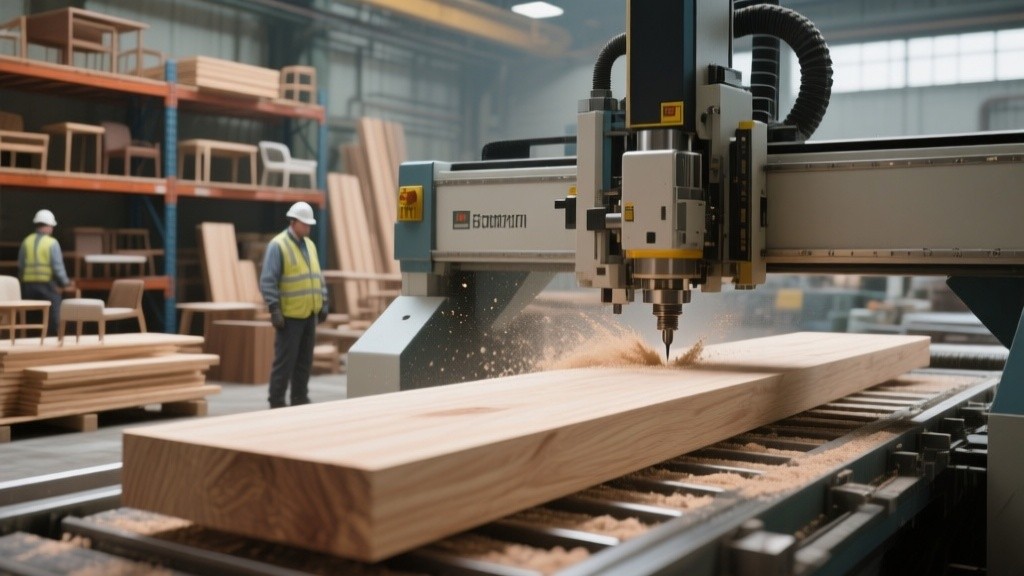
Imagine a workshop of the future, where intricate patterns appear on wood with mathematical precision and furniture parts are cut with such speed and consistency that it seems they were created not by a human hand, but by something greater. This is not science fiction, but the reality of modern furniture production, made possible by CNC (Computer Numerical Control) routers. These machines have radically changed the approach to woodworking, opening the door to designs that were previously unthinkable and optimising processes to an incredible degree.
Understanding how a CNC router works is the key to appreciating its value. In essence, it is a smart milling robot. Instead of a joiner guiding the cutting tool across the workpiece by hand, relying on experience and a good eye, the CNC machine does this under the control of a computer program. The operator creates a digital model of the part, sets the cutter’s path, and the machine flawlessly turns this digital drawing into a real object. This makes it possible not only to speed up production, but also to achieve the highest quality and repeatability of products, whether it is the serial output of kitchen fronts or the creation of an exclusive carved panel.
What a CNC router is and what it consists of
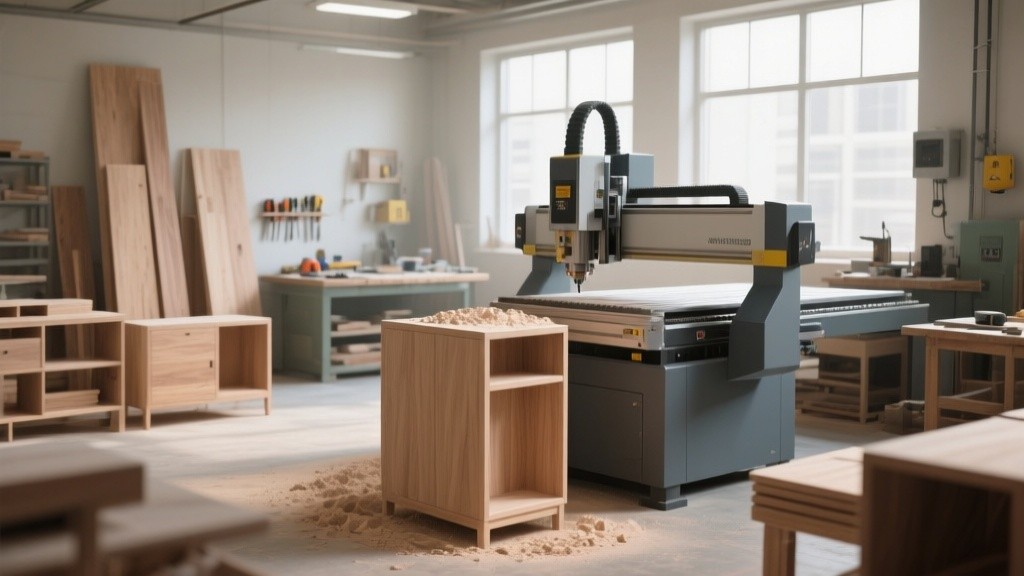
To understand how this technology works its magic on wood, you need to look “under the hood” of the machine itself. A CNC router is not just a single mechanism, but a complex system in which each component performs its own clear function. The basis of everything is the bed — a massive, rigid base that dampens vibrations and ensures the stability of the entire structure. The heavier and stronger the bed, the more accurate the machine’s work will be, since the slightest oscillation can ruin a part. The guide rails along which the other parts of the machine move are mounted on the bed.
The working “heart” of the router is the spindle. This is a high-speed motor that rotates the cutting tool — the cutter. The power and rotation speed of the spindle determine which materials the machine can work with and at what speeds. For machining soft woods such as pine or alder, a less powerful spindle may be sufficient, while for hardwoods such as oak or ash considerably more power is required to ensure a clean cut and avoid overheating the tool. The spindle’s cooling system, whether air or water, also plays an important role, preventing it from overheating during prolonged operation.
The movement of all the working parts is provided by the gantry and the stepper motors (or servo motors). The gantry travels along the X axis (along the bed) and the Y axis (across the bed), while the spindle on the gantry moves along the Z axis (up and down). It is precisely this three-dimensional coordinate system (X, Y, Z) that makes it possible to cut parts of any complexity. The stepper motors are responsible for precise positioning. They receive commands from the controller and rotate by a strictly defined angle, moving the gantry and spindle to the required point with an accuracy of hundredths of a millimetre. More expensive, high-performance machines use servo motors, which provide even greater precision and speed thanks to feedback with the controller.
And finally, the “brain” of the whole system is the CNC controller. This computer receives the G-code (the control program), interprets it and sends electrical signals to the motors, controlling each of their steps. The controller synchronises movement across all axes, regulates the spindle rotation speed and executes every command embedded in the digital model. The performance of the controller determines how complex and smooth the paths the machine can follow without jerks or delays. All of these components, working in unison, turn an ordinary piece of wood into a complex and precise product.
The working principle: from digital model to finished part
The process of creating a product on a CNC router begins long before the cutter touches the wood. It all starts in the digital space. The first and most important stage is the creation of a three-dimensional (3D) or two-dimensional (2D) model of the future product. A designer or engineer uses specialised software such as AutoCAD, SolidWorks, ArtCAM or Fusion 360 to draw a precise drawing or a solid model of the part. At this stage all the dimensions, shapes, curves, holes and patterns are worked out. The more detailed and accurate the model, the higher the quality of the final product will be.
Once the digital model is ready, it is time to create the control program (CP). This is where CAM systems (Computer-Aided Manufacturing) come into play. The CAM program analyses the created model and converts it into a set of commands the machine can understand. This set of commands is called G-code. At this stage the operator sets the key machining parameters:
- Cutter selection: Different types of cutters (end mills, engraving, ball-nose) of different diameters and with a different number of cutting edges are used for different tasks.
- Tool path: The program calculates the optimal path along which the cutter will move to cut the part, minimising idle passes and machining time.
- Cutting and feed speed: The operator sets the spindle rotation speed and the speed at which the tool will move through the material. These parameters depend on the type of wood, the cutter diameter and the desired surface quality.
- Depth of cut per pass: To avoid overloading the tool and the machine, material is removed layer by layer. The operator sets how much material thickness the cutter will remove in a single pass.
Once the G-code has been generated, it is loaded into the CNC machine’s controller. The operator then prepares the working area: they securely fasten the wooden workpiece to the machine’s worktable using clamps, a vacuum hold-down or other fastening systems. This is a critically important step, since any shift of the workpiece during operation will result in a reject. Next the “zero” is set — the reference point from which the machine will count all coordinates. The operator moves the cutter to this point on the workpiece and saves its coordinates in the control system.
After all the preparatory procedures, the operator starts the control program. From this moment the machine works autonomously. The controller reads the G-code line by line and passes commands to the motors, which move the spindle along the defined paths with high precision. The cutter, rotating at high speed, removes material, gradually forming the part in full accordance with the digital model. All the operator has to do is monitor the process, keep an eye on the tool’s condition and ensure the chips are cleared away.
Types of milling work on wood with CNC machines
The possibilities of a CNC router in woodworking are practically limitless. The technology makes it possible to perform a wide range of operations, from simple to incredibly complex, which are impossible or extremely labour-intensive to carry out by hand. One of the most common operations is the cutting of sheet materials. CNC machines are ideal for the precise and rapid cutting of plywood, MDF, particleboard and edge-glued panels. The program optimises the arrangement of parts on the sheet, minimising the amount of waste. This makes it possible to produce blanks for cabinet furniture, partitions and decorative panels at high speed.
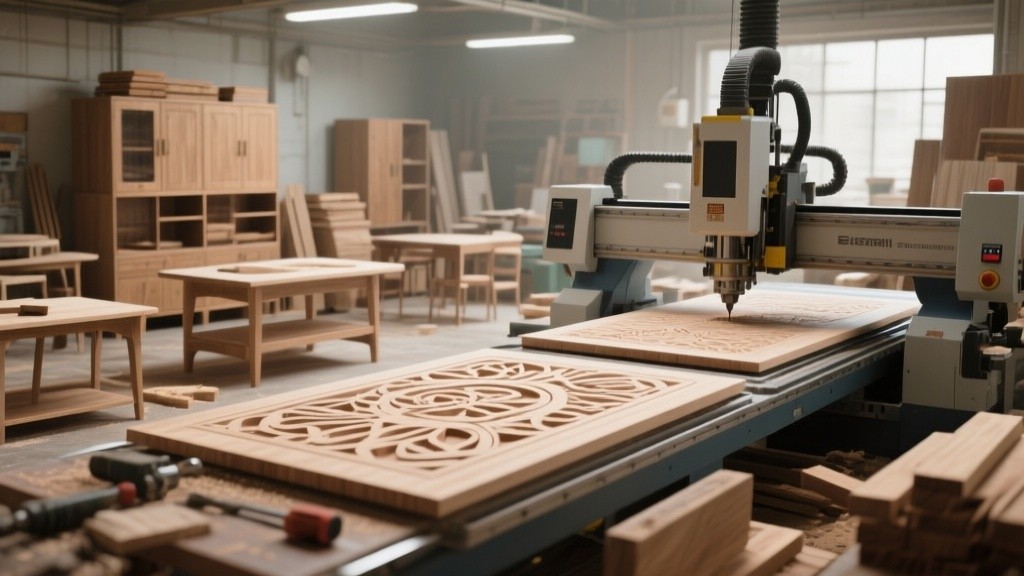
Another important area is 2D milling. This includes cutting out flat parts with a complex curved shape. These can be decorative elements, openwork grilles, letters for signs, parts for children’s toys. The machine easily handles the creation of complex contours, internal cut-outs and grooves. The positioning accuracy ensures a perfect fit of parts during subsequent assembly, which is especially important in furniture production, where even a millimetre of deviation can ruin the entire product.
The real magic begins with 3D milling. This technology makes it possible to create three-dimensional, relief products. Moving simultaneously along three axes (X, Y, Z), the machine is able to carve complex bas-reliefs, turned legs for tables and chairs, decorative overlays for furniture, icons and panels. The cutter gradually, layer by layer, removes material, forming the relief defined in the 3D model. Such work requires special ball-nose or tapered cutters that make it possible to create smooth transitions and work out fine details. It is precisely 3D milling that has opened up new horizons for furniture designers in creating exclusive, artistically valuable objects.
In addition, CNC machines cope excellently with engraving. Any images, logos, inscriptions or ornaments can be applied to a wooden surface. Engraving can be either contour (with a V-shaped cutter) or relief. This is actively used for branding products, personalising gifts, and creating unique kitchen or cabinet fronts. The precision and repeatability provided by CNC guarantee that even the most complex pattern will be reproduced identically across an entire batch of products, something unattainable with manual work.
Advantages of using CNC in furniture production
Introducing CNC routers into furniture production gives companies a whole range of undeniable competitive advantages. The main one is the highest precision and repeatability of products. The human factor, however experienced the craftsman may be, always allows for the possibility of a small error. The machine, on the other hand, works according to a strictly defined program with an accuracy of hundredths of a millimetre. This means that every part in a batch will be an exact copy of the previous one. Such identity is critically important in the serial production of furniture, where all the elements must fit together perfectly without additional adjustment.
The second key advantage is a significant increase in productivity. A CNC machine can work for hours without tiring, at a constant speed and quality. It performs cutting, milling and drilling operations far faster than a human could. While the machine carries out one task, the operator can prepare material for the next or assemble already finished products. This makes it possible to optimise workflows and complete orders in tighter timeframes, which directly affects production profitability.
Another important aspect is flexibility and design freedom. Manual woodworking imposes serious limitations on the complexity of shapes and patterns. Creating complex curved parts or relief carving by hand is long, painstaking and very expensive work, available only to a few master cabinetmakers. A CNC machine removes these limitations. It can just as easily cut both a simple rectangle and the most intricate openwork ornament. This gives furniture designers almost complete creative freedom, allowing them to bring to life the boldest and most original ideas that were previously technically impossible.
Nor should we forget about cost efficiency. Although the initial investment in purchasing a CNC machine can be significant, in the long term it pays off. This happens thanks to several factors:
- Reduction of material waste: CNC programs make it possible to arrange parts optimally on the material sheet (nesting), which keeps the amount of offcuts to a minimum.
- Lower reject rate: Thanks to high precision and the absence of the human factor, the number of ruined workpieces approaches zero.
- Reduced labour costs: A single operator can run one or even several machines, whereas performing the same volume of work by hand would require a whole team of joiners.
Thus, CNC milling is not just a way to speed up work, but a comprehensive solution that takes furniture production to a new technological level, increasing its quality, productivity and competitiveness.
Materials suitable for machining on a CNC router
CNC routers are versatile in terms of the materials they can work with. In the context of woodworking, the range of available options is very wide, which makes it possible to carry out the most diverse projects. Of course, the main material is solid natural wood. The machines successfully handle both soft species (pine, spruce, linden, alder) and hard ones (oak, beech, ash, maple, walnut). Soft species are easier and faster to machine and are ideal for creating decorative elements that are not subject to heavy loads. Hardwoods require more powerful equipment and special cutters, but products made from them turn out strong, durable and have an excellent appearance.
A huge share in furniture production is taken up by wood-based panel materials. CNC routers are excellent for machining them. Such materials include:
- MDF: Medium-density fibreboard is one of the most popular materials for CNC. Thanks to its homogeneous structure, MDF is easy to mill, making it possible to obtain a very smooth and clean cut surface. It is used to make furniture fronts with complex milling (panels, patterns), wall panels and decorative partitions.
- Plywood: This material, made of glued veneer layers, also lends itself well to machining. Parts for cabinet furniture, children’s toys and eco-style interior elements are cut from plywood on CNC machines. It is important to select the cutting parameters correctly to avoid chipping on the top veneer layer.
- Particleboard (MFC): Chipboard, including the laminated kind, is actively used for making furniture carcasses. A CNC machine makes it possible to carry out precise cutting of particleboard sheets and drilling of all the necessary technological holes for fasteners with high accuracy.
In addition to traditional materials, more modern wood-based composites can also be machined on CNC routers. For example, an edge-glued panel — wooden slats (lamellas) glued together. It combines the beauty of natural wood with the stability of a board, which makes it an excellent material for worktops, windowsills and stair treads, which can then be machined on CNC to give them the required shape or apply a pattern.
It is also worth mentioning solid surface material (acrylic stone), which is often used to make kitchen worktops and integrated sinks. Although it is not wood, the technology for machining it on a CNC router is very similar. The machine makes it possible to cut worktops of complex shape, make cut-outs for hobs and sinks, and mill the edges. This versatility makes the CNC router an even more valuable asset for a furniture company that strives to provide clients with comprehensive interior solutions.
Software for working with the machine
The efficiency of a CNC machine depends directly on the software used. The entire software package can be conditionally divided into three large groups, each of which is responsible for its own stage of the production cycle. The first group is CAD systems (Computer-Aided Design), or computer-aided design systems. In these programs, designers and engineers create the visual and geometric foundation of the future product.
In CAD programs, 2D drawings are produced or 3D models are built. These can be either universal engineering packages, such as AutoCAD or KOMPAS-3D, which are more often used for creating precise drawings, or specialised programs for 3D modelling, for example SolidWorks, Autodesk Fusion 360 or SketchUp. For creating artistic reliefs and complex bas-reliefs, programs more akin to digital sculpting studios, such as ZBrush or ArtCAM, are often used. It is precisely at this stage that all the dimensions, shapes and aesthetics of the future product are established. The quality and detail of the model created in the CAD system are the foundation for all the subsequent steps.
The second group is CAM systems (Computer-Aided Manufacturing), or computer-aided manufacturing systems. Their task is to “explain” to the machine exactly how to make the part designed in the CAD program. The CAM module takes the 2D or 3D model and, on its basis, generates the control program (G-code). At this stage the process engineer carries out a whole series of important settings. They select the required cutting tool (cutter) from the library, set the machining strategies (roughing, finishing, engraving) and establish the technological parameters — spindle rotation speed, feed rate, depth of cut. The CAM system visualises the cutter’s path, which makes it possible to identify possible problems in advance, for example a collision of the tool with the workpiece or fasteners. Popular CAM systems are ArtCAM, Mastercam, PowerMill and SprutCAM.
The third, and no less important, group of programs is the software for controlling the machine itself. This is the “control panel” installed on the computer connected to the machine’s controller. This program receives the G-code generated in the CAM system and directly controls the machine’s movement in real time. It allows the operator to start and stop the program, monitor the current coordinates, adjust the operating speed “on the fly”, and also perform manual movements to set up the workpiece and define the zero point. Among the best-known control programs are Mach3, LinuxCNC and NC Studio. The comfort and safety of the operator’s work depend on the stability and convenience of this program.
Applications of CNC milling in the furniture industry
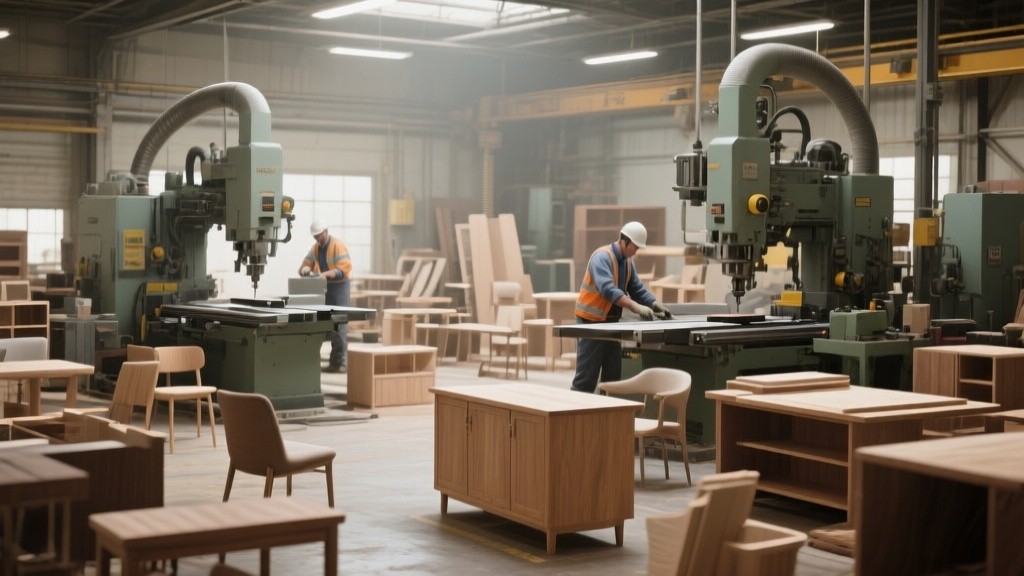
The field of application of CNC routers in furniture-making is incredibly wide. Practically no modern production, from a small private workshop to a large factory, can do without this technology. First and foremost, this is the production of cabinet furniture. Kitchens, sliding-door wardrobes, office furniture, dressing-room systems — all of this consists of many parts cut from MFC, MDF or plywood. A CNC machine ensures the perfect cutting of these materials, and also performs all the necessary technological operations, such as drilling holes for fasteners (boring), milling grooves for the back panel or drawer runners. This guarantees fast and accurate assembly of the finished product.
CNC is of enormous importance in the production of furniture fronts. It is precisely the fronts that determine the appearance and style of the furniture. Using CNC milling on MDF boards, it is possible to create fronts with any pattern: from classic panels imitating natural wood to modern geometric patterns and complex 3D reliefs. This makes it possible to offer clients a wide range of design solutions without being limited to standard options. Engraving logos or unique ornaments on the fronts also adds exclusivity to the furniture.
Nor can we overlook the production of solid-wood furniture. Here CNC routers are used to make complex carved elements, which used to be a sign of expensive, one-off cabinetmaking work. Carved legs for tables and chairs, headboards with elaborate patterns, decorative overlays for cabinet doors — a CNC machine can produce all of this at high speed and with perfect repeatability. This makes exclusive carved furniture more accessible to a wide range of consumers.
In addition to producing the furniture itself, CNC milling is indispensable in creating wooden interior and decor elements. These can be:
- Decorative partitions and screens: Openwork panels with any ornament for zoning a space.
- 3D wall panels: Creating relief surfaces on walls that become the main accent in an interior.
- Staircase elements: Making carved balusters, posts and risers with a complex pattern.
- Frames for mirrors and pictures: Producing frames of any shape and with any carved decoration.
In essence, a CNC router is a versatile tool that allows a furniture company to expand its range and offer not only standard furniture but also comprehensive interior design solutions, bringing to life practically any design concept.
The difference between a CNC router and a laser machine
In woodworking, two types of computer numerical control machines are often used: routers and lasers. Although both are controlled by a computer and work on a similar principle (moving the working tool along defined coordinates), there is a fundamental difference in the way they act on the material, which determines their strengths and weaknesses. The main difference lies in the cutting tool. On a router this is a physical object — a rotating cutter that mechanically removes material, taking off chips. On a laser machine the tool is a focused, high-power beam of light that burns, evaporates or melts the material at the point of contact.
This difference determines the nature of the machining. A router “cuts” the material, leaving behind an edge whose quality depends on the sharpness of the cutter and the cutting parameters. A laser machine “burns through” the material, leaving a characteristic dark, charred trace on the cut edge. For some products, for example those made of plywood, such a dark edge can even be an interesting design solution, but for solid-wood or MDF furniture intended for painting it is unacceptable, since it requires additional cleaning and processing.
Another important difference is the capability for three-dimensional machining. Thanks to its movement along the Z axis, a router is able to remove material to different depths, creating grooves, recesses and full three-dimensional reliefs. This is its key advantage in furniture production for creating panelled fronts, carved decor and other three-dimensional elements. A laser machine, in turn, is mainly a tool for 2D machining. It is ideal for the precise and rapid cutting of thin sheet materials (plywood up to 10-12 mm, MDF up to 6-8 mm) and for highly detailed engraving. A laser is able to apply very fine lines and complex images with photographic precision, something a router cannot do.
The productivity of the machines also differs depending on the task. When cutting thin plywood, a laser machine will often work faster than a router. However, when it comes to machining thick materials such as an edge-glued panel or solid wood 40-50 mm thick, a router has no competitors. A laser simply cannot cut through such a thickness, whereas a router will cope with this task, removing material layer by layer. Thus, these two types of equipment do not so much compete as complement each other. An ideal woodworking workshop often has both a CNC router and a CNC laser machine in its arsenal to handle the full range of tasks.

Safety when working with a CNC router
Despite the high degree of automation, working with a CNC router requires strict compliance with safety rules. This is powerful industrial equipment, and disregarding the rules can lead to serious injury or breakdown of the expensive machinery. First and foremost, the machine’s working area must be clearly marked out and free of foreign objects. While the program is running, the gantry and spindle move at high speed, and any object in their path can cause an accident. Under no circumstances should tools, workpieces or debris be left on the worktable.
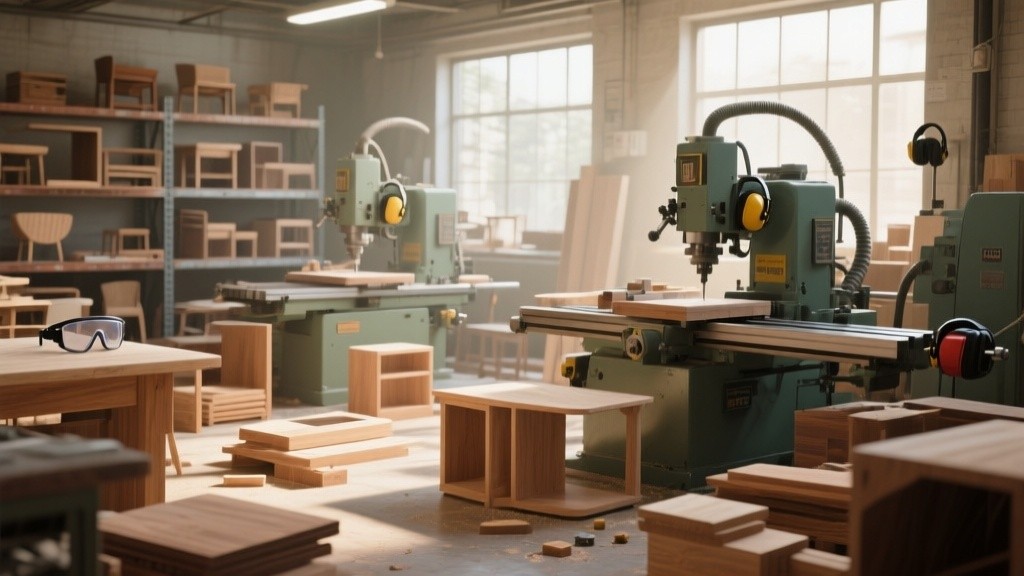
Particular attention should be paid to personal protective equipment. Even if the operator is not directly involved in the cutting process, they are in the immediate vicinity of the machine. It is mandatory to use safety glasses. During high-speed milling, fine chips and dust fly about and can damage the eyes. It is also recommended to use hearing protection (earmuffs or earplugs), since the running spindle and the cutting process create a high level of noise which, on prolonged exposure, is harmful to hearing. When working with materials that produce a lot of dust, such as MDF, it is necessary to use a respirator to protect the respiratory organs.
It is categorically forbidden to carry out any manipulations in the machine’s working area while it is running. You must not try to adjust the workpiece, remove chips by hand or measure a part until the program has been fully stopped and the spindle has ceased rotating. Modern machines are equipped with emergency stop systems (large red buttons), and the operator must know their exact location so that, in the event of an abnormal situation, they can immediately cut power to the equipment. Before every program start, it is necessary to check that the workpiece and tool are securely fastened. A poorly fastened workpiece can fly out from under the cutter, and a badly clamped cutter can fly out of the spindle collet, which poses an enormous danger.
An important aspect of safety is the extraction (chip removal) system. A powerful extraction system not only keeps the workplace clean, but also removes fine wood dust from the air, which is not only harmful to health but is also a fire hazard. A build-up of dry wood dust in an enclosed space can lead to it igniting from a chance spark. Regularly cleaning the machine and the working space of chips and dust is not only a matter of order, but also a key element of fire safety in production.
The future of CNC technologies in woodworking
Computer numerical control technologies do not stand still, and their future in woodworking and furniture production looks very promising. One of the key directions of development is increasing the number of machining axes. Already today there are 4- and 5-axis machining centres. Unlike standard 3-axis machines, they can not only move the tool along the X, Y, Z axes, but also tilt and rotate the spindle. This makes it possible to machine a part from several sides without repositioning it, as well as to create even more complex and intricate shapes, for example spiral legs for tables or sculptures of complex geometry. As such machines become cheaper, they will become increasingly accessible to furniture producers.
Another important trend is the integration of CNC systems with artificial intelligence and machine learning. Future machines will be able to independently optimise cutting parameters in real time. For example, by analysing the sound during milling or the vibration, the system will be able to understand that the cutter has become blunt and automatically reduce the feed rate so as not to ruin the part, then send the operator a notification that the tool needs replacing. Systems will also be able to automatically detect defects in the material (knots, cracks) and correct the machining path to bypass them, thereby reducing the reject rate.
The development of software also plays a huge role. Cloud technologies and the concept of “Industry 4.0” are penetrating ever deeper into production processes. Control programs will be able to be loaded onto the machine remotely, and a production manager will be able to track the status of an order, the equipment’s workload and material consumption in real time from their smartphone. This will make it possible to create a single digital ecosystem uniting the design, production preparation and the machining itself, making the whole process more transparent and manageable.
Finally, the level of automation and robotisationwill grow. Automatic tool-change systems already exist, where the machine itself takes the required cutter from a magazine to perform the next operation. In the future we will see entire robotic cells, where industrial robot manipulators will independently load workpieces onto the CNC machine’s table and remove finished parts. This will make it possible to create fully automated production lines capable of working 24/7 with minimal human involvement, which will increase the productivity and efficiency of the furniture industry even further. CNC technologies will continue to blur the boundaries between craft and high technology, opening up new horizons for the design and production of wooden products.