Promising categories of wooden products for selling through marketplaces: an analytical review and production recommendations

Amid the transformation of retail, marketplaces have become a key sales channel for woodworking companies. Working with these platforms requires the manufacturer not only to achieve high quality in processing the material but also to clearly understand the specifics of demand, logistics constraints and packaging requirements. Wooden products traditionally enjoy steady demand thanks to their eco-friendliness, durability and aesthetic qualities.
For a seller with access to woodworking capacity, it is important to segment the range by category: from small decor items to knock-down furniture. This article examines the most sought-after product groups, the technical requirements for making them and the specifics of bringing them onto digital trading platforms.
Kitchen accessories and serving accessories
Wooden kitchenware is one of the fastest-turning categories on marketplaces. It includes cutting boards, compartment platters, trivets, rolling pins and containers for storing dry goods. The main advantage of these products is their compactness, which reduces the costs of logistics and storage in marketplace warehouses.
When producing kitchen accessories, top priority is given to the choice of wood species. Hardwoods such as oak, beech, ash or acacia are considered optimal. They have high density and wear resistance, which is critical in contact with knives and moisture. Using soft coniferous species in this category is unacceptable due to resin release and low resistance to mechanical damage.
The manufacturing process must include careful sanding (grit up to P320) and finishing with certified compounds. For kitchen items, only those oils and waxes approved for contact with food are used. The seller needs to have the corresponding certificates or declarations of conformity, since marketplaces strictly monitor the safety of products in this group.
An important aspect is working with the item’s geometry. Cutting boards made of a single piece of solid wood are prone to warping with humidity fluctuations. To minimize this risk, it is recommended to use the technology of gluing from lamellas (panels) or to produce end-grain cutting boards. This increases the item’s stability and its artistic value in the buyer’s eyes.
The product design should take into account minimalism trends. Smooth shapes, the absence of unnecessary hardware and an accent on the natural texture of the wood make the product look more expensive. The presence of holes for hanging or milled handles adds ergonomics, which has a positive effect on buyer reviews.
Packaging for kitchen accessories should be individual. Usually this is shrink film that protects the wood from drying out or excess humidity in the warehouse, plus a branded cardboard box. Quality packaging not only prevents damage during transport but also raises the brand’s status in the eyes of the end consumer.
The marketing strategy in this niche is built on demonstrating durability and eco-friendliness. Sellers are advised to emphasize that wood is a renewable resource and that products made from it can be repaired (re-sanded and re-oiled). This approach attracts an audience oriented toward conscious consumption.
To expand the product matrix in this category, it is worth considering sets. Grouping several items (for example, three boards of different sizes on a stand) increases the average order value and makes logistics more profitable. Sets are always in higher demand in the pre-holiday periods as a ready-made gift solution.
Interior items and small architectural forms for the home
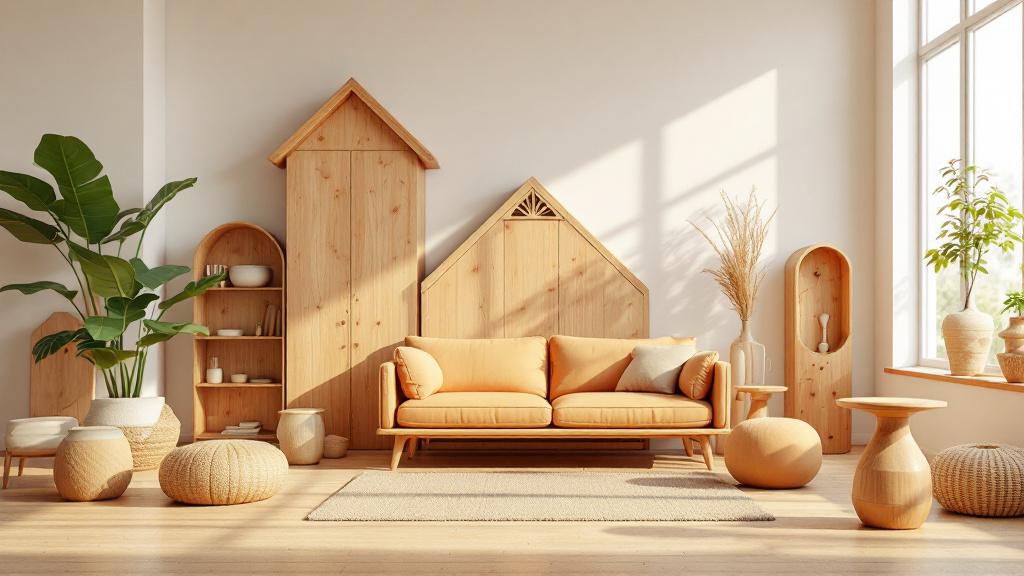
The second most popular category is interior decor. It includes wall shelves, plant pots, wall clocks in wooden cases, decorative panels and framed mirrors. Wood brings a feeling of coziness and premium quality into an interior, which makes these products sought-after among designers and private individuals.
Making interior decor allows the use of offcuts and leftover lumber from larger productions. This significantly reduces the cost of the products. For example, small pieces of valuable wood species can become the basis for stylish candlesticks or phone stands, which are also sold successfully on marketplaces.
Special attention should be paid to the moisture content of the wood. For items that will be located in heated spaces, the moisture content should not exceed 8-10%. Insufficient drying will lead to cracking and deformation of the item soon after the buyer picks it up from the pickup point. This entails returns and a drop in the seller’s rating.
The technical complexity of products in this category can vary. Simple loft-style shelves on metal brackets require minimal labor input but face high competition. More complex items, such as carved frames or multi-level shelf-planters, make it possible to set a higher markup thanks to the uniqueness of the design.
Coatings for interior items can be varied: from clear oils to dense acrylic enamel. It is important that the coating is uniform and free of defects (drips, dust under the varnish). In the photographs in the product listing, the buyer carefully studies the quality of the finish, so the final production stage must be controlled by the quality control department.
The logistics of large-format decor items (for example, mirrors in massive frames) is fraught with breakage risks. The seller must provide reinforced packaging: foam inserts, multi-layer corrugated cardboard and protective corners. The cost of quality packaging should be built into the product’s retail price at the financial planning stage.
From the standpoint of marketplace analytics, the decor category is subject to seasonality. For example, demand for wooden planters and garden figures grows in spring, whereas shelves and mirrors are bought steadily throughout the year. Competent planning of stock in the marketplace’s warehouses makes it possible to avoid out-of-stock situations and a drop in search rankings.
It is advisable to start developing this direction with a line of standard items. Unifying sizes and designs simplifies the production cycle and makes it possible to scale sales faster. Subsequently, based on the analysis of reviews, the line can be supplemented with modifications: new colors, sizes or functional elements.
Organizing the workspace: office and stationery accessories
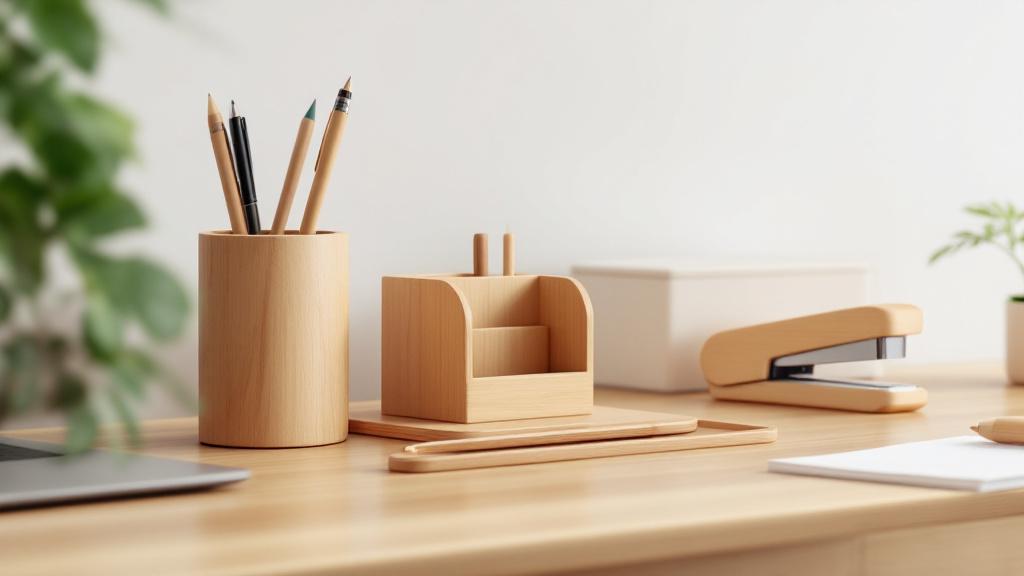
Wooden desk accessories are a segment of “business gifts” and productivity goods. This includes stationery organizers, stands for monitors and laptops, business-card holders, smartphone docking stations and desk calendars. These products are in demand both among corporate clients and among private individuals setting up home offices.
Making these items requires high precision in woodworking. CNC (computer numerical control) machines are often used to create complex grooves, recesses and engravings. Using CNC equipment makes it possible to achieve perfect repeatability of parts, which is critical for assembled structures and the snug fit of elements into one another.
The choice of material in this category often leans toward veneered MDF boards or high-grade birch plywood (S2/S2 or S1/S2). These materials are more stable in small forms than solid wood and make it possible to create modern, laconic shapes. Nevertheless, the premium segment still requires the use of solid walnut, oak or ebony.
The finishing of office accessories usually involves matte or semi-matte coatings. Excessive gloss can interfere with work and look cheap. Hard-wax oil provides pleasant tactile sensations, which is important for items the user contacts every day for many hours.
Marketplaces offer an excellent opportunity for branding this category of products. Laser engraving of the manufacturer’s logo in a prominent place gives the item a finished look. In addition, many sellers offer a customization service, which significantly raises the product’s value in the eyes of a buyer looking for a gift.
When designing stands for gadgets, it is necessary to take into account ergonomics and compatibility with modern devices. The width of the slots for smartphones should allow the gadget to be placed in a case, and laptop stands should provide sufficient ventilation of the device’s bottom panel. Attention to such details directly affects the number of positive reviews.
The packaging of office organizers should be not only protective but also presentable. Using kraft cardboard and paper filler emphasizes the brand’s eco-friendly focus. Investments in packaging design pay off through a reduced number of damages and the creation of a positive first impression for the buyer.
Wooden stationery accessories are highly profitable. With a relatively small consumption of material and automated production, the market value of the finished item can exceed the cost of the raw material by 5-10 times. This makes this category one of the most attractive for small and medium woodworking workshops.
Small-format furniture and folding structures

The furniture segment on marketplaces is growing actively, but logistics dictates its own rules. It is most profitable for sellers to sell small-format furniture: bedside tables, coffee tables, shoe cabinets, benches and folding chairs. The main requirement for such products is the ability to be shipped disassembled in flat packaging.
The construction of furniture for marketplaces should be maximally simplified for assembly by the end user. Using quality hardware and providing detailed assembly instructions are mandatory conditions. Errors in the marking of holes or the absence of a single screw in the kit lead to a negative customer experience and the return of a bulky item.
The main material for such furniture is often edge-glued panel made of pine, birch or oak. Pine is a budget option that is well suited to shelving for storerooms or balconies. For living areas, birch or oak is preferable, as they are more resistant to dents and have a more noble texture.
Special attention is paid to the finishing of edges and corners. On marketplaces, furniture is often bought for families with children, so the absence of sharp corners and a quality chamfer are competitive advantages. All surfaces must be perfectly smooth to rule out the risk of getting splinters.
The color palette of the products should match market demands. At the moment, the most sought-after are:
- Natural wood under clear varnish/oil.
- White (Scandinavian style).
- Anthracite or black (industrial style).
- Shades of gray and “whitewashed oak”.
Folding furniture (chairs, tables for picnics or working on a laptop) requires precise fitting of the mechanisms. Wood tends to expand and contract, so technological gaps must be provided in the moving joints. Using metal bushings at friction points significantly increases the service life of folding items.
Photo content for the furniture category plays a decisive role. It is important for the buyer to see the item in an interior and understand its real dimensions. It is recommended to use infographics that clearly indicate the dimensions (height, width, depth) and the maximum permissible load on the item. This removes most questions before the moment of purchase.
For successful competition in the furniture segment, the manufacturer needs to optimize production costs. Serial production of similar models makes it possible to reduce the cost price and ensure product availability in the marketplaces’ regional warehouses, which shortens delivery time and increases customer loyalty.
Products for children: toys and furniture for the children’s room
The children’s category on marketplaces is characterized by high requirements for safety and certification. Wooden toys (blocks, construction sets, puzzles, balancers) and children’s furniture (high chairs, helper towers, house beds) are a steadily growing market. Parents increasingly prefer natural materials over plastic.
When making children’s products, the use of toxic adhesives, varnishes and paints is unacceptable. All finish coatings must have a safety certificate for children’s toys (for example, the EN 71-3 standard). The wood must be top grade, without knots, cracks and resin pockets, which can cause injury.
The construction of children’s furniture must be maximally stable. The center of gravity is calculated so as to rule out the item tipping over if the child decides to climb on it. Smoothed corners and the absence of small removable parts in toys for children under 3 are basic safety requirements.
The manufacturing technology often includes sanding in several stages with intermediate raising of the grain. Wooden parts can become rough after being painted with water-based compounds, so a repeat finishing sanding is needed. This is a labor-intensive process, but it is precisely the smoothness of the surface that determines the quality of a premium item.
The range of children’s products can be divided into two groups:
- Educational toys: Montessori methods, busy boards, construction sets. Here functionality and the right color scheme are important.
- Furniture for active development: wall bars, Pikler triangles, sports corners. Here the strength of the joints and the reliability of the fasteners come to the fore.
Marketing of children’s products is built on trust in the brand. Sellers who describe the production process in detail, show certificates for the materials and use quality photographs with children receive more orders. Reviews in this category are critically important: one negative comment about a splinter can zero out sales of a product.
The packaging must ensure the safety of parts during repeated handling in warehouses. For construction sets and blocks, bags made of natural fabric inside the main box work well. This adds value to the product and is convenient for the buyer’s subsequent storage of toys at home.
Given the high competition, manufacturers should pay attention to unique niches. For example, personalized wooden night lights or growth charts with a unique design. Wood makes it possible to create items that are passed down through inheritance, and this aspect of “lasting memory” works excellently in the marketing of children’s products.
Accessories for the bathhouse, sauna and country leisure

Wood is the main material for bathhouse culture. This category includes headrests, ladles, buckets, door signs, hangers, shelves and floor gratings (duckboards). In addition, goods for setting up a barbecue zone are very popular: wooden cases for skewers, wine tables and grill shelves.
Only certain wood species resistant to high temperature and humidity are suitable for bathhouse accessories. Traditionally these are linden, alder or aspen. They do not release resin when heated, have low thermal conductivity (they do not burn the skin) and have a pleasant aroma. The use of coniferous species here is limited to items that do not come into direct contact with the body.
The production process includes stages of antiseptic treatment. However, it is important to use compounds that do not release harmful vapors when heated. Many manufacturers prefer to leave bathhouse accessories uncoated, which requires perfect cleanliness of the cut and sanding from the woodworking.
The logistics of bathhouse goods on marketplaces has its own features. Many items (for example, buckets or pails) have a large volume with a low weight. To avoid overpaying for “air” during delivery and storage, sellers are advised to develop nested structures or sell goods in sets that pack tightly into one another.
The design of bathhouse accessories most often adheres to a traditional or rustic style. Rough finishing, imitation of hand hewing and the use of natural ropes as handles create the right atmosphere. At the same time, functionality must not suffer: hangers must withstand the weight of heavy wet robes, and headrests must have an anatomical shape.
Goods for country leisure, such as wine tables (compartment platters with holes for glasses and a bottle), have become a marketplace hit in recent years. They are compact, aesthetic and often bought as a gift. Using hardwoods (oak, beech) in this category makes it possible to position the product in the mid and high price segments.
Seasonality in this niche is quite pronounced. The peak of sales of bathhouse accessories falls in the winter months and pre-holiday days, while goods for barbecue and country leisure are actively bought from April to August. Production planning must take these fluctuations into account so that the warehouses are as full as possible by the start of the season.
An important advantage for the seller will be offering comprehensive solutions. For example, a “Gift set for the bath attendant” that includes a headrest, a thermometer and a sign. Forming such sets makes it possible to increase margins by combining several simple items into a single product with higher added value.
Pet supplies: wooden products for pets
The pet products market shows steady growth, and wooden items occupy a special niche here. Popular products include: bowl stands for dogs and cats, play complexes for cats, houses for rodents and birds, as well as enclosures and kennels (in disassembled form).
Bowl stands are one of the simplest to produce and most sought-after products. The wooden base must be treated with a moisture-resistant compound, since contact with water is inevitable. The use of stainless-steel or ceramic bowls in the set is mandatory. The design of the stands should be laconic to fit into a modern apartment interior.
For cat play complexes, wood is a more durable and aesthetic alternative to cardboard and plastic counterparts. It is important to combine wooden elements with wear-resistant materials (jute, carpeting). The structure must be heavy and stable so the animal cannot tip it over while jumping.
When making houses for rodents and birds, the use of strong-smelling adhesives and toxic paints is categorically forbidden, since animals can gnaw the material. The best solution is tongue-and-groove assembly or the use of safe mechanical fasteners. The wood must be clean, without traces of rot or fungus.
The quality-of-processing requirements for pet products are no less strict than for children’s ones. Any nick or splinter can injure the pet, which will lead to owner complaints and product returns. All surfaces, including the inner parts of the houses, must be carefully sanded.
Demand analysis shows that pet owners value aesthetics no less than functionality. Wooden furniture for animals is often bought as an interior element, so it must match furniture trends. Using natural shades and quality finishing makes it possible to sell such products significantly more expensively than plastic counterparts.
Logistically, it is most profitable to sell knock-down structures. For example, a cat house that assembles without tools on cam locks or on the principle of a construction kit. This makes it possible to reduce the volume of the packaging and lower the risk of corner damage during transport by the marketplaces’ logistics services.
In the product listings for animals, video reviews showing the process of the pet using the item work effectively. It is also useful to indicate the breeds of dogs or cats for which a given size of the item is suitable. This reduces the percentage of returns due to the product “turning out smaller/larger than expected”.
The market for wooden pet products is not yet oversaturated, which gives manufacturers a chance to establish their positions. Developing unique models, for example wall-mounted play zones for cats in a “hi-tech” style, can become a successful direction for developing a brand on marketplaces.
Souvenirs and wooden packaging
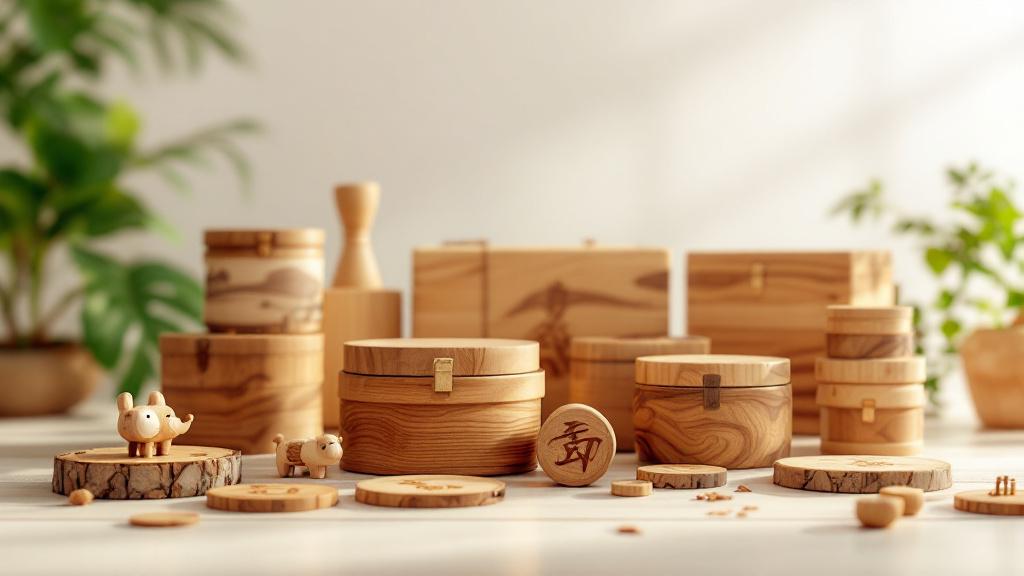
Wooden packaging (boxes, pencil cases, slatted crates) is itself a sought-after product on marketplaces. It is bought both by other sellers to pack their goods and by retail buyers to present gifts. In addition, the souvenir segment includes wall key holders, money boxes, plywood world maps and medal holders.
The production of souvenir products requires laser and CNC milling machines. Laser cutting makes it possible to create complex patterns and openwork structures that cannot be made by hand. The main material here is birch plywood from 3 to 6 mm thick, and less often solid wood of thin cut (lamella).
Money boxes and key holders are impulse-demand goods. Their success on marketplaces depends on the originality of the idea and the quality of the painting. Using stains of different shades makes it possible to emphasize the wood structure and create a vintage look that is in demand among souvenir buyers.
Wooden packaging (boxes for wine, jewelry boxes) must have quality hardware: hinges, latches, clasps. The use of flimsy fasteners that can break on the first opening is unacceptable. Even an inexpensive plywood box looks premium if it has neat joints and reliable hardware.
In this category, it is important to keep track of trends and holidays. The sales calendar in the souvenir segment is rigidly tied to dates: New Year, February 14, February 23, March 8. Preparing the range for these holidays must begin 2-3 months in advance in order to have time to produce the goods and place them in the marketplaces’ warehouses.
Features of souvenir production:
- minimal material consumption with high added value.
- the ability to easily customize for the requests of large customers.
- compact dimensions that simplify storage and logistics.
- broad opportunities for using engraving and full-color printing on wood.
To increase competitiveness, sellers are advised to offer ready-made sets. For example, a key holder together with keychains in a single style. This makes the offer more interesting for the buyer and increases the profitability of a unit of sale.
The packaging of souvenir products for delivery must be maximally rigid. Small carved plywood parts are very fragile and easily break when pressed. Using bubble wrap and sturdy boxes of three-layer corrugated cardboard is a mandatory standard for this category.
Wooden world maps have become a separate large niche. They require complex production and careful completion (the presence of spacer holders, instructions, glue or double-sided tape). Despite the high competition, quality multi-layered maps with backlighting remain a sought-after product in the high price segment.
Storage and order: space organization systems
The category of storage goods includes wooden boxes, organizers for linens (drawer dividers), shoe cabinets, clothes hangers and jewelry holders. Amid the trend toward eco-friendliness and an aesthetic daily life, buyers increasingly replace plastic containers with wooden storage systems.
Slatted crates are the basic product in this category. They are used for storing vegetables in the kitchen, toys in the children’s room or tools in the garage. Pine slats are used for production. It is important that the slats are well planed and that the fastening points (nails or screws) are recessed and concealed.
Dividers for pull-out drawers made of thin plywood or bamboo are a fast-turning product. Buyers value the ability to adapt the dividers to their needs, so sliding or modular designs have an advantage. Dimensional accuracy is of key importance here: a deviation of a few millimeters can make the product useless.
Wooden clothes hangers are a mass product where it is hard to compete on price with large retailers. However, producing specialized hangers (for belts, ties, bags or heavy outerwear made of solid oak) makes it possible to find one’s buyer. The quality of the varnishing must be flawless so as not to leave snags on the fabric.
Jewelry holders and watch stands are aesthetic decor with high functionality. Using a combination of wood and soft materials (velvet, leather) inside the cells or on the holders improves the consumer properties of the product. Such items are often bought as a gift, so presentable packaging is mandatory.
Features of selling storage systems on marketplaces:
- the need for clear infographics indicating the internal dimensions.
- the ability to stack (boxes must fit into one another or stand stably on top of one another).
- a variety of colors to match standard furniture fronts (white, wenge, pine).
For the seller, it is profitable to produce storage systems that can be scaled. If the buyer bought one box and liked it, there is a high probability they will return for a few more of the same to fit out a shelving unit. Consistency of color and shape from batch to batch is the key to building a base of loyal customers.
The production of storage systems makes it possible to efficiently use up lumber leftovers. Short board offcuts can become the walls of small crates, and thin slats can become partitions. This makes it possible to maintain high profitability even at moderate market prices for the finished products.
Garden furniture and goods for landscape design
The garden segment on marketplaces is represented by outdoor chairs (for example, Adirondack chairs), folding loungers, flower pergolas, decorative fences and garden paths made of wooden slices or tiles. This is a seasonal product whose sales peak falls in the spring-summer period.
The key requirement for outdoor items is resistance to weather. Deep antiseptic impregnation and finish coatings with UV filters are mandatory in production. The wood must be rot-resistant (larch, thermowood or pine that has undergone quality kiln drying and treatment).
The construction of garden furniture must take into account the possibility of assembly by the buyer. As a rule, these are large-format goods, so delivering them assembled through marketplace logistics would be unreasonably expensive. The seller needs to develop a system of “major-unit assembly”, where the main parts (back, seat) are already assembled at the production facility and the buyer only needs to connect them together.
For chairs and benches, ergonomics is important. The angles of the backrest incline and the seat height must comply with comfort standards. Using concealed fasteners (screws from the back or the use of wooden plugs) improves the aesthetics and safety of the garden furniture.
Decorative fences and garden borders made of wood are in demand thanks to the ease of installation and the natural look. They must be supplied in sections convenient for transport. It is important that the pointed parts intended for driving into the ground have additional protection from moisture.
Marketing of garden products on marketplaces works effectively through the demonstration of usage scenarios. Photographs against the backdrop of a green lawn, with throws and cushions, create an emotional response in the buyer. It is also important to indicate the maximum load weight and recommendations for seasonal care of the wood.
Advantages of working in the garden niche:
- a high average order value.
- lower competition density compared with small decor.
- the ability to offer related products (oils for refreshing the coating, soft cushions).
The main difficulty is storage and logistics. Large-format goods take up a lot of space in the warehouse, so working under the FBS scheme (shipping from the seller’s warehouse to order) is often more preferable for garden furniture. This makes it possible not to freeze working capital in stock in the marketplace’s warehouses during the off-season.
Bringing woodworking products onto marketplaces requires a systematic approach. The manufacturer needs to balance the quality of materials, the precision of processing and the manufacturability of the packaging. Regardless of the chosen category, the key to success is attention to detail, compliance with wood moisture standards and the use of safe coatings. Marketplaces provide unlimited access to an audience, but only a quality product combined with sound logistics and marketing will make it possible to build a sustainable business.